

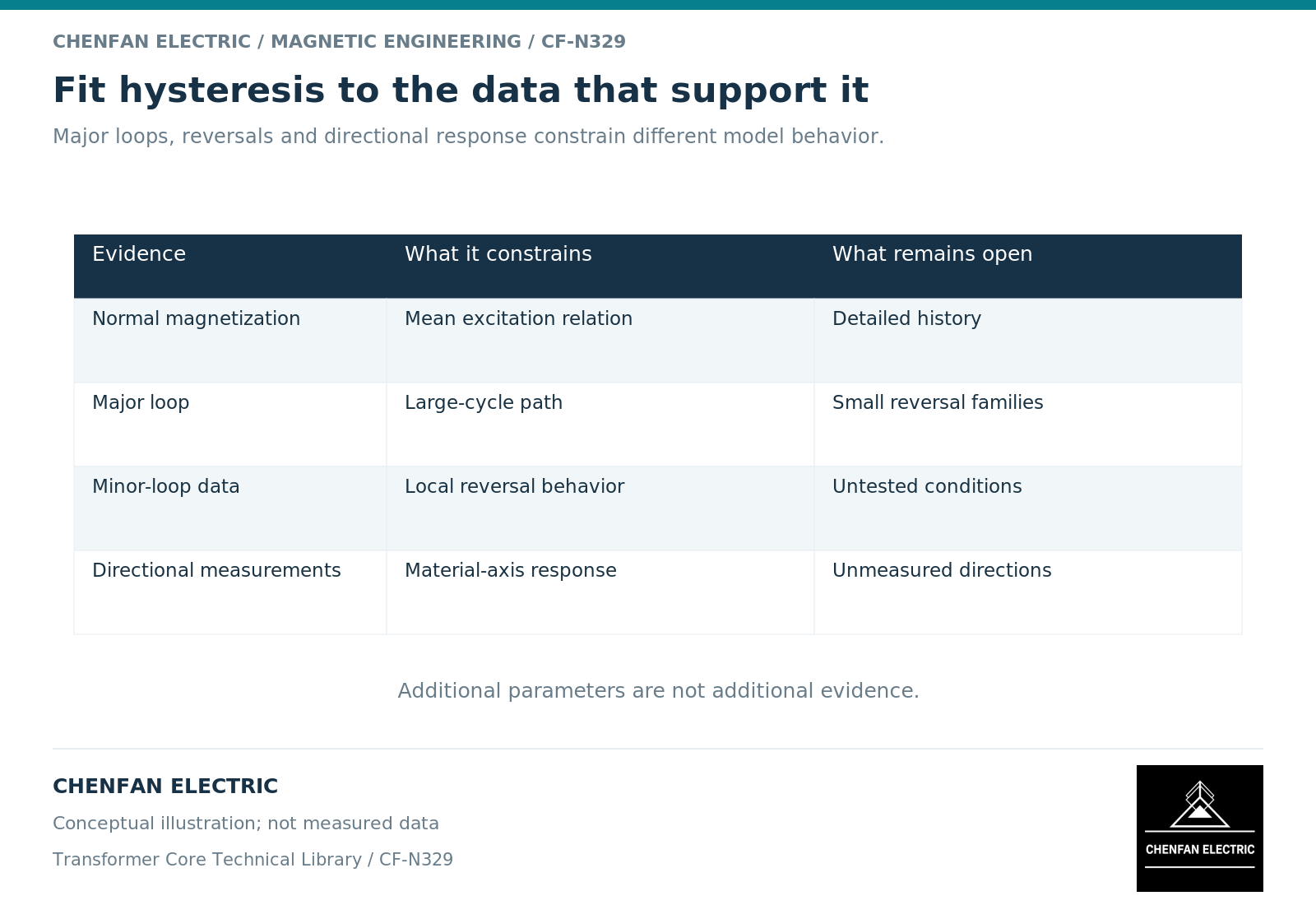
Laboratory data for a hysteresis model must support the behavior the model will be asked to predict. One major loop or a few normal magnetization points may constrain part of the response, but they do not uniquely identify every minor-loop, bias, directional and rate-dependent parameter.
Begin with the intended magnetic trajectories
List the expected excitation types: centered alternating cycles, biased excursions, small reversals, interruption histories or locally rotating fields. This list defines the data requirement more effectively than selecting the largest available parameter set first.
Constitutive models differ in what they retain. A single-valued curve, an effective frequency-domain characteristic and a history-dependent formulation are not interchangeable descriptions. [1] The laboratory program should be matched to that choice rather than treating every file labeled B-H as equivalent.
A model intended only to estimate a fundamental response may not need the same data as one intended to reproduce remanence after a switching event. Conversely, a fitted major loop cannot justify a claim about every transient simply because the software supports hysteresis.
Preserve specimen and test definitions
For each dataset, retain material identity, specimen geometry, direction relative to rolling, conditioning, temperature, waveform, frequency and units. Record how B and H were derived and whether the data include rate-dependent effects.
Keep the time ordering for loops and reversal trajectories. A spreadsheet sorted by field strength can destroy the path information required by a hysteresis fit. The original acquisition record should remain available even when a processed dataset is supplied.
The assembled core introduces additional geometry and stress conditions. Material identification supports the constitutive input; assembled-core measurements are needed to assess how that input performs within the actual model boundary.
Do not infer directional behavior from one axis
Grain-oriented steel has a preferred material direction. A scalar fit along that direction cannot automatically represent a region where the field turns or rotates. A vector hysteresis benchmark explicitly treats directional response in a laminated three-limb core. [2]
This does not mean every transformer study requires a vector model. It means that omitting directional behavior should be a conscious approximation tied to the region and observable. A limb-average flux estimate and a local joint-loss estimate have different demands.
When directional data are missing, separate the supported prediction from the assumed extension. A parameter optimization can produce a smooth numerical solution without creating the absent physical evidence.
Assess identifiability and independent performance
| Data group | Role in the model review |
|---|---|
| Large loops | Envelope and high-excitation behavior |
| Minor loops | Reversal and local-history response |
| Biased cycles | Behavior around a displaced operating region |
| Directional measurements | Anisotropic or rotating-field representation |
| Reserved validation cases | Prediction outside the fitting set |
Several parameter combinations may fit one dataset similarly. Examine whether they diverge on the intended operating cases. That divergence is useful evidence of parameter uncertainty, not merely an optimization inconvenience.
Provide fitted values with units, bounds, objective function and the data used to identify them. Preserve the independent comparison results and the range beyond which extrapolation is unsupported.
The procurement request should therefore ask for a traceable identification package, not only a parameter table. The value lies in knowing which measured trajectories constrain the model and which predictions remain conditional on assumptions.
References
[1] Cesare Tozzo / COMSOL. Modeling Ferromagnetic Materials in COMSOL Multiphysics.
[2] COMSOL. Vector Hysteresis Modeling.