

Magnetic history is part of the test condition when comparing excitation measurements. Aligning voltage and frequency is necessary, but may not be sufficient. The prior excitation, conditioning, connection and observation window can change the state from which the next measurement begins.
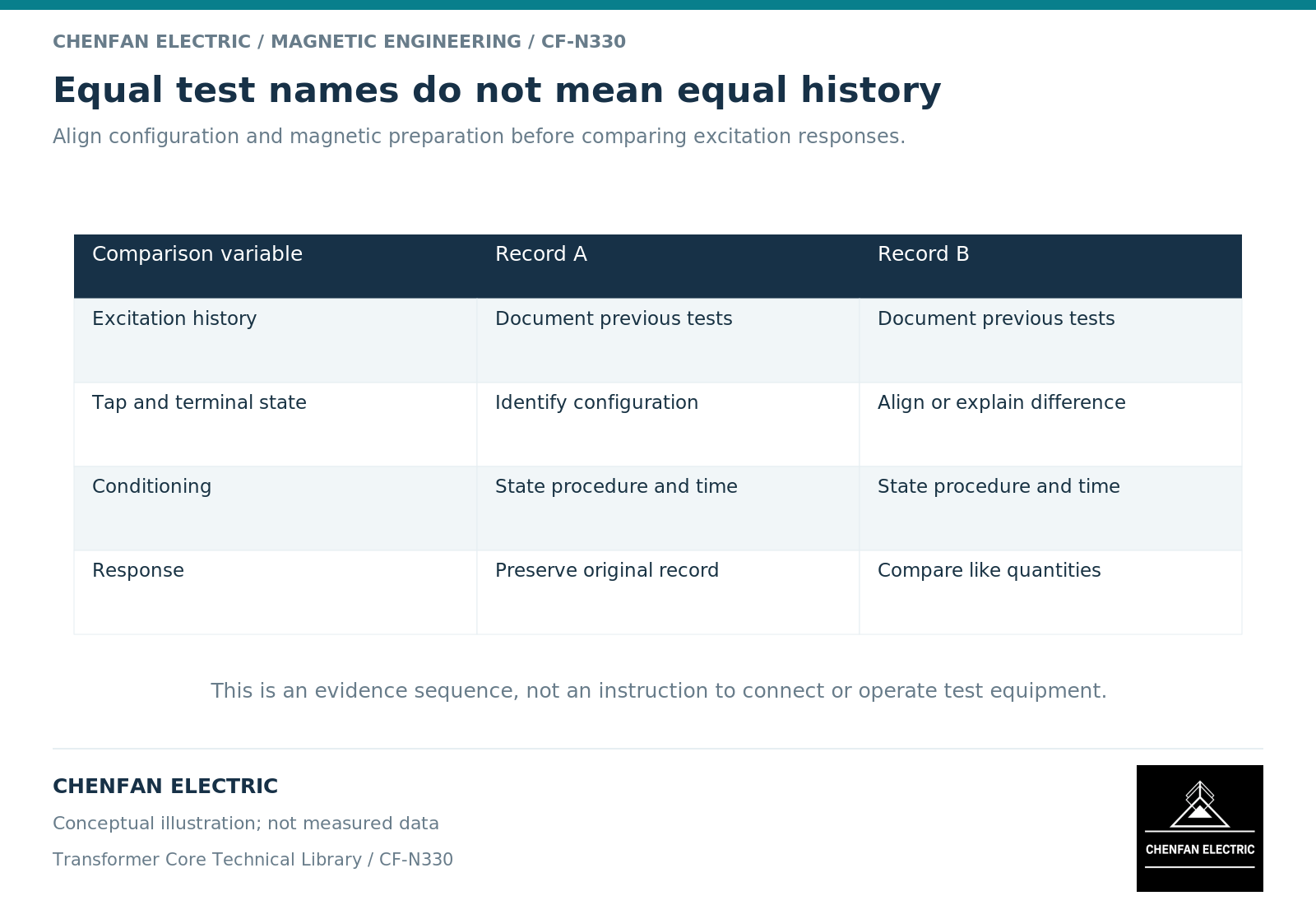
Define the comparison before explaining the difference
Start by naming the observable: root-mean-square excitation current, peak current, active loss, a selected harmonic or a reconstructed flux waveform. Different observables respond differently to waveform shape and initial state.
Then identify the test object and configuration. A bare core with a temporary winding is not the same electrical assembly as a completed transformer. Neither is a single-phase excitation arrangement equivalent to a balanced three-phase measurement.
Transformer test guidance distinguishes magnetic and electrical diagnostic activities, while hysteresis models explicitly retain path dependence. [1] [2] Together these points justify keeping the chronology and test boundary alongside the numerical result.
Create a short magnetic-history timeline
The timeline should include preceding alternating-current excitation, direct-current tests, any documented conditioning and the interval before the compared measurement. Use actual recorded events rather than reconstructing an ideal sequence after an anomaly appears.
A timeline can also expose incomplete evidence. “Tested yesterday” does not establish whether another magnetic or electrical operation occurred between the two records. Mark an unknown interval as unknown instead of assigning a convenient zero-residual state.
For repeated measurements, preserve whether the reported value came from the first cycles, a later settled interval or an average over the whole record. A transient contribution can be diluted or emphasized by the selected window.
Control the variables that can be controlled
A useful repeat comparison aligns winding connection, energized phase, turns or tap position, waveform and measurement definitions. Conditioning is one variable among several, not a substitute for the others.
If a difference changes after controlled conditioning, report that observation without assuming it explains every feature. If the difference remains, keep the evidence and investigate the remaining possibilities. The purpose is to isolate variables, not to force the result toward a preferred diagnosis.
| Comparison layer | Question |
|---|---|
| Identity | Is this the same assembly and revision? |
| Electrical boundary | Are the winding and terminal states equivalent? |
| Magnetic history | Are the prior excitation and conditioning known? |
| Measurement | Are units, waveform and time window aligned? |
| Interpretation | Does the remaining difference exceed known uncertainty? |
This framework is especially useful when factory and receiving records were produced by different teams. It allows each team to explain its own configuration without labeling the other result incorrect prematurely.
Keep conditioning effects separate from acceptance
A better-matched repeat measurement can improve confidence in comparability. It does not create an acceptance criterion that was absent from the specification. The agreed requirement, measurement method and decision rule still govern acceptance.
Likewise, an excitation discrepancy is not automatically proof of a particular core defect. It is evidence that must be interpreted with the test boundary, material and assembly records. Avoid assigning a cause from one current number alone.
The final comparison should state what was aligned, what remained different and which conclusion the evidence supports. That produces a usable technical disposition rather than a generic statement that the core was “tested again.” It also preserves a reliable baseline for the next comparison instead of leaving future reviewers to guess the magnetic history.
References
[1] OMICRON. TESTRANO 600 Brochure.
[2] Cesare Tozzo / COMSOL. Modeling Ferromagnetic Materials in COMSOL Multiphysics.