

Geomagnetic activity and HVDC ground-return operation can each drive quasi-DC current through grounded AC networks. Attribute a transformer-neutral record by comparing source histories and observations across stations. [1] [2]
Bailey’s regional GIC work models geoelectric excitation and its network allocation. Source identification must therefore establish the driving conditions, not simply confirm that DC entered a grounded transformer.
Start with candidate inputs and their timestamps
For the geomagnetic explanation, retain regional magnetic or geoelectric information with its location, sampling and interpretation. For the HVDC explanation, obtain the relevant operating mode, electrode-current history and switching times. Absence of an accessible operating log is an information gap, not evidence that earth-return operation did not occur.
Synchronize these records with the current-monitoring clock. A lag introduced by a measurement filter can shift an apparent onset. Keep that delay separate from any physical response attributed to the network.
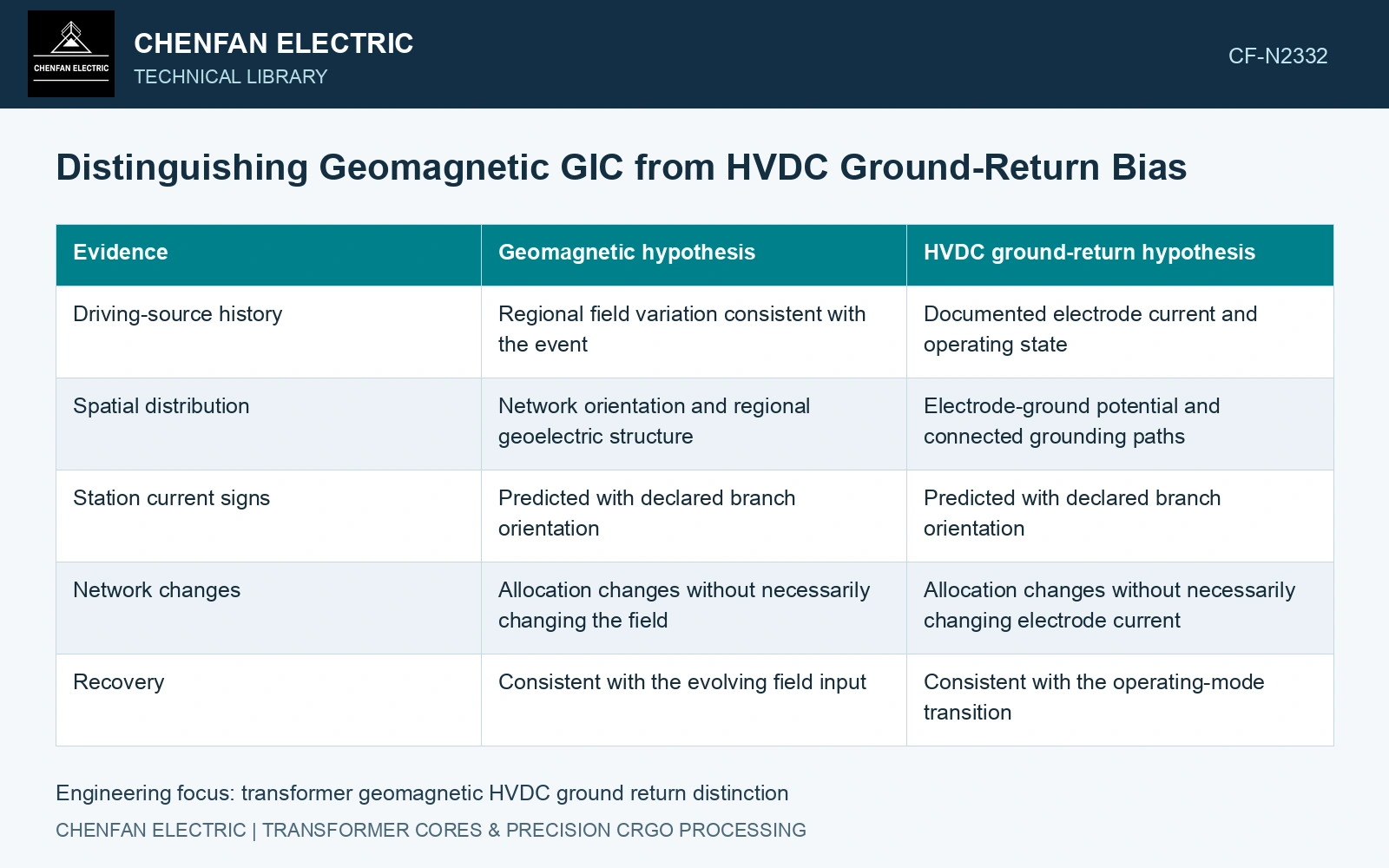
Ask each source model to explain several stations
| Evidence | Geomagnetic hypothesis | HVDC ground-return hypothesis |
|---|---|---|
| Driving-source history | Regional field variation consistent with the event | Documented electrode current and operating state |
| Spatial distribution | Network orientation and regional geoelectric structure | Electrode-ground potential and connected grounding paths |
| Station current signs | Predicted with declared branch orientation | Predicted with declared branch orientation |
| Network changes | Allocation changes without necessarily changing the field | Allocation changes without necessarily changing electrode current |
| Recovery | Consistent with the evolving field input | Consistent with the operating-mode transition |
Use the same AC-network DC resistances and grounding representation when comparing candidate sources. Changing network assumptions between hypotheses can make either source fit by construction. Electrode-related potential is not interchangeable with a spatially uniform geoelectric field unless that simplification is justified for the studied area.
Compare signed current patterns rather than absolute magnitudes alone. Two hypotheses can match one station’s magnitude and predict different signs or ratios elsewhere. Those additional channels are often more discriminating than a stronger fit at the original monitor.
Keep correlation and causation separate
A current increase near a geomagnetic event supports further investigation but does not exclude a concurrent HVDC mode change. Conversely, a long plateau near an earth-return interval can still include geomagnetic variation.
For a linear quasi-DC network under fixed topology, source contributions can be superposed in the network calculation. This does not make the transformer’s subsequent magnetic or thermal response linear. Evaluate the combined winding current when assessing that response.
Show which source histories and multi-station observations each explanation reproduces. Report mixed or unresolved attribution where the available records support both, and identify the next observation that separates them.
References
- R. L. Bailey and coauthors, Modelling geomagnetically induced currents in midlatitude Central Europe using a thin-sheet approach, Annales Geophysicae 35, 2017. DOI: 10.5194/angeo-35-751-2017.
- M. Kamel, H. Saeed, A. Karrar, A. Eltom, G. Kobet and I. Grant, CIGRE US National Committee, Effects of GIC Neutral Blocking Devices (NBDs) on Transmission Lines Protection Performance and Potential for Resonance, Grid of the Future Symposium, 2015.