

An aged XLPE feeder can raise a water-tree concern without producing a convenient, repeatable partial-discharge location. [1] Water-tree deterioration and an actively discharging local defect are different diagnostic questions. A test selected for one should not be treated as complete evidence for the other. [2]
The feeder’s construction and history come first. Identify insulation type, joints, repairs, wet exposure and any mixed sections. The transformer supplied by the cable does not determine the cable’s dielectric assessment criteria.
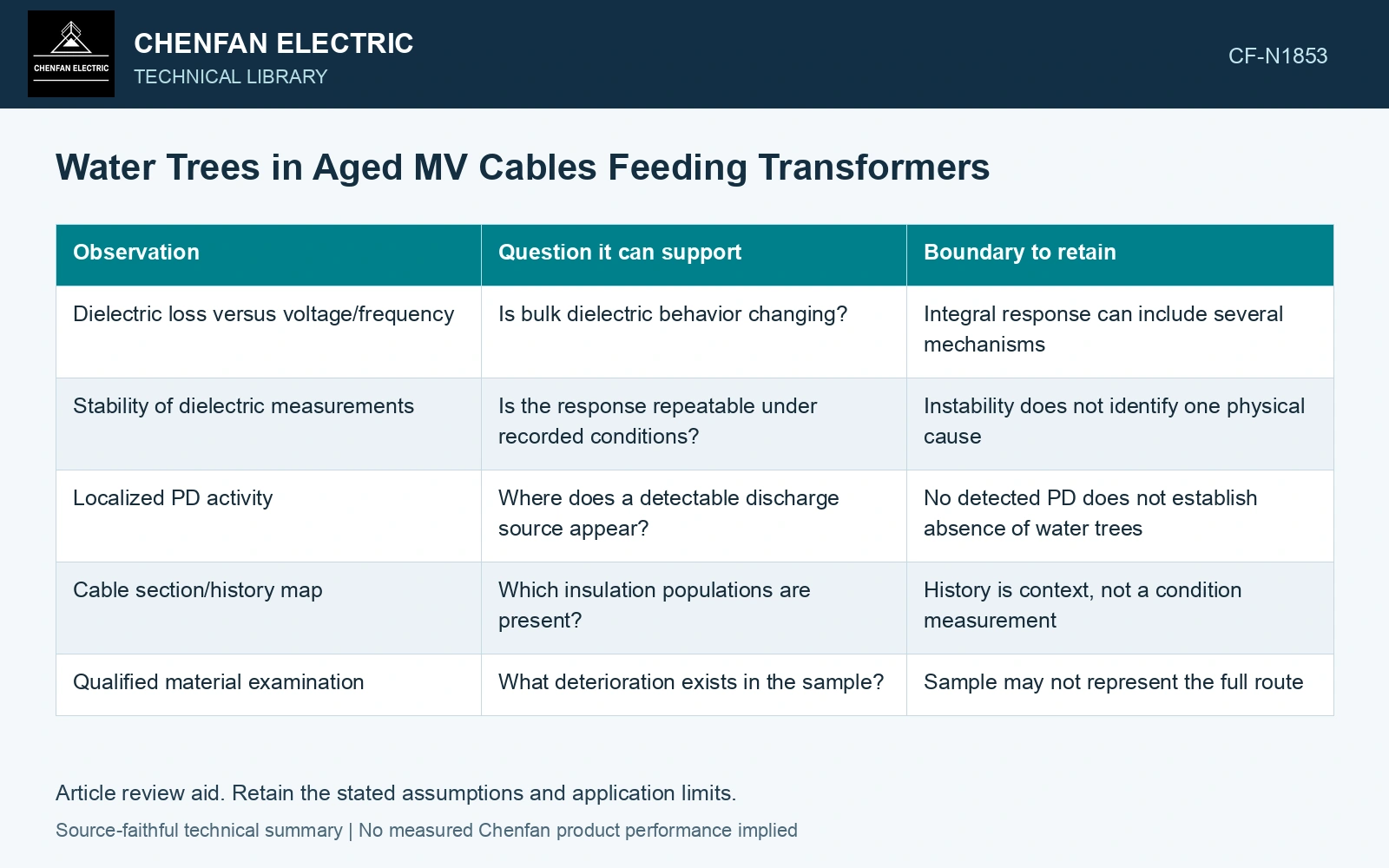
Match the observation to the mechanism
| Observation | Question it can support | Boundary to retain |
|---|---|---|
| Dielectric loss versus voltage/frequency | Is bulk dielectric behavior changing? | Integral response can include several mechanisms |
| Stability of dielectric measurements | Is the response repeatable under recorded conditions? | Instability does not identify one physical cause |
| Localized PD activity | Where does a detectable discharge source appear? | No detected PD does not establish absence of water trees |
| Cable section/history map | Which insulation populations are present? | History is context, not a condition measurement |
| Qualified material examination | What deterioration exists in the sample? | Sample may not represent the full route |
Keep global and local evidence connected
A dielectric result averages the tested system’s response in an electrical sense. Its interpretation depends on which cable sections and accessories are included. A short deteriorated section can contribute differently from a long broadly aged one; the result does not automatically give a physical location.
Avoid a remaining-life shortcut
A high or changing loss result justifies further evaluation under the applicable cable-specific criteria. It does not directly provide years of remaining life. Temperature, insulation formulation, accessories and test conditions can influence the response, so assigning every change to water trees overstates the evidence.
Similarly, a favorable result is bounded by the tested circuit and method. It should not be presented as a guarantee against every future failure. A local accessory defect and a bulk insulation concern may require different follow-up investigations.
Zhu and Ng report that water-tree deterioration can require loss-factor and stability assessment even when PD does not locate an active electrical tree. Their evaluation criteria were developed for their utility population; they are not general cable thresholds. [1]
Separate a bulk screen from localization
In Zhu and Ng’s published investigated cable case, Table 4 gives phase-A and phase-C tanδ at U₀ as 1.913×10⁻³ and 2.337×10⁻³. The C/A ratio is only 1.22. Their reported time-stability standard deviations are 0.003×10⁻³ and 0.058×10⁻³, a ratio of 19.33; the corresponding 0.5U₀-to-1.5U₀ increments are 0.357×10⁻³ and 3.349×10⁻³, a ratio of 9.38. Thus a mean-only ranking loses substantial discriminatory information. In that investigated case, prioritize phase C for water-tree follow-up using the population-specific assessment and material evidence; do not infer a location or remaining life from any of these ratios. [1]
References
- K. Zhu and T. F. Ng, Improvement of cable defect identification for power distribution networks, HKIE Transactions 29(1), 2022, section 3 and Table 4. DOI: 10.33430/V29N1THIE-2021-0016.
- IEEE, IEEE 400.2-2024, IEEE Guide for Field Testing of Shielded Power Cable Systems Using Very Low Frequency (VLF) (less than 1 Hz).