

A feeder’s VLF tan-delta value has increased since the previous survey. That observation becomes useful only after confirming that the test frequency, waveform, voltage schedule, temperature context and tested circuit are comparable. Without those conditions, a trend can describe the measurement setup as much as the insulation. [1]
Tan delta expresses dielectric loss relative to the capacitive response under the defined excitation. It is an integral circuit measurement. The transformer at the end of the route does not make transformer oil-paper thresholds appropriate for the cable.
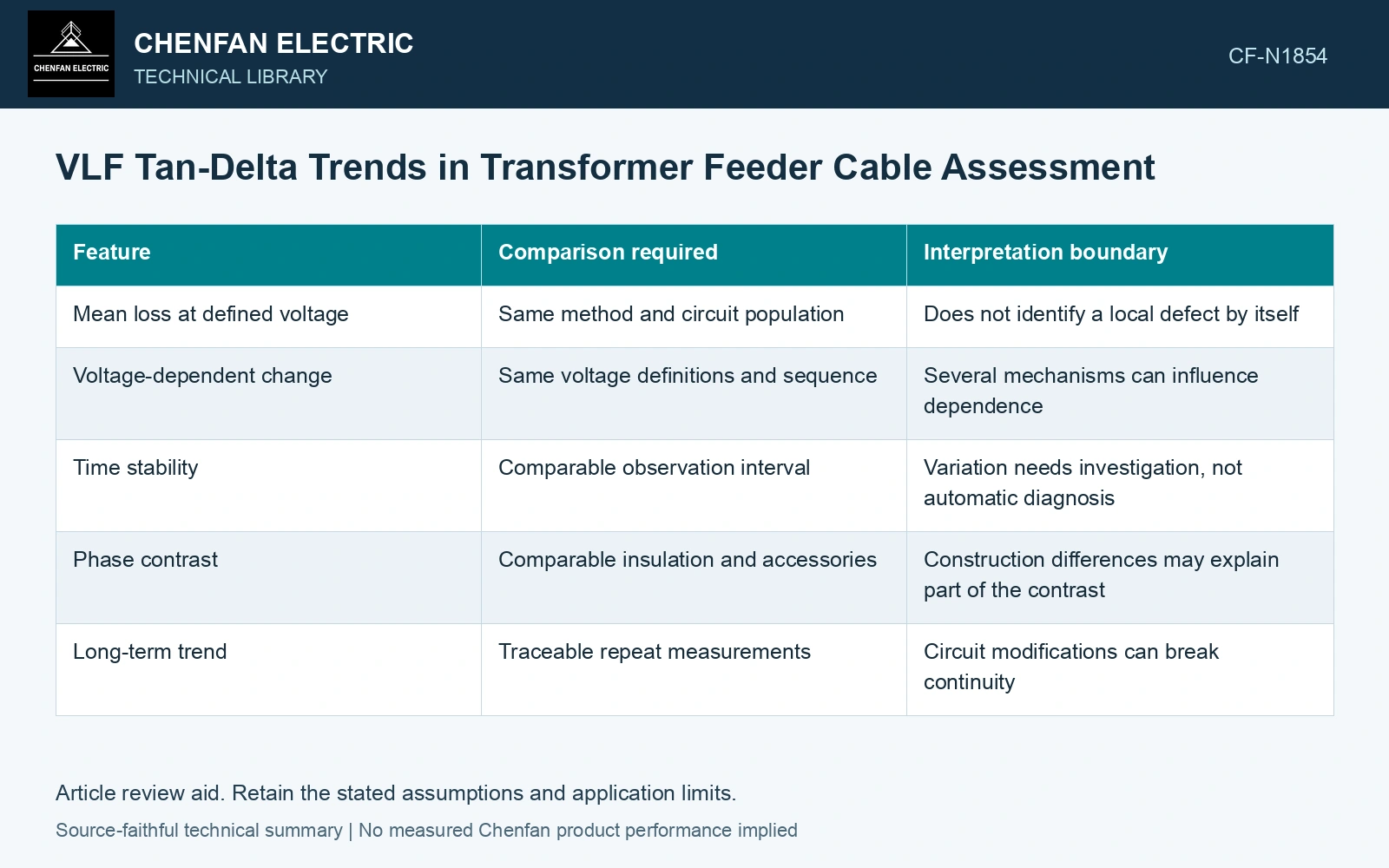
Keep three features separate
The mean value at a defined voltage, its change with voltage and its variation during a measurement are different features. Preserve all three where the method provides them. Reducing the report to one averaged number can erase a response pattern worth investigating.
| Feature | Comparison required | Interpretation boundary |
|---|---|---|
| Mean loss at defined voltage | Same method and circuit population | Does not identify a local defect by itself |
| Voltage-dependent change | Same voltage definitions and sequence | Several mechanisms can influence dependence |
| Time stability | Comparable observation interval | Variation needs investigation, not automatic diagnosis |
| Phase contrast | Comparable insulation and accessories | Construction differences may explain part of the contrast |
| Long-term trend | Traceable repeat measurements | Circuit modifications can break continuity |
Check whether the cable population changed
A new joint, replaced section or changed termination can alter the tested system. Record the modification before comparing its new integral response with the previous circuit. For a mixed XLPE and paper-insulated route, one label such as cable tan delta conceals different dielectric populations.
Use a trend to frame the next question
If the basis is aligned, ask whether the pattern is consistent across phases, voltages and repeat readings. A phase-specific change may focus attention on a local component or section, but tan delta does not automatically locate it. Complementary diagnostic evidence can help determine where a concern resides.
Preserve the original measured data and any correction or normalization. A spreadsheet that silently removes inconvenient values prevents a reviewer from understanding whether the trend was stable, intermittent or method dependent.
Zhu and Ng distinguish mean tan delta, voltage dependence and time stability, and explain why their utility’s cable population required its own evaluation criteria. Preserve those feature definitions rather than transferring another population’s thresholds. [2]
Compare the voltage dependence separately
Assumptions: matched 0.1 Hz surveys at the same temperature and unchanged circuit give tanδ = 0.004 at U₀ in both surveys. At 1.5U₀, the earlier value is 0.005 and the later value 0.007. The explicitly defined U₀-to-1.5U₀ increment rises from 0.001 to 0.003 dimensionless: a threefold increase, with the later increment equal to 0.3 percentage points. The unchanged U₀ mean therefore conceals a changed high-voltage response. Prioritize a controlled repeat and complementary assessment before accepting an unchanged-condition label. This increment is not Zhu and Ng’s 0.5U₀-to-1.5U₀ metric, and no universal rejection threshold is assigned. [2]
References
- IEEE, IEEE 400.2-2024, IEEE Guide for Field Testing of Shielded Power Cable Systems Using Very Low Frequency (VLF) (less than 1 Hz).
- K. Zhu and T. F. Ng, Improvement of cable defect identification for power distribution networks, HKIE Transactions 29(1), 2022, section 3 and Table 4. DOI: 10.33430/V29N1THIE-2021-0016.