


Transformer Core Engineering Notes · CF-N230
Retrofilling replaces the insulating liquid in an existing transformer, but leaves much of the original equipment in place. The remaining paper, seals, coatings, cooling circuit and accessory ratings determine what the changed unit can safely do. A new liquid’s advantages do not automatically become a new transformer rating or a guaranteed extension of service life.
Establish the condition before changing the fluid
Document the transformer’s design, service history, known defects and current liquid condition. Identify the reason for the project: fire planning, fluid condition, maintenance strategy or another objective. Replacing liquid does not restore already degraded solid insulation or repair an unrelated mechanical defect. The review should distinguish benefits expected from the fluid change from issues that require separate repair or investigation. Keep the original condition records as the baseline for later assessment.
Review what remains in contact with the new liquid
List the solid insulation, gaskets, internal paint, adhesives and accessories. Confirm compatibility for the selected product and the intended operating temperature. Residual original liquid is also part of the final mixture and may affect property claims or classification. Cargill publishes different retrofill guides for different equipment scopes, illustrating why one generic procedure is inappropriate. Use the applicable OEM-approved process rather than transferring instructions between unlike tank designs or voltage classes.
Check cooling and every limiting component
Reassess circulation, temperature rise and cold-start duty using the new fluid. For natural ester, verify the air-protected preservation arrangement described by IEC 62770:2024. Separately check bushings, leads, tap-changing equipment and auxiliaries: another component may remain the loading limit. A fluid change does not authorize a higher nameplate capacity. The tank’s pressure and vacuum capability must constrain the OEM-approved processing method.
Commission a new documented baseline
The completion package should identify the final fluid, residual-mixture assumptions, replaced materials, processing records and agreed post-work tests. Update labels and monitoring interpretation where required, including moisture and dissolved-gas analysis. Record any operational restrictions that remain. A successful retrofill is not simply a tank filled with a different liquid; it is an approved modified configuration with traceable evidence and a maintenance plan suited to that configuration.
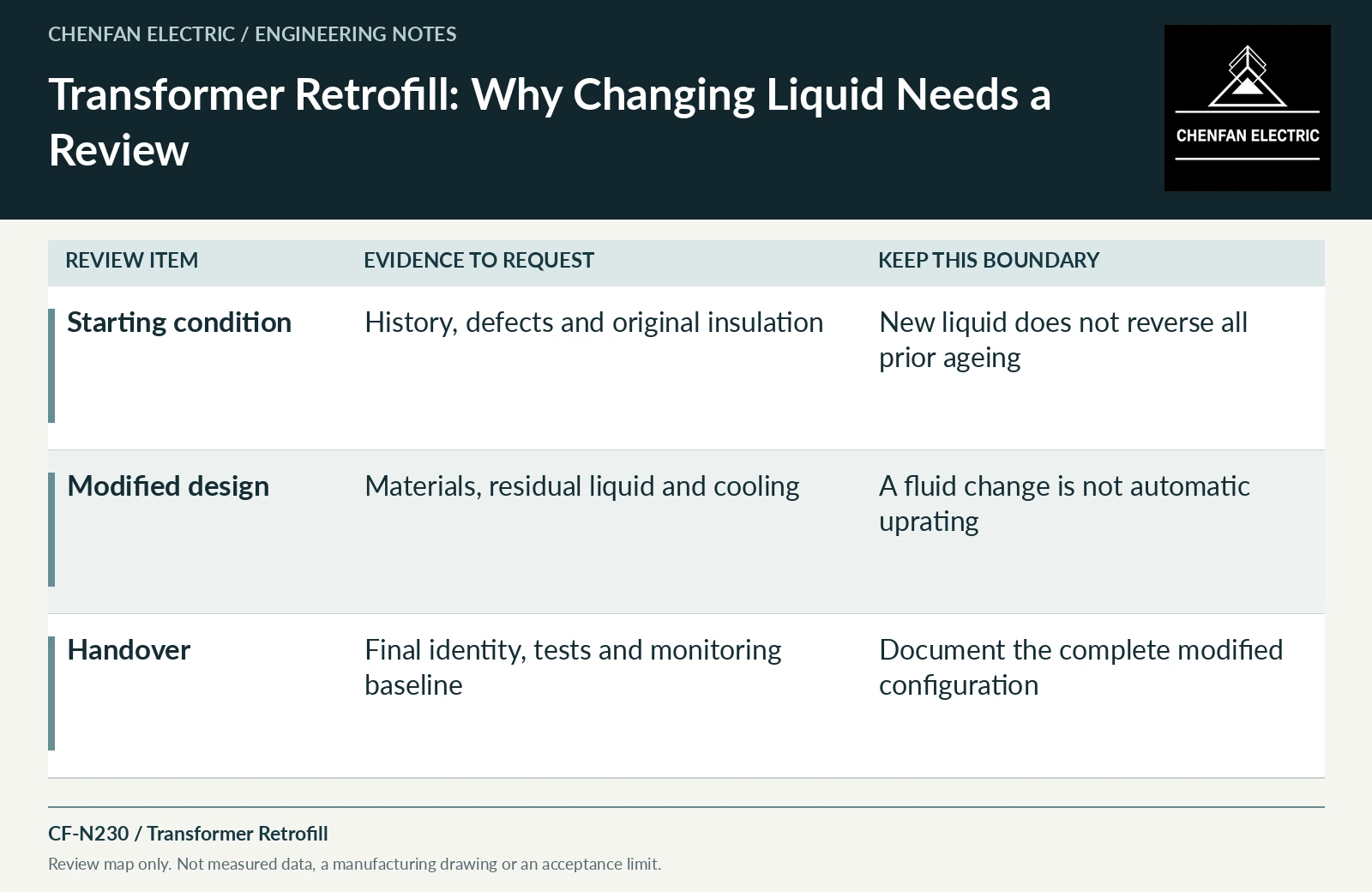
| Review item | Evidence to request | Boundary to preserve |
|---|---|---|
| Starting condition | History, defects and original insulation | New liquid does not reverse all prior ageing |
| Modified design | Materials, residual liquid and cooling | A fluid change is not automatic uprating |
| Handover | Final identity, tests and monitoring baseline | Document the complete modified configuration |
References and scope
- Retrofilling with FR3 fluidManufacturer application page · Retrofill is an equipment/material/process review, not a nameplate uprating by fluid substitution alone.
- IEC 62770:2024 — Unused natural estersPublic standard abstract · Unused natural-ester specification; application is restricted to sealed or suitably air-protected systems.
- IEEE C57.166-2026 — Acceptance and Maintenance of Insulating Liquids in Transformers and Related EquipmentPublic standard abstract · Acceptance and maintenance of insulating liquids; equipment type, liquid family and compartment must be identified.
- IEC 60076-14:2013 — Liquid-immersed power transformers using high-temperature insulation materialsPublic standard abstract · High-temperature insulation materials in liquid-immersed transformer systems; no automatic dry-type or retrofit rating transfer.