

A dielectric model is useful only within its physical and mathematical scope. An unconstrained optimizer can produce a close fit with negative circuit elements, implausible geometry or extreme time constants. The residual alone is an incomplete acceptance test. [1]
Check the equivalent before trusting the parameters
For a conventional passive resistor-capacitor representation, resistances and capacitances must be nonnegative within the chosen formulation. Relaxation time RC has units of seconds. Negative elements require a different justified model interpretation; they should not pass unnoticed as ordinary material properties.
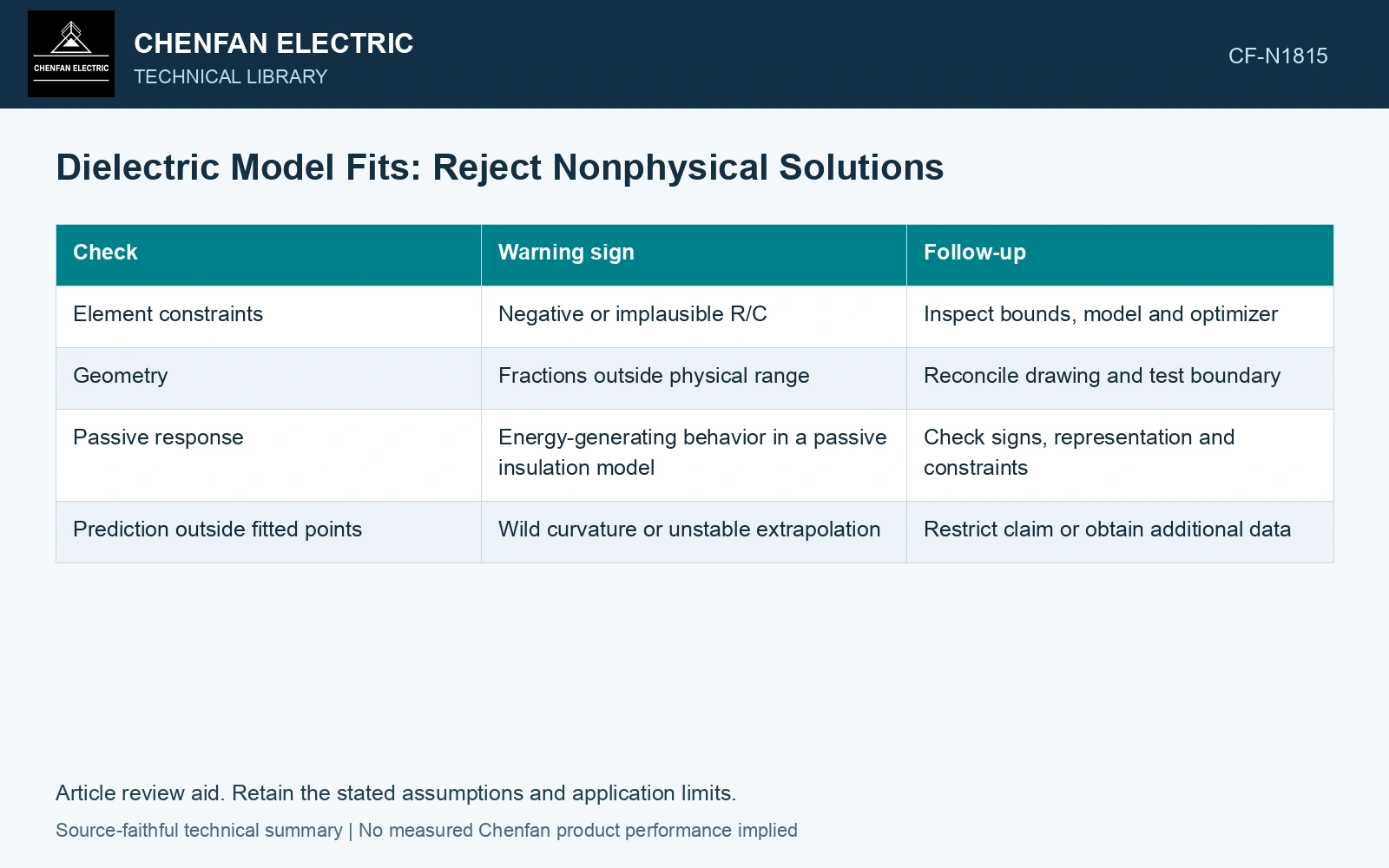
| Check | Warning sign | Follow-up |
|---|---|---|
| Element constraints | Negative or implausible R/C | Inspect bounds, model and optimizer |
| Geometry | Fractions outside physical range | Reconcile drawing and test boundary |
| Passive response | Energy-generating behavior in a passive insulation model | Check signs, representation and constraints |
| Prediction outside fitted points | Wild curvature or unstable extrapolation | Restrict claim or obtain additional data |
Distinguish causality from a smooth graph
A causal response cannot precede its excitation. Passive physical models also constrain energy behavior. A smooth numerical curve does not establish either property. Use a representation with justified physical structure and, where appropriate, consistency checks suited to the available bandwidth.
Finite frequency coverage limits such checks. Do not claim complete causality verification from a narrow measured window, or extrapolate a fitted equivalent indefinitely because it is algebraically convenient.
Raxsa and co-authors remove negative exponential coefficients when constructing their extended Debye equivalent. Retain physical parameter constraints with the fitting objective; a lower residual cannot make an ordinary passive RC branch physically admissible. [2]
Reject an energetically impossible fitted branch
Assume a candidate passive relaxation branch is fitted as R = 10 MΩ and C = −1 nF. Its calculated time constant is −0.010 s, inconsistent with the intended decaying passive RC model. Reject that solution even if residual decreases, then inspect missing processes or the selected representation. A numerical fit is not physical qualification.
References
- IEEE, IEEE C57.161-2018, IEEE Guide for Dielectric Frequency Response Test.
- J. Raxsa, P. Nimsanong, T. Mai-Eiam and P. Yutthagowith, Determination of Dielectric Models Based on Effective Multi-Exponential Fittings, Energies 16, 4615, 2023. DOI: 10.3390/en16124615.