

Software may return a precise fitted moisture parameter because many points constrain one selected model. That precision does not include every uncertainty in temperature, geometry or the reference material. Report the interval with its definition. [1]
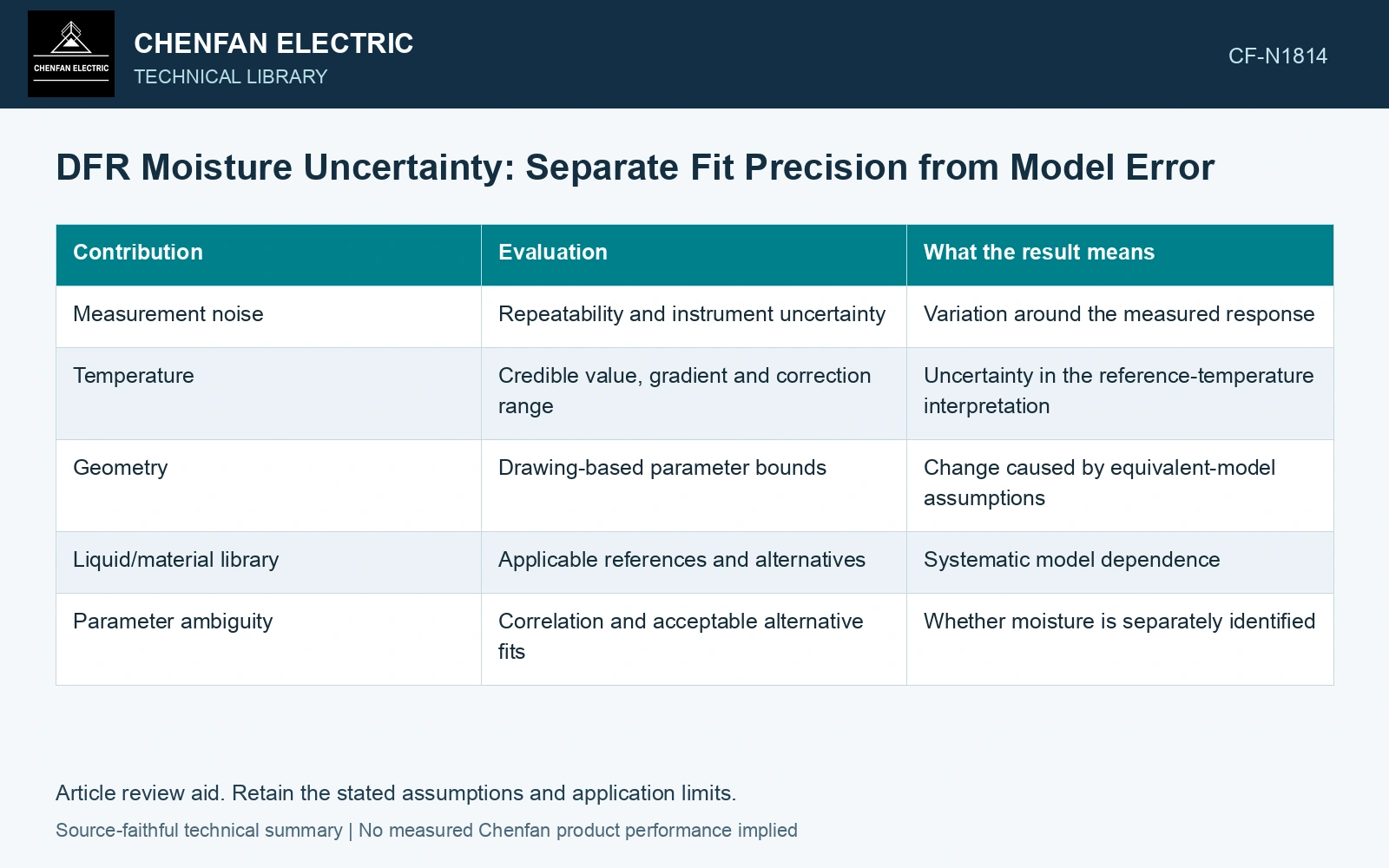
Separate the uncertainty sources
| Contribution | Evaluation | What the result means |
|---|---|---|
| Measurement noise | Repeatability and instrument uncertainty | Variation around the measured response |
| Temperature | Credible value, gradient and correction range | Uncertainty in the reference-temperature interpretation |
| Geometry | Drawing-based parameter bounds | Change caused by equivalent-model assumptions |
| Liquid/material library | Applicable references and alternatives | Systematic model dependence |
| Parameter ambiguity | Correlation and acceptable alternative fits | Whether moisture is separately identified |
Use statistical intervals only under stated assumptions
A confidence interval derived from residual noise assumes a statistical model and an adequate response model. Correlated points, drift or weighting choices can change that interval. A small residual does not demonstrate that the material library is correct.
For input sensitivity, vary temperature and geometry within justified bounds and retain the resulting moisture estimates. These scenario bounds are not automatically a probability-based confidence interval. Label them accordingly rather than attaching a confidence percentage with no distribution basis.
Combine standard uncertainties with covariance where effects are correlated; repeatability alone does not include all systematic contributions. [2]
Report model sensitivity apart from fit spread
Assume fitted moisture is 2.0% by dry mass, with an algorithmic repeat spread of ±0.1 percentage point. Reanalysis over justified geometry and temperature scenarios gives 1.4–2.8%. That scenario width is 1.4 percentage points, seven times the 0.2-point repeat width. Report both definitions; neither interval automatically has a stated probability coverage.
References
- IEEE, IEEE C57.161-2018, IEEE Guide for Dielectric Frequency Response Test.
- B. N. Taylor and C. E. Kuyatt, NIST Technical Note 1297, Guidelines for Evaluating and Expressing the Uncertainty of NIST Measurement Results, 1994, sections 5 and 6.