

A mineral-oil dielectric library is not automatically transferable to an ester-filled transformer. Liquid conductivity, paper impregnation and moisture partitioning can differ. The instrument may measure the response correctly while the selected reference model interprets it incorrectly. [1]
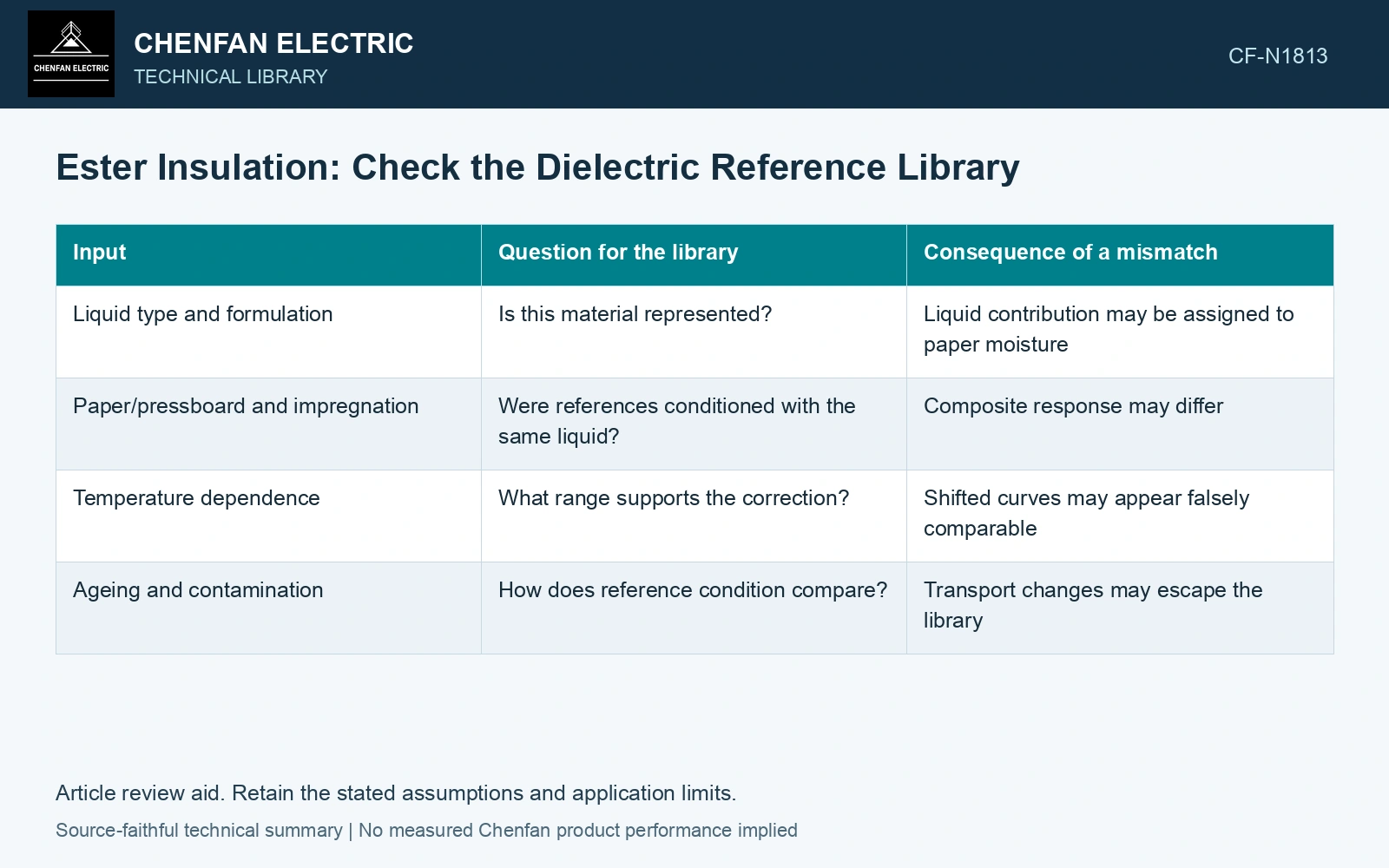
Identify the complete material system
| Input | Question for the library | Consequence of a mismatch |
|---|---|---|
| Liquid type and formulation | Is this material represented? | Liquid contribution may be assigned to paper moisture |
| Paper/pressboard and impregnation | Were references conditioned with the same liquid? | Composite response may differ |
| Temperature dependence | What range supports the correction? | Shifted curves may appear falsely comparable |
| Ageing and contamination | How does reference condition compare? | Transport changes may escape the library |
Do not transfer moisture through oil concentration alone
Water concentration in the liquid and water content in cellulose describe different quantities. Their relationship depends on material and temperature, as well as whether equilibrium is a defensible assumption. The same liquid concentration need not imply the same paper condition in different liquids.
Record the water measurement basis and the model’s convention. Converting between mass fractions or using an equilibrium relation requires the appropriate material data; a mineral-oil relation cannot be carried over silently.
Lyutikova and co-authors report that mineral/ester composition changes water solubility and the permittivity/loss response of impregnated paper. This supports checking the actual liquid/paper reference system; it does not validate an arbitrary ester moisture library. [2]
Compare libraries at identical measured data
Assumptions: the same 20 °C ester-impregnated specimen data produce 1.0% and 2.0% dry-basis moisture estimates from two libraries, one validated only for mineral oil and one of undocumented material scope. The twofold spread reflects model choice, not measured water removal. Reject both as a release basis until one library is validated for the actual liquid/paper/temperature system; do not select the lower estimate or average them to 1.5%. Preserve independent representative water evidence while qualifying the library. [1][2]
References
- IEEE, IEEE C57.161-2018, IEEE Guide for Dielectric Frequency Response Test.
- M. Lyutikova, S. Korobeynikov, U. Mohan Rao and I. Fofana, Mixed Insulating Liquids with Mineral Oil for High Voltage Transformer Applications: A Review, IEEE Transactions on Dielectrics and Electrical Insulation, 2022. DOI: 10.1109/TDEI.2022.3157908.