

An altered dielectric curve does not identify its chemical cause. Moisture, dissolved ionic species, paper degradation products and temperature can affect conduction or relaxation. Assigning the whole change to water needs evidence beyond a fit residual. [1]
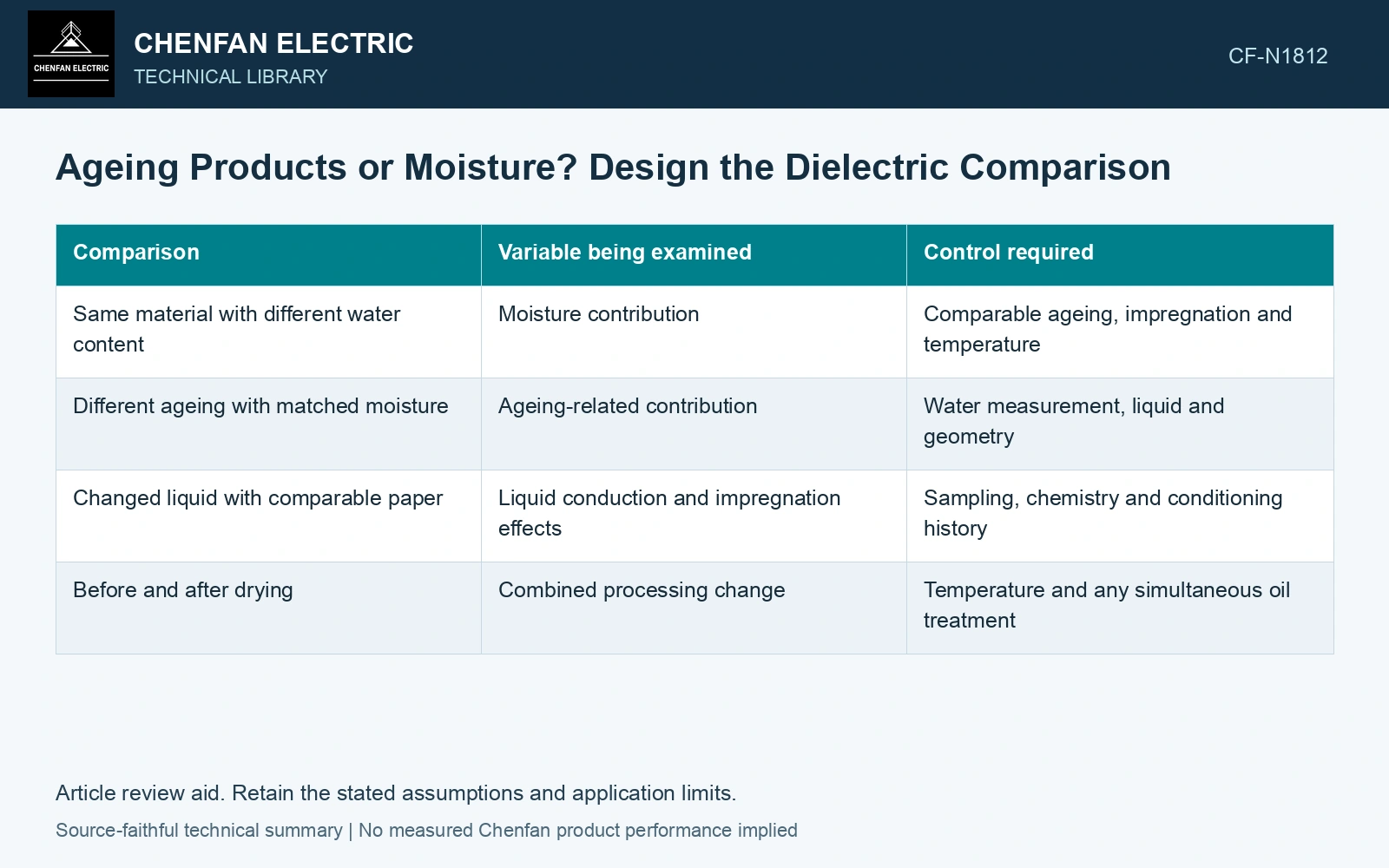
Use controls that separate the variables
| Comparison | Variable being examined | Control required |
|---|---|---|
| Same material with different water content | Moisture contribution | Comparable ageing, impregnation and temperature |
| Different ageing with matched moisture | Ageing-related contribution | Water measurement, liquid and geometry |
| Changed liquid with comparable paper | Liquid conduction and impregnation effects | Sampling, chemistry and conditioning history |
| Before and after drying | Combined processing change | Temperature and any simultaneous oil treatment |
Do not treat one laboratory trend as universal
Oil acidity and other chemical measurements can supply independent context, but one oil number does not uniquely identify the condition of every paper region. Relate each sample to its material, timing and representativeness.
Arsad and co-authors discuss how ageing/contamination changes oil solubility and polar species. Keep independent water and chemical observations beside the dielectric result; one fitted moisture parameter cannot separate all contributing material changes. [2]
Check a non-moisture conductance change
Assumptions at 20 °C: an ideal parallel dielectric model at 1 Hz has fixed capacitance 1 nF, while conductance rises from 0.1 to 0.2 nS. Independent representative paper sampling is assumed to show unchanged dry-basis water at 1.5%. Tanδ = G/(2πfC) rises from 0.01592 to 0.03183, doubling despite the assumed unchanged water condition. Reject a moisture-only explanation for this controlled comparison; examine liquid conductivity, chemistry and model completeness with the matched material samples. Neither the circuit calculation nor an oil-acidity result alone proves which ageing process produced the extra conductance. [1][2]
References
- IEEE, IEEE C57.161-2018, IEEE Guide for Dielectric Frequency Response Test.
- S. R. Arsad et al., Water Content in Transformer Insulation System: A Review on the Detection and Quantification Methods, Energies 16, 1920, 2023. DOI: 10.3390/en16041920.