

Temperature-dependent core loss couples the magnetic source with the thermal solution. Use data for the actual steel, processing and excitation to determine whether that feedback materially changes the predicted duty. [1] [2]
Published measurements on specific grain-oriented and non-oriented electrical steels show temperature-dependent permeability and loss. The response belongs to the tested grade, frequency and magnetic state; retain those conditions when supplying the coupled model. [3]
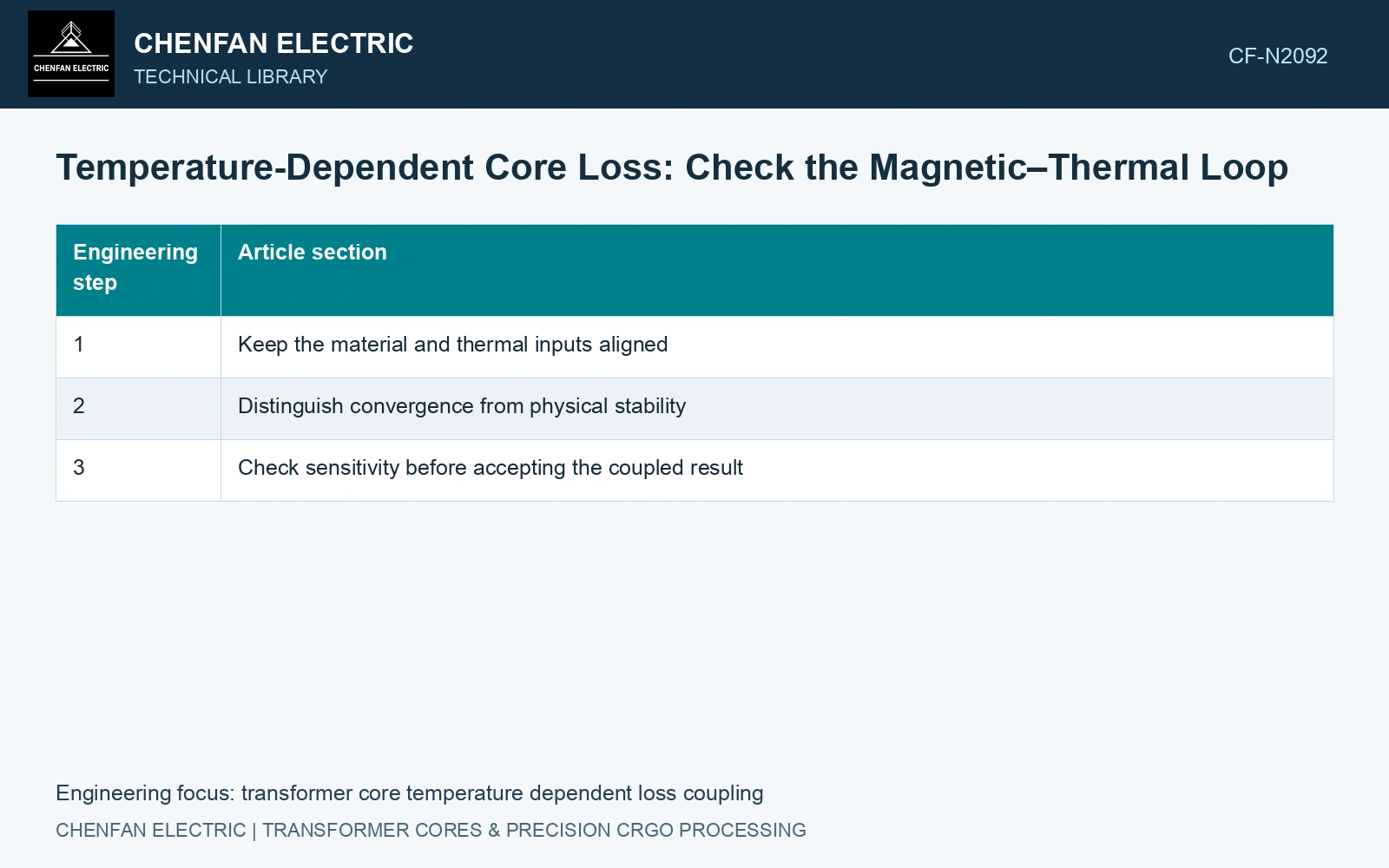
Keep the material and thermal inputs aligned
Store loss as a supported function of temperature and the relevant magnetic variables. Preserve waveform, direction and processing state. A resistivity correction alone may not represent the full change in hysteresis, magnetization and local field distribution.
Use the temperature of the region generating the loss, rather than one oil or mean-core temperature for every packet. If temperature materially changes the magnetic solution, update that solution too instead of adjusting the final watts independently.
- Evaluate the magnetic field and local loss with the current temperature-dependent inputs.
- Apply the spatial heat source to the thermal model with the actual boundary conditions.
- Update temperatures and relevant properties, then repeat or solve the coupled system.
- Check residuals, energy balance and sensitivity to the chosen coupling procedure.
Distinguish convergence from physical stability
A simplified steady-state iteration is Tnext=Tfluid+RP(T). Its local fixed-point convergence requires |R P′(T)|<1. This is a property of that iteration, not a universal thermal-safety criterion.
For the corresponding scalar dynamic model C dT/dt=P(T)−G(T−Tfluid), with G=1/R and positive C, a local equilibrium is stable when P′(T)<G.
As an illustrative example, take R=0.2 K/W and P′=−6 W/K. The simple iteration has slope −1.2 and can oscillate rather than converge, even though the scalar thermal equilibrium is stable because −6<5 W/K. These are fictional coefficients demonstrating the difference between numerical and physical behaviour.
Check sensitivity before accepting the coupled result
Try appropriate damping or a different coupled solution strategy when the simple iteration fails. Verify that success is not merely a loose stopping tolerance. Examine plausible temperature-dependent curves and thermal-boundary alternatives, especially near the material-data limits.
A converged solution outside the measured temperature range is still an extrapolation. A converged mean temperature also does not establish local compliance if the packet distribution is unresolved.
The 23ZH90 catalogue limit is 0.90 W/kg at 1.7 T and 50 Hz; it is not a temperature coefficient. [4] Assume a 100 kg represented region and, solely for a sensitivity calculation, P(T) = 90 − 0.2(T − 20) W, fluid at 20 °C and R = 0.2 K/W. With θ = T − 20, equilibrium gives θ = 0.2(90 − 0.2θ), hence θ = 17.31 K and P = 86.54 W. A constant 90 W source instead gives 18.00 K, a difference of 0.69 K. Use this difference to judge whether the assumed temperature dependence matters, then replace its slope with matched material measurements; the catalogue does not establish it.
Grade, stress-relief route, cutting damage and joint/clamp stress must match the temperature-dependent test data. A fitted slope for an annealed strip cannot be transferred unchanged to a differently restrained assembled core.
Report the temperature range, spatial update method and residual checks. Support a simplified fixed-loss calculation with a sensitivity comparison across the relevant duty.
References
- Z. Chen, Z. He and S. Wang, Transformer Iron Core Temperature Field Calculation Based on Finite Element Analysis, Energies 18, 6537, 2025. DOI: 10.3390/en18246537.
- U.S. Department of Energy, DOE-HDBK-1012/2-92, Thermodynamics, Heat Transfer, and Fluid Flow, Volume 2, 1992.
- Z. Wang, K. Xu and Y. Du, Temperature Rise Calculation of Magnetic Core Considering the Temperature Effect of Magnetic Properties in an Electrical Steel Sheet, Symmetry 14, 2315, 2022. DOI: 10.3390/sym14112315.
- Nippon Steel Corporation, Grain-Oriented Electrical Steel Sheets, catalogue D004je, April 2020, specification and typical-property tables.