

Requalify the core features affected by a cutting-line upgrade. Compare feeding, tool motion, joint registration and stacking against the previous route, then connect each changed feature to its dimensional, magnetic or assembly consequence.
Describe the real change
Compare the old and new route, including tooling, control programs, measurement systems and any changed subcontract operation. Separate replaced functions from unchanged downstream assembly. A line name alone does not identify which physical conditions moved. [1]
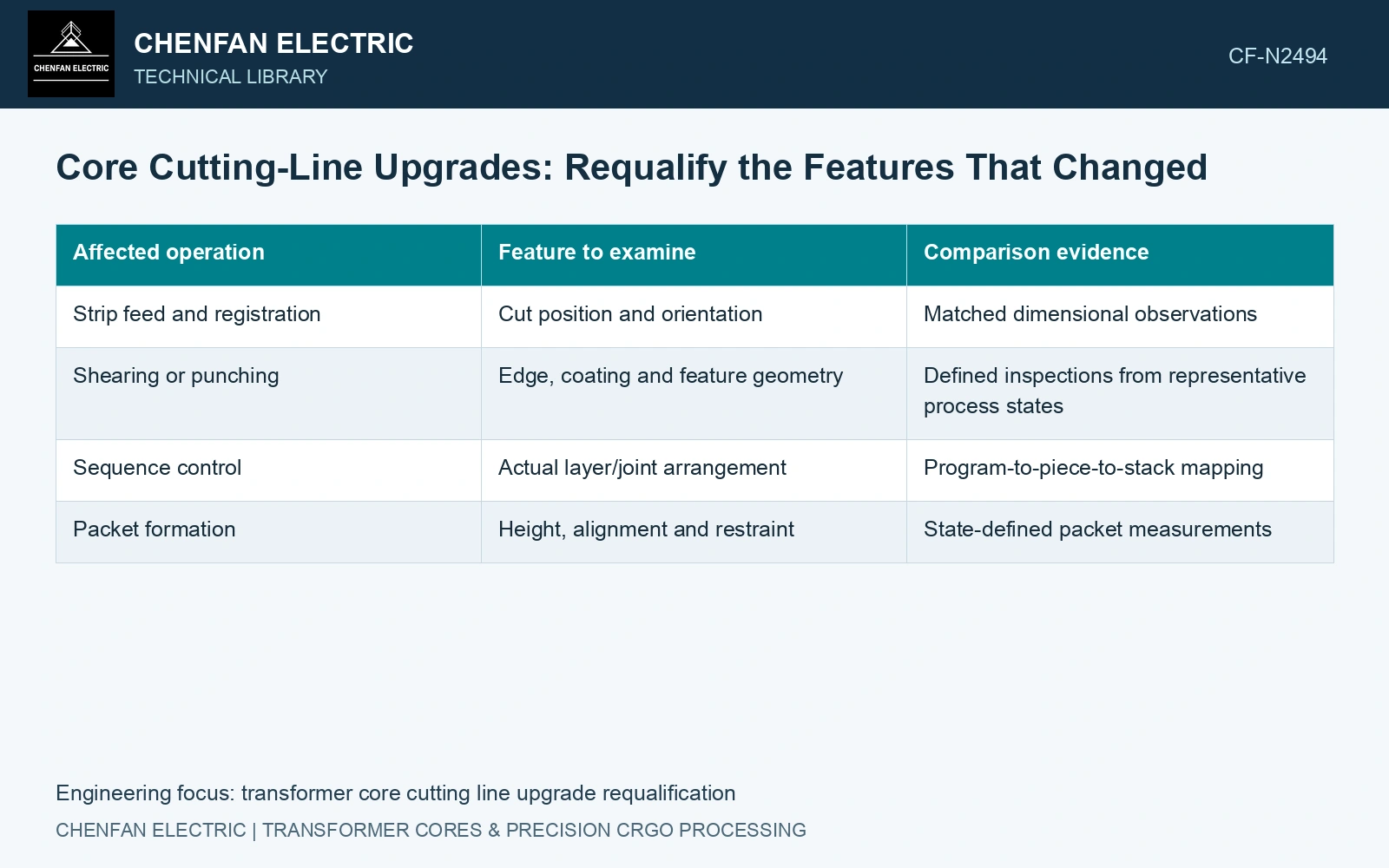
| Affected operation | Feature to examine | Comparison evidence |
|---|---|---|
| Strip feed and registration | Cut position and orientation | Matched dimensional observations |
| Shearing or punching | Edge, coating and feature geometry | Defined inspections from representative process states |
| Sequence control | Actual layer/joint arrangement | Program-to-piece-to-stack mapping |
| Packet formation | Height, alignment and restraint | State-defined packet measurements |
Keep the comparison controlled
Use suitably matched material and part definitions to distinguish the line effect from a simultaneous steel change. Record tool condition, setup and the production interval represented. One selected sample from each line cannot characterize routine variation.
If the new process needs changed settings or fixtures, include them in its configuration. Comparing nominally identical programs while operators apply undocumented corrections creates an unclear baseline.
Reconnect features to assembled performance
Evaluate the changed features against their consequence: fit, joint geometry, interlaminar condition or another supported design dependency. An improvement in one edge measurement cannot by itself establish lower assembled loss or better noise performance.
Limit inheritance to unchanged conditions
Identify older evidence whose governing material, feature and assembly conditions remain represented. Record why it can be retained. Mark results that require confirmation rather than reopening every file indiscriminately or inheriting the entire qualification without review.
Check the stability of the new production process before interpreting capability statistics; mixed commissioning and stable-production data describe different populations. Define ongoing monitoring around the affected features and future setup changes. [2]
Test the upgraded edge process against an explicit requirement
The catalogue lists burr height ≤0.025 mm for its sheet supply [3]. Assumptions for a downstream cutting qualification: the purchase specification instead requires burr height <0.020 mm, and representative measured edges are 0.018 mm and 0.024 mm under the same inspection method. Margins to that strict upper boundary are 0.002 mm and −0.004 mm. The second edge may meet the catalogue supply figure but fails the assumed cut-part requirement. Hold the affected production population for disposition and confirm measurement uncertainty before accepting a result close to the boundary.
Blade clearance, edge condition, feed registration and tool wear control the changed features. Verify coating integrity and assembled magnetic response where the new cut condition can affect interlaminar paths or joints.
Release the new line for its documented configuration, stable production population and confirmed feature results. Support each improvement claim with a controlled comparison of the property concerned, while retaining the monitoring and requalification triggers for future setups and process changes.
References
- NASA, NASA Systems Engineering Handbook, section 6.5, Configuration Management, official online text.
- NIST/SEMATECH, e-Handbook of Statistical Methods, section 6.1.6, What is Process Capability?, official online text.
- Nippon Steel Corporation, Grain-Oriented Electrical Steel Sheets, catalogue D004je, April 2020, specification tables, size tolerances and Annealing by Customers.