

Normalize the delivered core state, assembly responsibility and test scope before comparing quotations. Loose cut laminations with a material certificate and an identified, loss-tested assembly are different supply options; price ranking requires a common, supported technical basis. [1]
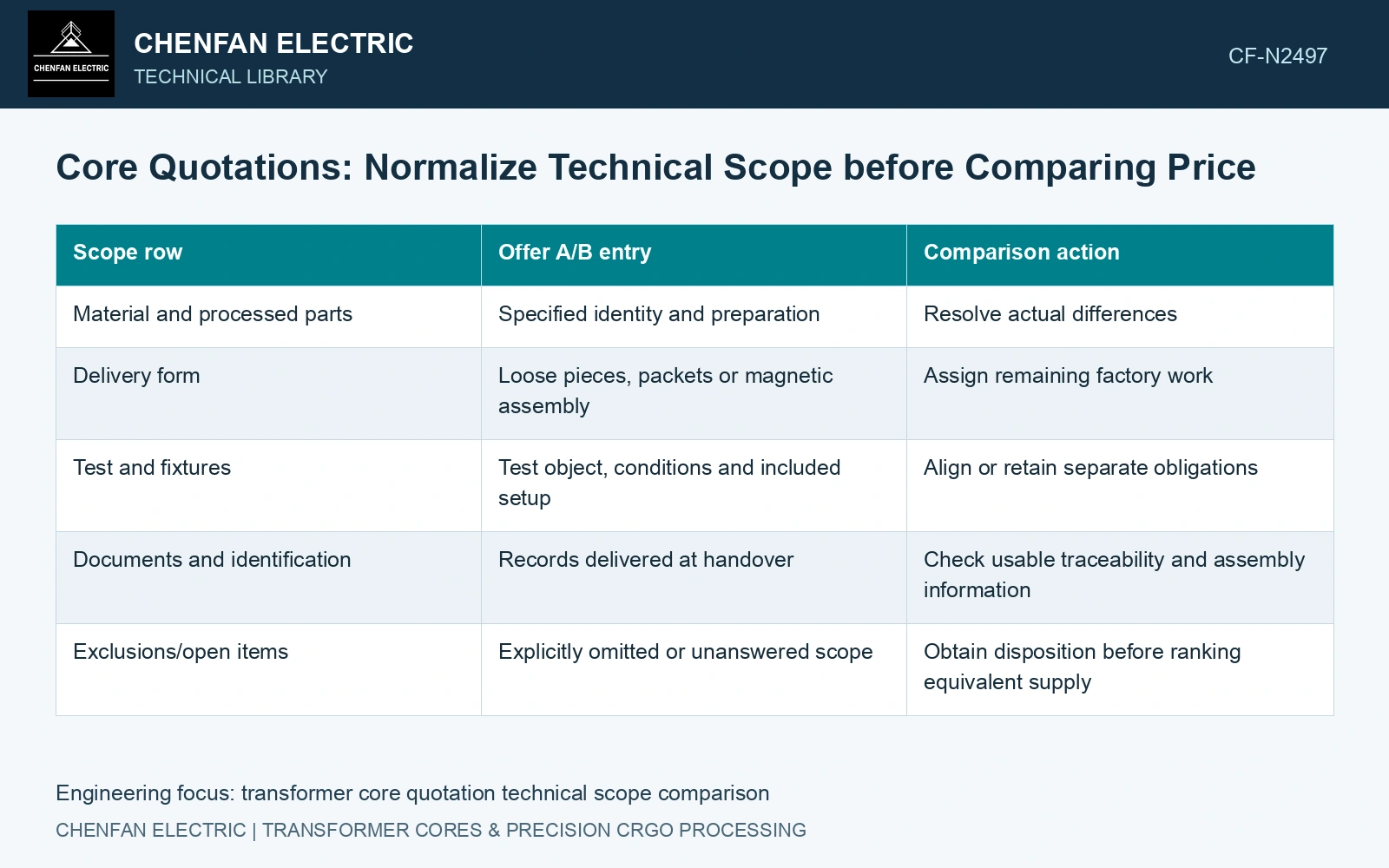
Freeze a common technical basis
State material designation, gauge, treatment, controlled drawing and required delivered state. Define the measured performance boundary and assembly responsibility. Keep quantities and relevant delivery terms explicit without assuming that identical descriptions include identical work.
| Scope row | Offer A/B entry | Comparison action |
|---|---|---|
| Material and processed parts | Specified identity and preparation | Resolve actual differences |
| Delivery form | Loose pieces, packets or magnetic assembly | Assign remaining factory work |
| Test and fixtures | Test object, conditions and included setup | Align or retain separate obligations |
| Documents and identification | Records delivered at handover | Check usable traceability and assembly information |
| Exclusions/open items | Explicitly omitted or unanswered scope | Obtain disposition before ranking equivalent supply |
Record included, excluded and unresolved scope
Mark each item included, excluded or unresolved. Silence is unresolved. It should not become “included” because the previous supplier usually provided it. Likewise, a quote’s material certificate should not be interpreted as an assembled-core performance report.
Attach the supporting offer text or clarified response to the scope row. Preserve revisions so a later commercial change does not silently remove the technical condition used in the comparison.
Keep transferred work visible
When a source leaves final stacking or testing with the buyer, document the required factory process, tooling, verification and responsible resources. Use those actual requirements in the commercial comparison and retain the evidence behind the transferred work.
Evaluate consequential responsibility gaps too. A test may be offered without a stated fixture state; identified packets may arrive without the sequence information needed for reconstruction. Both items can be nominally present while failing to close the interface.
Compare only after resolving the basis
Group offers that share a supported technical scope, and retain different configurations as different options. A qualified alternative can be commercially useful even when it requires a changed process; the comparison should show that requirement instead of hiding it inside price.
Put transferred factory work into the quotation total
Use 0.23 mm 23ZH90 as the common catalogue material designation [2]. All prices and quantities in this example are assumptions: 1,000 kg per core, loose-cut supply at USD 3.00/kg, tested assembly at USD 3.35/kg, and buyer stacking, fixture and verification costs of USD 250, USD 80 and USD 90 per core. The loose-cut route totals USD 3,420; the assembly route totals USD 3,350 when its stated scope includes those operations. The apparent USD 350 purchase-price advantage becomes a USD 70 disadvantage. Confirm the same final-state performance obligation before using that ranking.
Cut-piece accuracy, packet identification, yoke reconstruction and the accepted clamping state determine the factory work transferred. Price that work from the actual route, rather than treating nominally identical steel as an identical delivered core.
Rank offers within a common scope of included work, exclusions and resolved responsibilities. Keep loose-lamination and tested-assembly options separate until the buyer’s stacking, fixtures and verification are defined, then compare the complete supported supply configurations.
References
- NASA, NASA Systems Engineering Handbook, section 6.5, Configuration Management, official online text.
- Nippon Steel Corporation, Grain-Oriented Electrical Steel Sheets, catalogue D004je, April 2020, specification tables, size tolerances and Annealing by Customers.