

Qualify core preservation materials for the condition required by the next manufacturing interface. Identify the film, corrosion-control treatment, adhesive and removal residues, then evaluate their contact with the actual coatings, fluid and bonding or drying process.
Identify materials beyond the trade name
Obtain the actual product identity, relevant technical documentation and intended exposure. Record where it touches steel, coatings, insulation or temporary fixtures. Include adhesives, transfer residues and removal agents rather than reviewing only the outer wrapping.
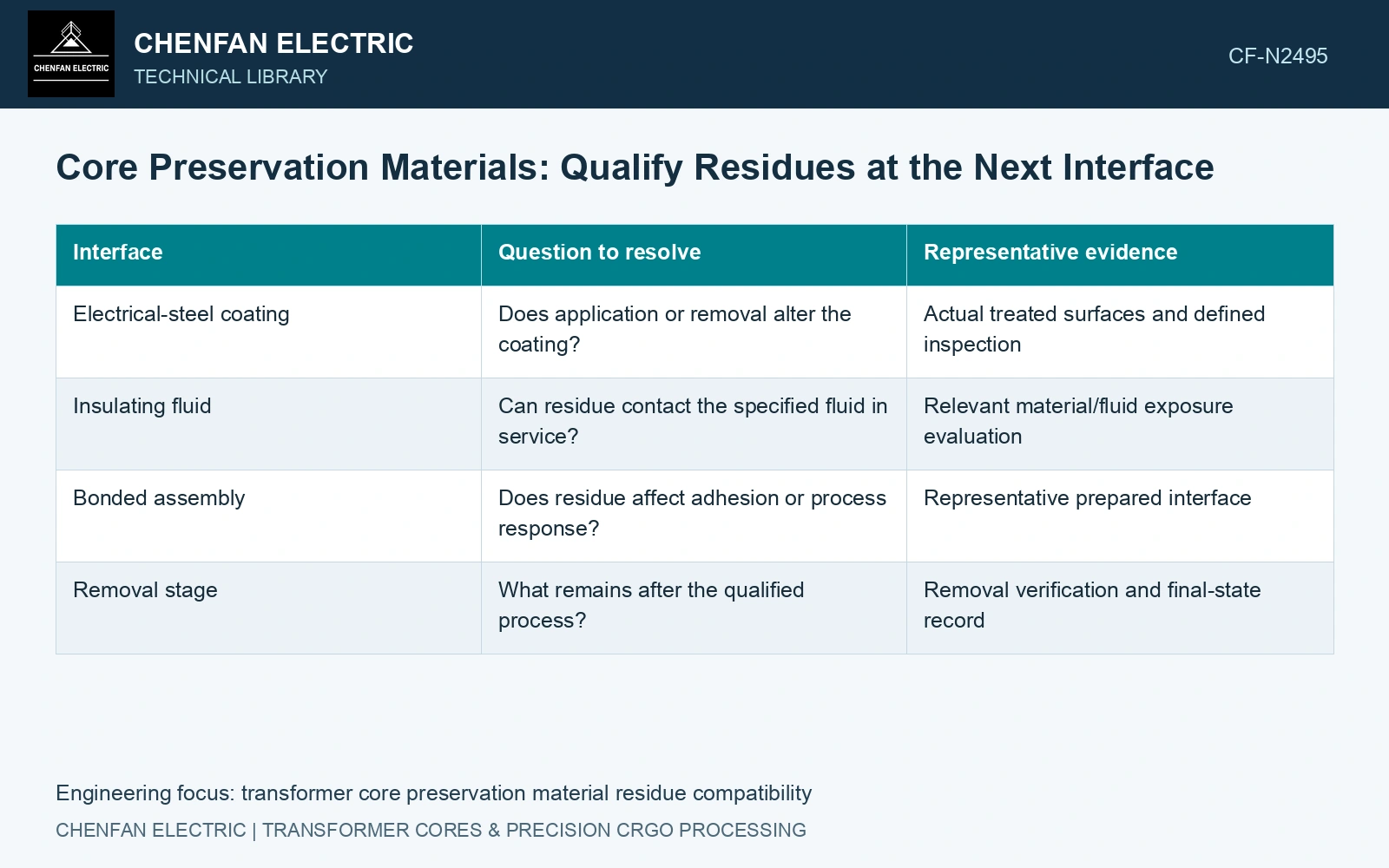
| Interface | Question to resolve | Representative evidence |
|---|---|---|
| Electrical-steel coating | Does application or removal alter the coating? | Actual treated surfaces and defined inspection |
| Insulating fluid | Can residue contact the specified fluid in service? | Relevant material/fluid exposure evaluation |
| Bonded assembly | Does residue affect adhesion or process response? | Representative prepared interface |
| Removal stage | What remains after the qualified process? | Removal verification and final-state record |
Define the final material state
Distinguish fully removed wrapping, intentionally retained treatment and uncertain residue. The specification must say which state the transformer process receives. A statement that the product is removable is not evidence that the delivered core has reached the required residual condition.
The Nippon catalogue requires remaining processing lubricants to be removed before annealing and warns against carbon pickup from furnace materials [1]. Establish whether preservation is removed before that thermal step, then verify both the final surface and the coating after the proposed removal process.
Test the consequential interfaces
Use IEC 63177:2024 when planning the construction-material/insulating-liquid compatibility test [2]. Add the coating, removal, bonding and thermal-route checks required by the actual core process. Preserve fluid, temperature history, exposure and specimen preparation; the public standard scope supplies no unviewed cycle or acceptance limit.
Control the supplier’s preservation route
Record application, consequential storage time, removal responsibility and the inspected receiving state. Keep the chemical identity and supplier/process revision linked to the approved configuration [3]; a changed adhesive or removal agent reopens its relevant evidence.
Separate a small residue mass from coating compatibility
Use the catalogue 0.23 mm gauge and assumed density 7.65 kg/dm³ [1]. Further assumptions: sheet area 0.010 m² and one-face preservative loading 1.0 g/m². Steel mass is 17.595 g and applied film is 0.010 g, only 0.0568% of steel mass. Assume the specified post-cleaning inspection requires no observable film transfer under its agreed method; the treated coupon shows transfer while the untreated blank does not. Hold that removal route against its defined final-state requirement despite the small mass fraction. Record the method’s detection capability and repeat the corrected process. A clean-surface result also needs its separate material/fluid compatibility evidence.
Application loading, cleaning method, surface handling and the thermal route control the interface. Keep residue verification distinct from burr, joint and magnetic-loss acceptance.
Release the preservation route with verified residual condition and compatibility at the next fluid, bonded or processed interface. Keep unresolved material interactions as explicit release conditions, and review changes in adhesive, protective chemistry, storage exposure or removal method against the same requirements.
References
- Nippon Steel Corporation, Grain-Oriented Electrical Steel Sheets, catalogue D004je, April 2020, specification tables, size tolerances and Annealing by Customers.
- IEC, IEC 63177:2024, Test methods for compatibility of construction materials with electrical insulating liquids.
- NASA, NASA Systems Engineering Handbook, section 6.5, Configuration Management, official online text.