

A saturation knee is not a uniquely defined point unless the criterion is stated. It may be a material-curve feature, a chosen slope change, a fitted model parameter or a test-derived threshold. Two documents can report different knee values without describing different steel if they use different definitions.
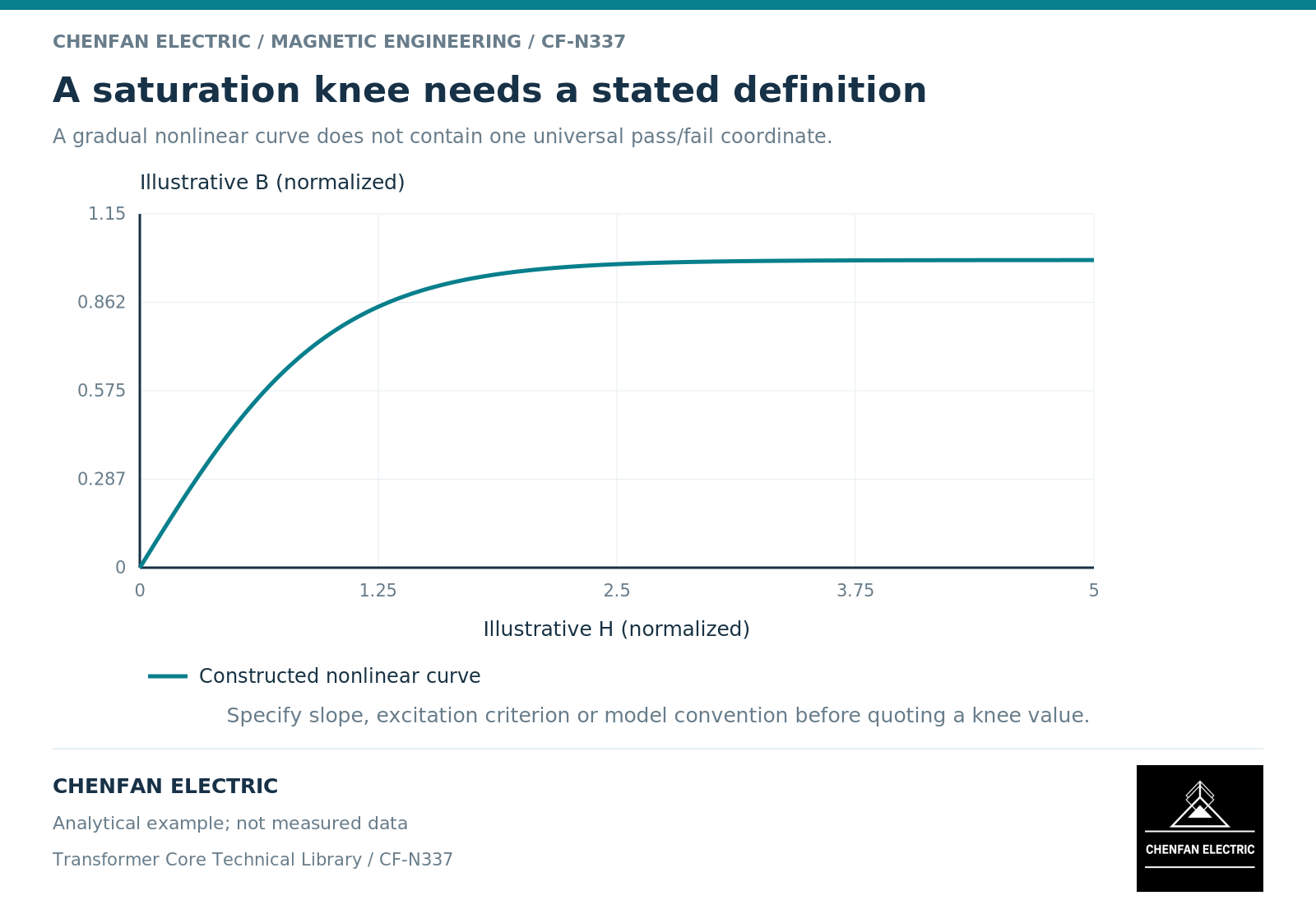
Identify the axes before identifying the knee
A B-H curve uses flux density and magnetic field strength. A flux-linkage versus current curve includes winding and geometric scaling. An excitation-current versus applied-voltage curve adds frequency, waveform and circuit assumptions.
These curves are related, but their numerical coordinates are not interchangeable. A knee voltage in per unit needs a named voltage, frequency and winding basis. A knee density in tesla needs the area and flux definition used to obtain it.
Classical transformer models may use a knee parameter as part of a chosen analytical saturation characteristic. [1] Such a parameter is a model input, not automatically a directly measured material constant.
Different criteria can select different points
One engineer may identify the knee visually. Another may use an incremental-slope criterion or the intersection of fitted asymptotes. A test procedure may define a specific relationship between changes in voltage and current. Without the definition, the word “knee” hides those differences.
Do not import a criterion from a different equipment class merely because it also uses magnetic cores. A current-transformer test definition, for example, is not automatically a requirement for a power-transformer design.
A comparison should preserve the raw or processed curve and mark the chosen point on it. This allows the reviewer to distinguish a data difference from a definition difference.
Check the data near and beyond the selected point
A smooth fitted curve can conceal sparse high-field measurements. Extrapolation beyond the measured range may strongly affect an inrush or bias study even when the fitted knee appears reasonable.
Constitutive-model guidance distinguishes normal magnetization data from hysteretic and other nonlinear representations. [2] The curve type, conditioning and rate dependence should match the intended use.
| Reported knee | Required supporting definition |
|---|---|
| B-H knee | Curve type, units, direction and criterion |
| Flux-linkage knee | Reference winding, turns and model convention |
| Voltage knee | Frequency, waveform, tap and voltage basis |
| Fitted knee parameter | Equation or model family and calibration data |
The report should also identify the range over which the resulting curve is validated. A knee point alone does not describe the entire post-saturation slope.
Use the criterion as a comparison tool, not a universal limit
For a design comparison, apply the same criterion to data produced under compatible conditions. Then assess the operating trajectory relative to the full nonlinear response rather than treating the knee as an abrupt physical on/off switch.
A local region can become strongly nonlinear before an average-core quantity reaches a chosen threshold. Conversely, a brief excursion past a fitted knee does not, by itself, establish damage. Thermal and circuit consequences require their own evaluation.
The practical request is straightforward: provide the curve, the definition used to select the knee and the intended model or acceptance use. That resolves ambiguity more effectively than arguing over a single number labeled “saturation point,” and prevents a convenient fitting parameter from becoming an unsupported product guarantee.
References
[1] Manitoba Hydro International / PSCAD. The Classical Approach.
[2] Cesare Tozzo / COMSOL. Modeling Ferromagnetic Materials in COMSOL Multiphysics.