

Your purchase order counts kilograms. Your transformer release decision depends on behaviour.
The scorecard should connect the two.
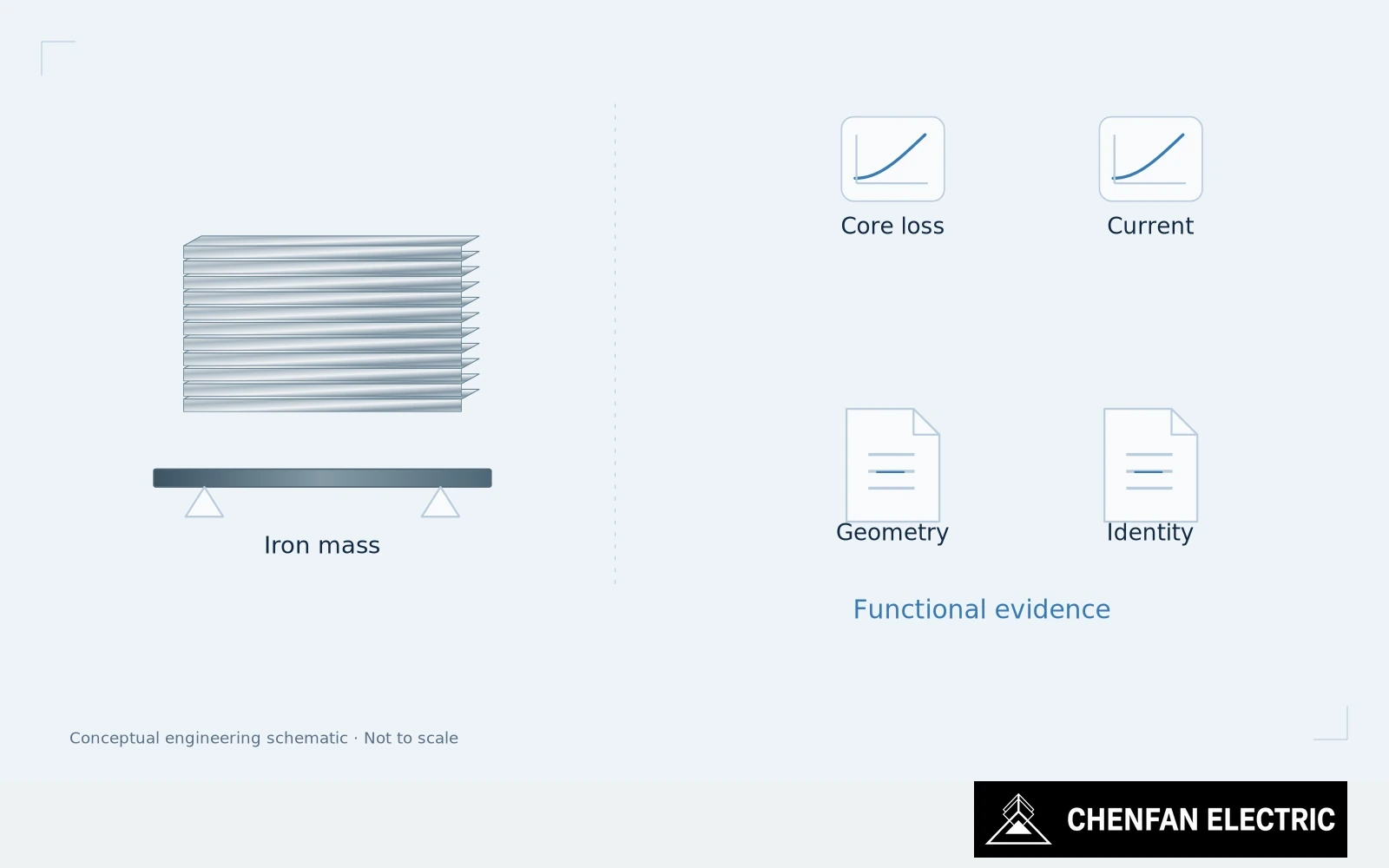
Define the function behind the purchased mass
Mass is a necessary commercial quantity: it establishes what is supplied, handled and paid for. It does not describe how reliably the core will meet its magnetic allocation or fit the next manufacturing operation.
A performance-based scorecard needs more than replacing “tonnes” with “watts”. If it contains only a loss limit, it may overlook exciting current, interface dimensions and the condition in which the measurement was made. A core is a coupled magnetic and mechanical assembly, not a single output number.
Start by defining the promised function for the specific design family. That can include loss at the agreed excitation point, an independently stated current limit, critical winding interfaces and the delivery configuration. Retain material identity so that the function can be traced to the steel actually used.
Distinguish unit conformity from process capability
Then distinguish capability from conformity. One core within its limits establishes conformity for that tested item. A sequence of comparable first-pass results gives evidence about the manufacturing route. NIST’s process-capability framework makes this distinction explicit: capability concerns a stable process relative to its specification limits.
For low-volume power cores, the data may not support a confident capability index. That is not a reason to invent one. Use the individual records, their conditions, observed variation and documented changes. A small honest dataset is more useful than a precise statistic built from unrelated designs.
The commercial scorecard should retain delivery reliability and technical response as separate dimensions. A supplier can meet the loss target while creating avoidable assembly questions. Another can answer quickly but repeatedly require concessions. Neither behaviour disappears because the other scores well.
Approve a core family and its handover condition
This approach also improves negotiation. Ask what process or scope changes support a proposed price reduction. A different material source, reduced inspection scope or changed delivery form may be acceptable, but it should not enter production disguised as the same qualified product.
Purchasing is still buying physical steel. What it needs from the supplier is a controlled conversion of that steel into a reproducible assembly.
The meaningful unit of supplier approval is therefore a core family, a manufacturing route and a defined handover condition. Keep kilograms on the invoice. Put repeatable function on the approval record.
Practical takeaway
Invoice quantities and production-release criteria measure different things.
Chenfan Electric manufactures custom transformer cores according to customer drawings. Where applicable to the specified material and core design, agreed process controls include burr height below 0.02 mm and stacking factor above 97%. Measurement methods and acceptance conditions are defined for each order.