

A core quotation can win on USD per tonne and lose on the number of transformers your factory can release.
That is a scope problem before it is a price problem.
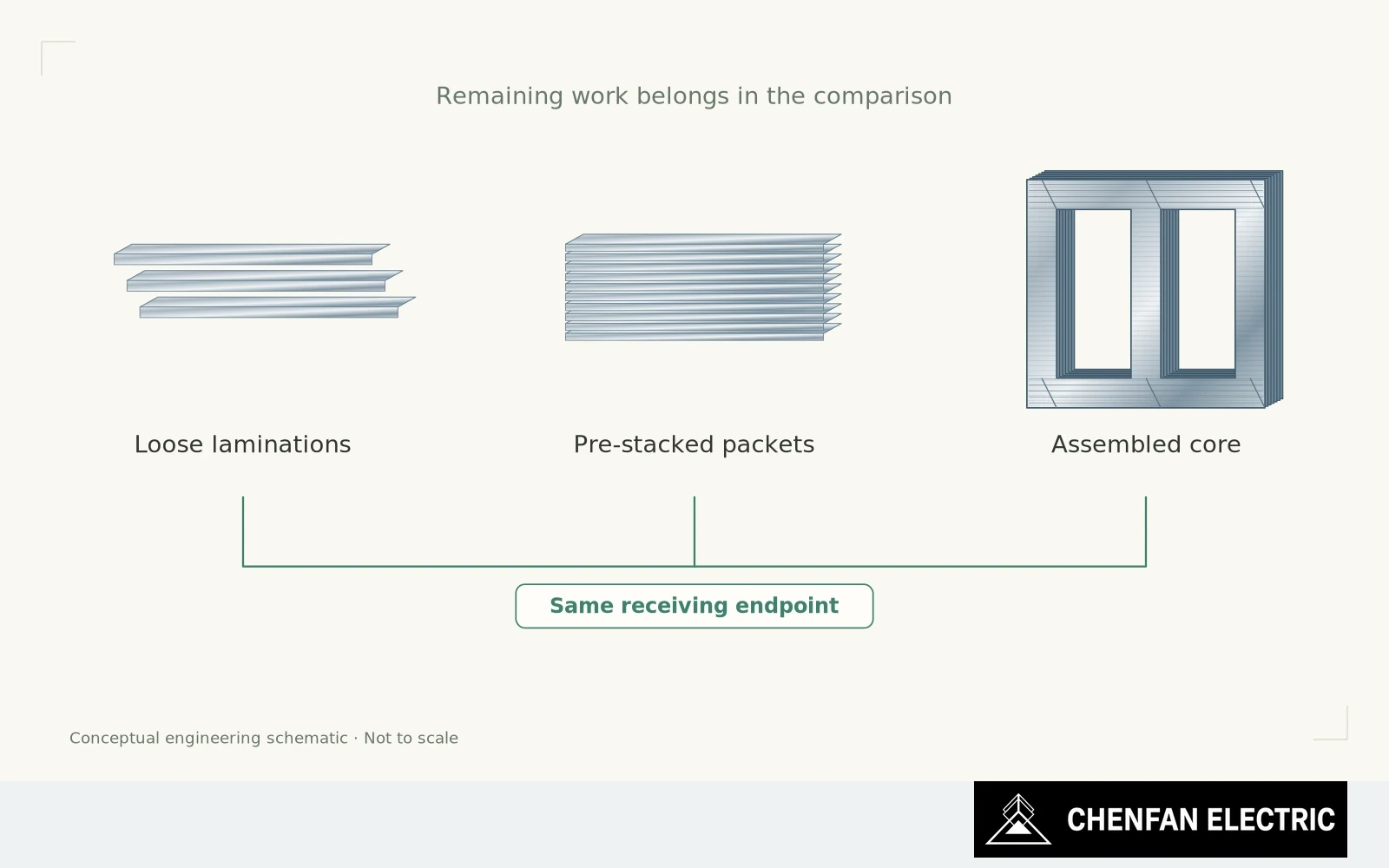
Define the same delivery scope
One offer may include identified laminations. Another may include pre-stacked packets. A third may include a tested assembly with transport supports. Comparing their unit rates without separating the remaining factory work rewards whichever supplier leaves more work outside the quotation.
Start with a common delivery boundary. Then price the actual interfaces: packet sorting, stacking, top-yoke removal, winding insertion, reassembly, inspection and any repeat test required by your manufacturing plan. Use your own recorded labour and cycle times rather than a supplier’s generic savings claim.
Loss evaluation needs its own boundary. For an energized transformer, no-load loss continues when the secondary load is small or absent. But assigning a lifetime value to a watt requires an operating profile, energy price, discount assumption and ownership period. It is not a universal multiplier that belongs in every core quotation.
Keep loss value and factory exposure separate
For a transformer manufacturer, the immediate commercial exposure may instead be a contractual loss guarantee or a production release constraint. Keep that exposure separate from the end user’s capitalized energy cost. Counting both as the same avoided expense can exaggerate the economic case.
Consistency also has a measurable factory consequence. Compare first-pass assembly acceptance and magnetic acceptance for comparable designs. Include rejected and reworked deliveries in the record; a report containing only released units hides the work needed to release them.
A practical comparison therefore has a steel-and-processing price, a remaining-work estimate and a clearly stated performance obligation. Uncertain items stay visible as uncertain items. They should not disappear into a conveniently precise total-cost figure.
Compare the cost of an accepted core
None of this means the lowest unit price is wrong. When the scope, performance and process capability are genuinely equivalent, it may be the right purchase. The point is to establish equivalence before celebrating the saving.
During quotation review, I would ask production to identify the next operation it must perform on each offered delivery form. Engineering would identify the remaining performance risk. Purchasing would then compare the same deliverable.
The number that deserves negotiation is the cost of an accepted core at the agreed handover point. USD per tonne becomes useful after that point is defined.
Practical takeaway
An attractive unit rate can reflect excluded factory work rather than better purchasing value.
Chenfan Electric manufactures custom transformer cores according to customer drawings. Where applicable to the specified material and core design, agreed process controls include burr height below 0.02 mm and stacking factor above 97%. Measurement methods and acceptance conditions are defined for each order.