

Could an ordinary GOES grade outperform a premium grade after assembly?
Yes, in a particular comparison. That does not make the grades interchangeable.
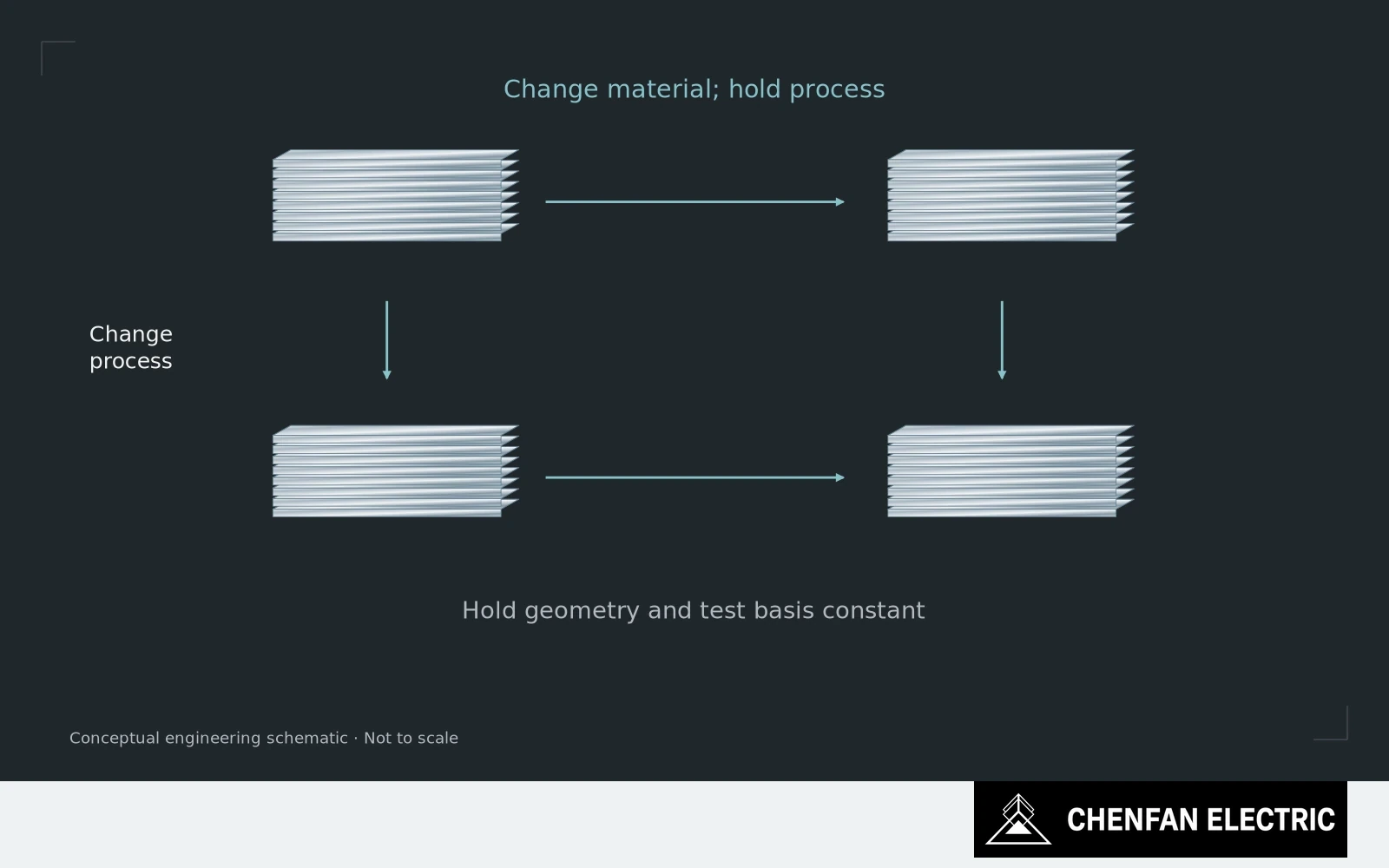
Separate the material advantage from process effects
The result depends on the starting material advantage and the additional effects introduced by each core design and manufacturing route. Treating either contribution as negligible is a poor basis for a purchasing decision.
A premium grade may provide lower specified loss, a different magnetization characteristic or useful headroom at the intended operating point. A well-controlled factory cannot create those intrinsic properties in a lower-grade sheet simply by stacking it carefully.
Equally, buying a better sheet does not prevent joint misassembly, undesirable stress or damaged interlaminar insulation. A material advantage can be partly consumed by avoidable manufacturing effects. The size of that consumption must be measured for the application; it cannot be assigned a convenient universal percentage.
Test material and manufacturing sensitivities
I would test the question as two separate sensitivities. First, change the material while holding the qualified geometry and process constant. Second, improve a defined process variable while keeping the material and geometry constant. Comparing two unrelated quotations changes too many things to show which investment helped.
The practical boundary is the operating envelope. A combination that meets a loss target at one excitation point may still have an unsuitable exciting-current characteristic or insufficient margin near the design limit. Noise and assembly requirements can also prevent a decision based on watts alone.
For production, consider how the result repeats. A lower-cost grade with a stable qualified route may be appropriate for one design family. Another family may need the premium grade even with excellent manufacturing control. Neither outcome supports a general claim that material quality or workmanship always dominates.
Qualify the proposed production alternative
There is a further limitation to the comparison: an exceptional reworked sample is not the same manufacturing proposition as a repeatable first-pass build. Include the production route that achieved the result, not merely the result itself.
Purchasing can then negotiate real alternatives: the specified grade through the established process, or a proposed substitution supported by design review and representative core verification. The supplier should state what changes and what remains guaranteed.
I would remove avoidable process variation before relaxing a material requirement. Once the process is understood, grade selection becomes an engineering trade-off rather than an argument over which factory tells the better story.
Practical takeaway
A lower-grade material can win one comparison without becoming an equivalent substitute.
Chenfan Electric manufactures custom transformer cores according to customer drawings. Where applicable to the specified material and core design, agreed process controls include burr height below 0.02 mm and stacking factor above 97%. Measurement methods and acceptance conditions are defined for each order.