

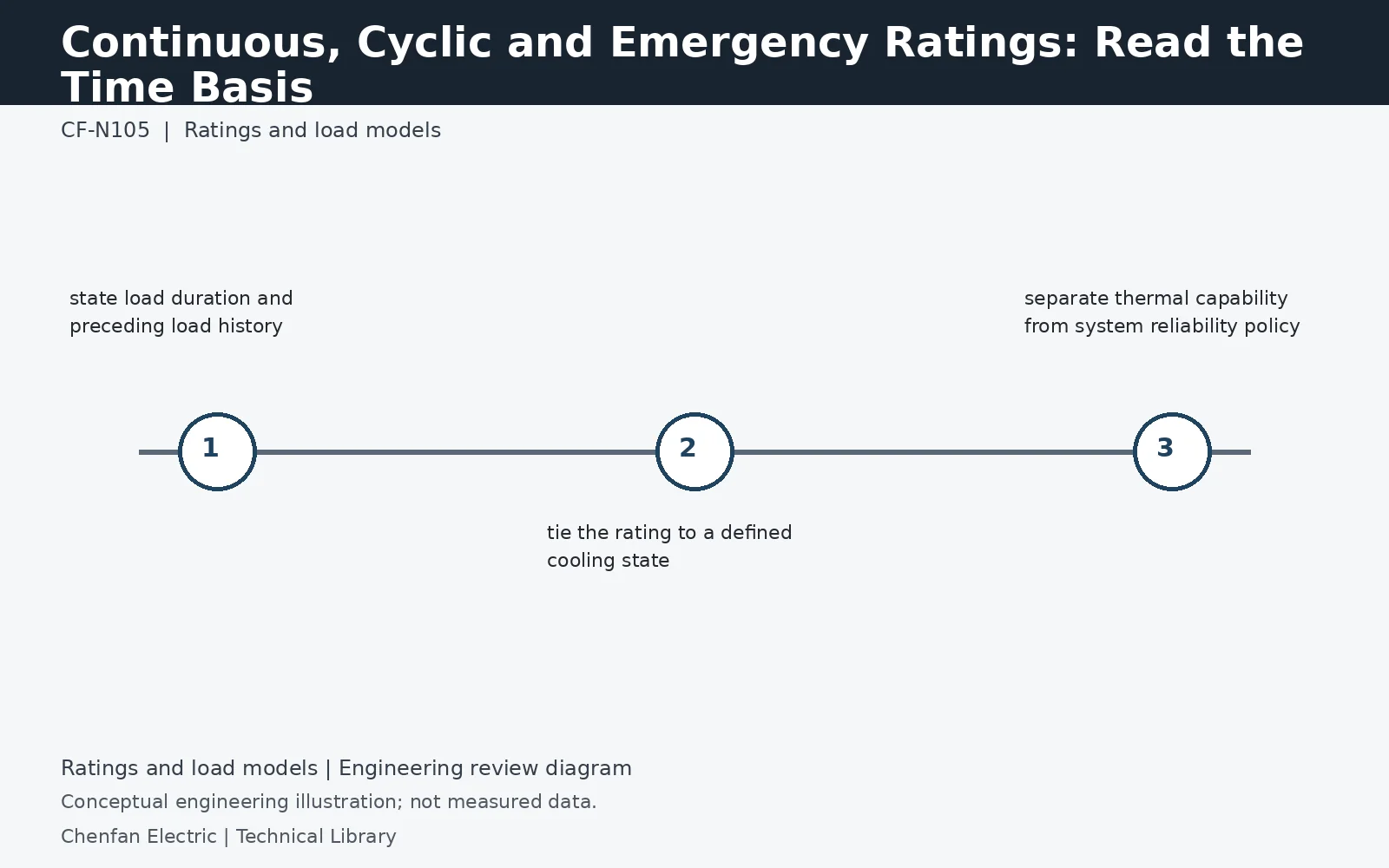
Continuous, cyclic and emergency loading are not interchangeable labels. Cyclic loading depends on the preceding thermal history and the time available for cooling; emergency loading is a risk-managed temporary condition, not a new continuous nameplate. Ambient temperature, cooling mode, initial top-oil and winding temperatures, duration and acceptable ageing or accessory limits must all be stated before an overload claim is meaningful.
The same peak can start from different temperatures
Consider two illustrative duty profiles that both reach 1.20 per unit load for two hours. One follows a long light-load period; the other follows sustained full load at a higher ambient temperature. Their hot-spot trajectories need not match. A peak MVA value without the preceding load history cannot establish cyclic capability. Supply a time series with interval length, ambient temperature and cooling state, and identify whether the study starts from measured temperatures, a prior calculated state or an assumed steady condition.
Check accessories before accepting an overload case
Winding temperature is not the only possible limit. Bushings, tap-changer contacts, leads, cable boxes, cooling equipment and measurement arrangements may restrict current or temperature. Loss of a fan group during an emergency can invalidate a capability calculated with all cooling available. The manufacturer should identify the limiting components for the proposed duty and the cooling configuration assumed. An acceptable top-oil indication cannot by itself prove that winding hot spots or current-carrying accessories remain within their permitted conditions.
Keep emergency approval separate from the nameplate
An emergency loading assessment should specify duration, expected repetition, monitoring requirements and the consequence accepted by the asset owner. Thermal ageing is cumulative and is not represented by simply averaging current over a day. IEC 60076-7 and IEEE C57.91 provide loading frameworks for mineral-oil-immersed transformers; applying those models to a different liquid or insulation system requires an appropriate basis. Retain the approved duty envelope with the operating plan. It must not be rewritten as an unconditional continuous rating in a quotation or replacement specification.
Technical reference framework
[1] IEC 60076-1:2011 — Power transformers, General.
[2] IEC 60076-8:1997 — Application guide.
[3] IEC 60076-7:2018 — Loading guide for mineral-oil-immersed power transformers.
[4] IEEE C57.91-2025 — Loading mineral-oil-immersed transformers and step-voltage regulators.