

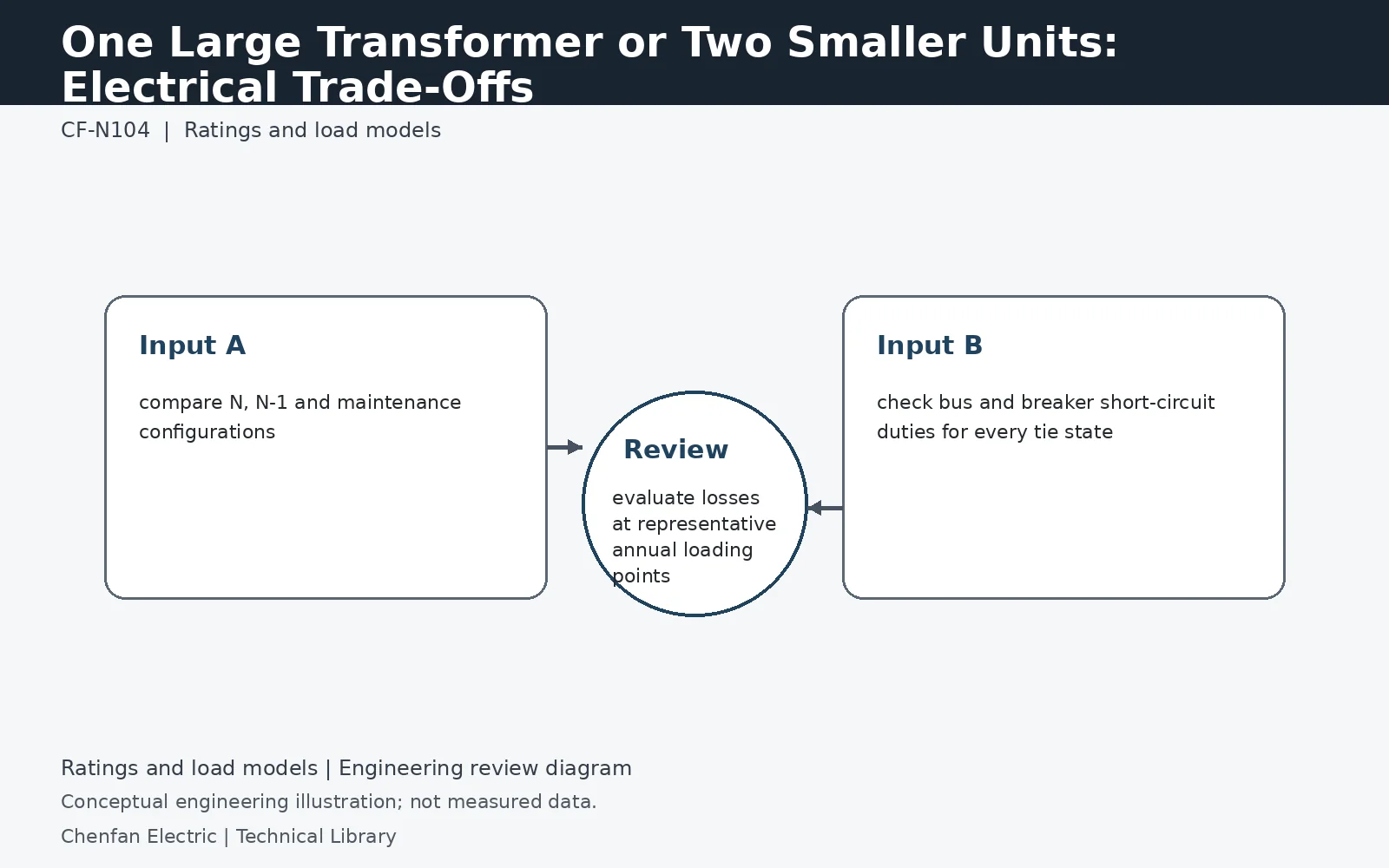
The one-large-versus-two-small decision is a system architecture question. One large unit usually concentrates fault contribution and outage consequence; two units can improve maintenance flexibility and light-load dispatch, but paralleling may raise bus fault duty and add protection and control complexity. Efficiency should be compared across the expected annual load profile and contingency states, not at one nameplate point.
Two units do not automatically provide N-1 capacity
A pair of 1 MVA transformers has 2 MVA of installed capacity, but only 1 MVA of nameplate capacity remains after one unit is lost. Serving a 1.5 MVA essential load would then require approved temporary loading, load shedding or larger units. Establish which loads must remain supplied and for how long before claiming redundancy. Also check common-mode dependencies: two transformers sharing one upstream breaker, one flood-prone room or one control supply may not provide the independence expected from the equipment count.
The bus-tie position changes the comparison
With a normally open bus tie, each transformer can feed a separate section and limit the contributions seen by a fault on that section. Closing the tie changes both fault current paths and protection coordination. A two-unit proposal should therefore include normal split-bus operation, maintenance transfer and any permitted parallel state. Compare transformer impedances and connection impedances in each case. Do not assume that a two-transformer arrangement is electrically identical to one larger transformer merely because their summed ratings match.
Evaluate losses across the operating year
A useful screening model is P_loss ≈ P0 + k²Pk for each energized unit, where P0 is no-load loss, Pk is load loss at the stated reference condition and k is loading relative to that rating. Two energized units incur two no-load-loss contributions; sharing current may reduce their combined load-loss contribution. Use guaranteed losses for the actual alternatives and weight each dispatch state by hours. Include switching restrictions and outage consequences before choosing a light-load shutdown strategy. This comparison concerns system design, not a universal claim that one arrangement is more efficient.
Technical reference framework
[1] IEC 60076-1:2011 — Power transformers, General.
[2] IEC 60076-8:1997 — Application guide.
[3] IEC 60076-7:2018 — Loading guide for mineral-oil-immersed power transformers.