

Tap-changer deadband and time delay prevent unnecessary operations when voltage fluctuates near the target. A deadband that is too narrow or a delay that is too short can cause hunting, especially when capacitor banks, distributed generation or another regulator responds at a similar timescale. Coordination should use measured or simulated voltage variability and the response times of interacting devices.
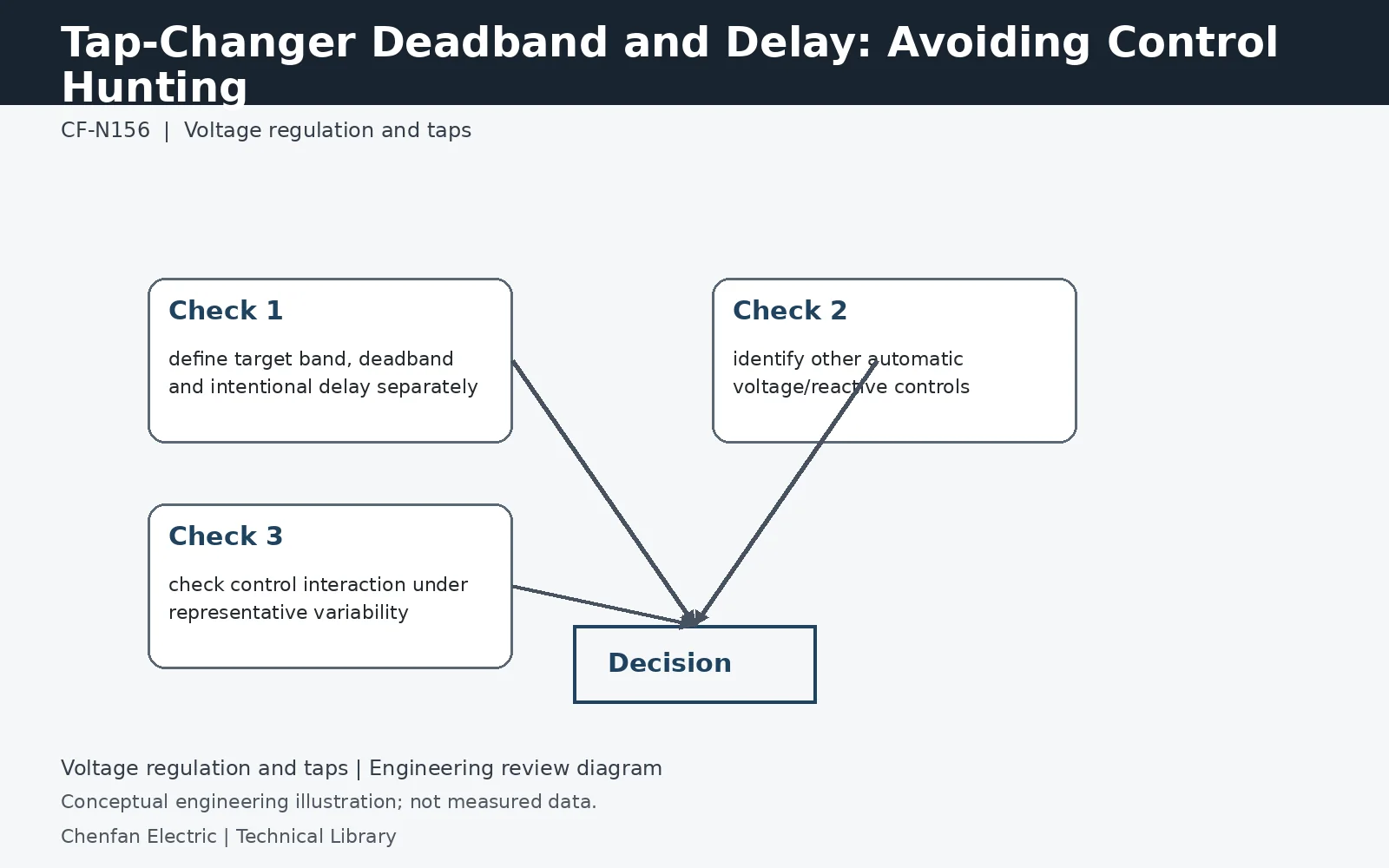
Compare the deadband with one tap’s voltage effect
A controller can overshoot its target if one tap changes the controlled voltage by more than the useful control band around the operating point. The actual effect depends on network conditions and the tapped winding, not only on the nameplate step percentage. State whether the controller's deadband entry means total width or deviation on either side of the target. Confusing those definitions can produce a factor-of-two error before any dynamic coordination is attempted.
Use time-series behavior rather than isolated voltage points
A steady-state load flow shows whether a tap can correct a voltage condition, but not how often the controller will respond to fluctuations. Use measured or simulated time series to examine excursions, persistence and repeated reversals. Retain the controller's timer-reset behavior and any distinction between initial and subsequent tap delays. A delay that filters brief disturbances can still be unsuitable for a sustained voltage problem, so operation count and voltage quality must be evaluated together.
Assign distinct roles to interacting voltage controls
Capacitor switching, inverter reactive-power control and a neighboring regulator can counteract or amplify an OLTC response. Model their targets and response times instead of assessing the tap changer in isolation. The acceptance criteria should include unacceptable oscillation, excessive operations and failure to restore the required voltage envelope. No single deadband or delay value is universally correct; the chosen values need a recorded rationale tied to the equipment and the network variability.
Technical reference framework
[1] IEC 60076-8:1997 — Application guide.
[2] IEC 60214-1:2014 — Tap-changers, Performance requirements and test methods.
[3] IEEE C57.131-2024 — Tap-changers, Performance requirements and test methods.