

Reverse power can invalidate an OLTC control assumption that was built for one-way load flow. The regulated side, line-drop compensation sign, reactive-current logic and parallel-control method may all behave differently when distributed generation exports through the transformer. The control philosophy should explicitly define forward and reverse modes and the transition between them.
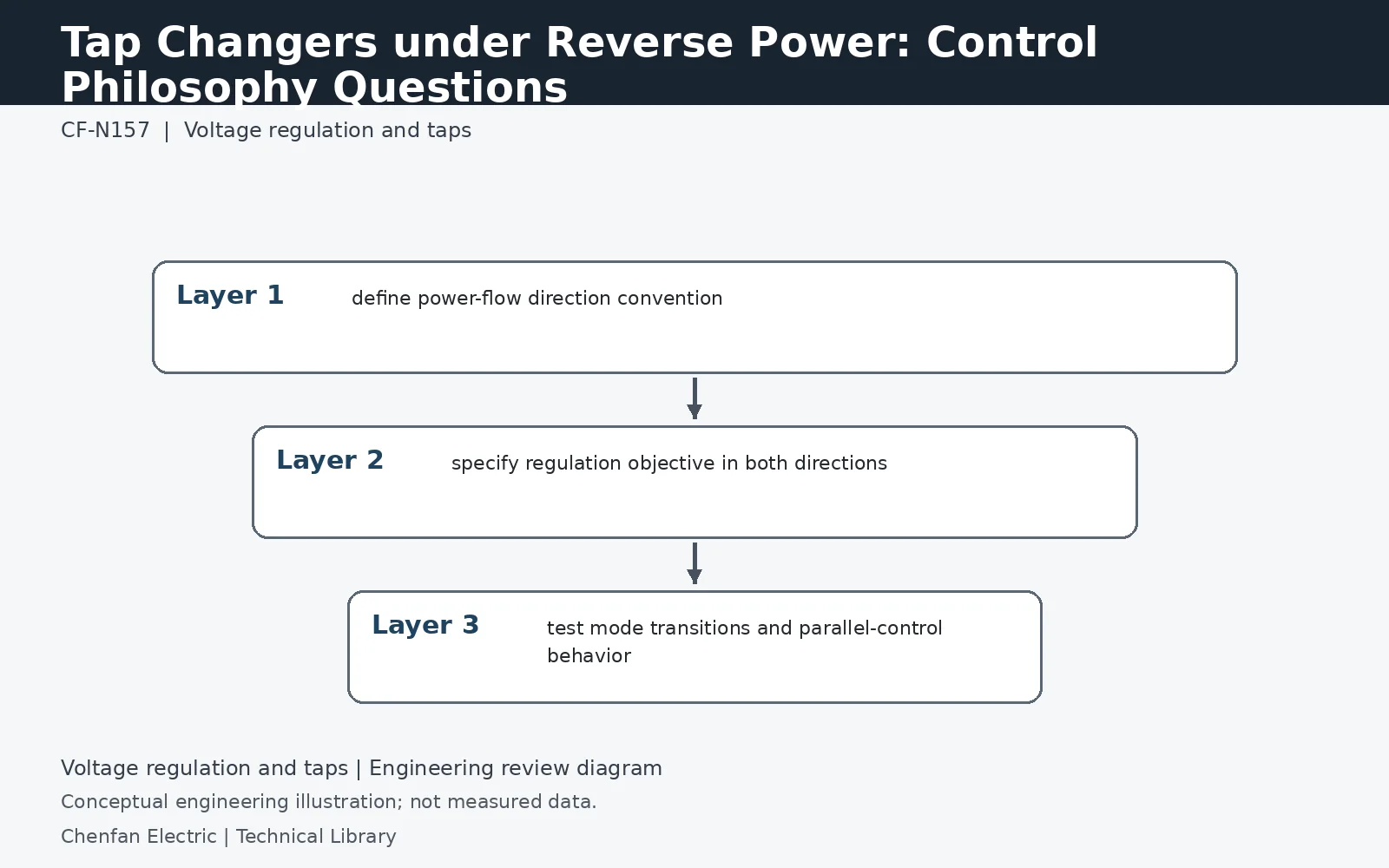
Define reverse flow at a named measurement point
Use an explicit active-power direction and CT/VT reference rather than relying on a display's plus or minus sign. A transformer can carry reverse active power while still importing or exporting reactive power independently. The controller's decision should therefore follow the approved algorithm, not a general assumption that every current component reverses together. Record the power threshold, hysteresis and persistence logic used to identify a change of mode without prescribing generic settings.
The desired regulated bus may not change with power direction
Some schemes continue to regulate the same physical bus during export; others use a different strategy because the upstream network is stiff or the local generation controls voltage. These choices must be deliberate. Blindly reversing line-drop compensation or swapping the regulated side can drive the wrong node away from its target. Confirm the permitted voltage envelope on both sides and the tap limits for high-generation, low-demand operation before enabling an automatic reverse mode.
Test the transition around zero active power
Fluctuating generation can repeatedly move net power through zero. Without suitable transition logic, the controller may alternate modes or issue conflicting tap requests while the electrical state changes only slightly. Examine time-series cases with inverter voltage or reactive-power control active. Acceptance testing should also cover unavailable direction information and recovery from that condition. Preserve the controller mode in event records so unexplained tap activity can be distinguished from an ordinary load-driven voltage response.
Technical reference framework
[1] IEC 60076-8:1997 — Application guide.
[2] IEC 60214-1:2014 — Tap-changers, Performance requirements and test methods.
[3] IEEE C57.131-2024 — Tap-changers, Performance requirements and test methods.