

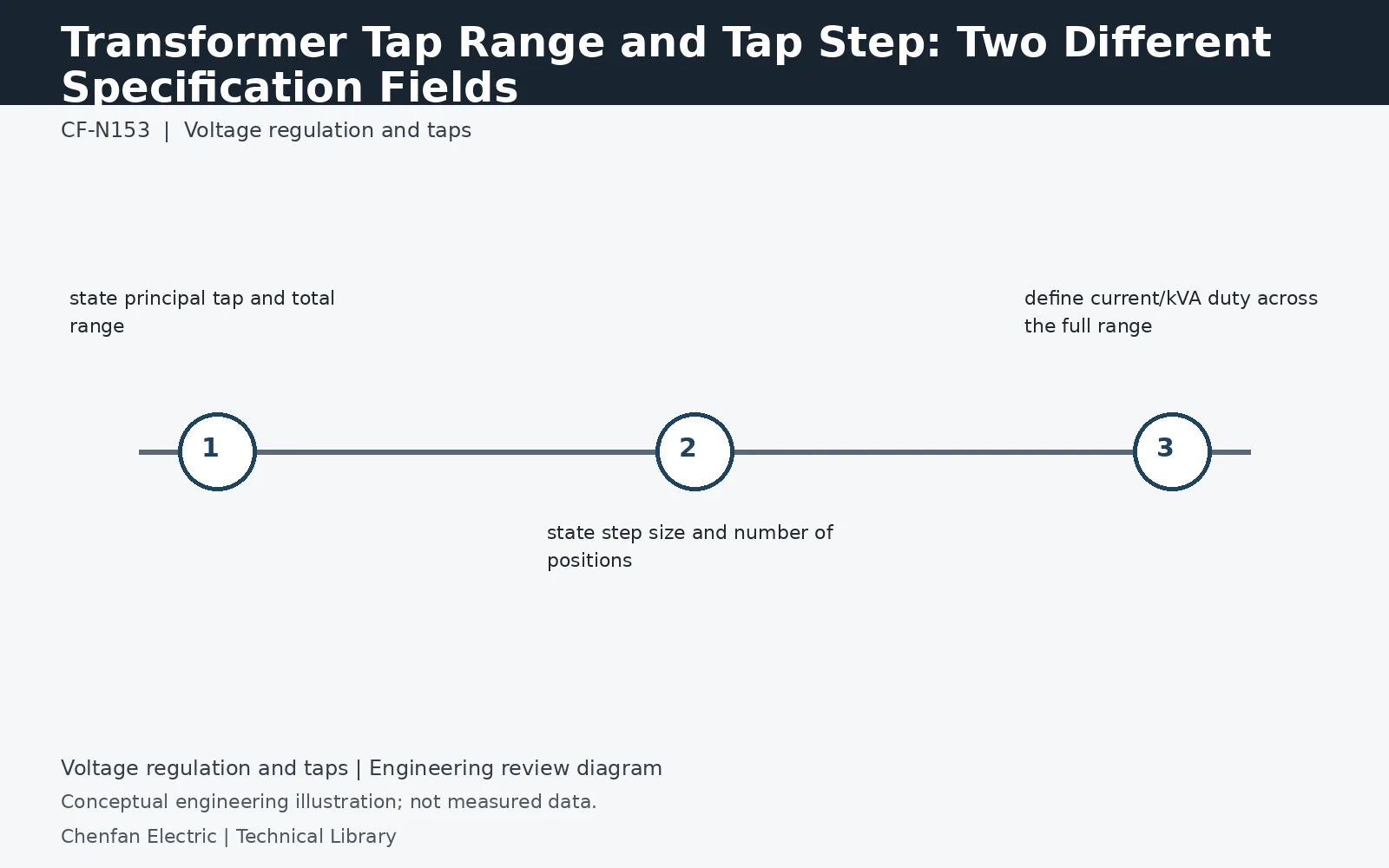
Tap range and tap step describe different parts of the ratio schedule. Range defines the total available ratio excursion around the principal tap, while step defines the increment between adjacent positions; the number of positions follows from both. Procurement should state the voltage basis, principal tap, upper/lower limits, step size and whether all positions carry the same current or kVA duty.
Count positions only after defining the interval
For an illustrative uniform schedule from −10% to +10% around the principal tap in 1.25-percentage-point increments, there are 20/1.25 = 16 intervals and 17 positions. The neutral position is included once. This calculation assumes a continuous uniform schedule; changeover arrangements, asymmetric ranges or special coarse/fine schedules need the actual manufacturer table. Writing “±10%, 16 taps” without clarifying whether taps means intervals or positions invites a preventable procurement mismatch.
A winding-voltage increase can lower the opposite-side voltage
Suppose the taps change the HV turns while the applied HV voltage and LV turns remain fixed. Increasing the effective HV turns reduces the LV no-load voltage because VLV/VHV follows NLV/NHV in the ideal ratio. Thus a “plus” HV tap label need not mean an increase in LV bus voltage. Define raise and lower in terms of the controlled bus, and retain the rated winding voltage and ratio at each physical position.
Attach a complete tap schedule to the offer
Each row should show position, ratio, applicable voltage, permitted current or MVA and any restricted operating condition. Where impedance or loss data at extreme taps are needed for the project study, request them explicitly rather than assuming the principal-tap value applies unchanged. The position count then becomes a check on the table, not the entire specification. This also provides an unambiguous reference for control scaling and later commissioning records.
Technical reference framework
[1] IEC 60076-8:1997 — Application guide.
[2] IEC 60214-1:2014 — Tap-changers, Performance requirements and test methods.
[3] IEEE C57.131-2024 — Tap-changers, Performance requirements and test methods.