

A reduced station GIC model must preserve the winding-current allocation required for equipment assessment. Retain or reconstruct each neutral-path current while reproducing the external network response. [1]
Bailey’s regional model uses explicit network simplifications and transformer connections. When a reduced result becomes an equipment input, the reduction must retain or recover the distinctions that govern each transformer’s exposure.
Decide which variables must survive
Identify external terminals, station grounding nodes, relevant transformer winding sections and the currents needed by the thermal assessment. Keep distinct nodes where their potentials or connections can differ. Do not merge terminals merely because they appear at the same station on a regional map. [2]
Shared grounding impedance can couple branch currents. Treat that shared element separately from individual winding and neutral-path resistance. Otherwise, independently applying a grounding resistance to every branch can create a different network.
Separate total-current equivalence from allocation
Assume two purely resistive paths share a prescribed 1 V difference. With R1 = 0.2 Ω and R2 = 0.5 Ω, their currents are 5 A and 2 A. Their parallel equivalent is approximately 0.1429 Ω and carries 7 A under the same boundary voltage.
The equivalent preserves the total in this example. Assigning half its current to each transformer would give 3.5 A, an error of −30% for the first path and +75% for the second. The reduction did not cause those errors; discarding the branch-recovery relationship did.
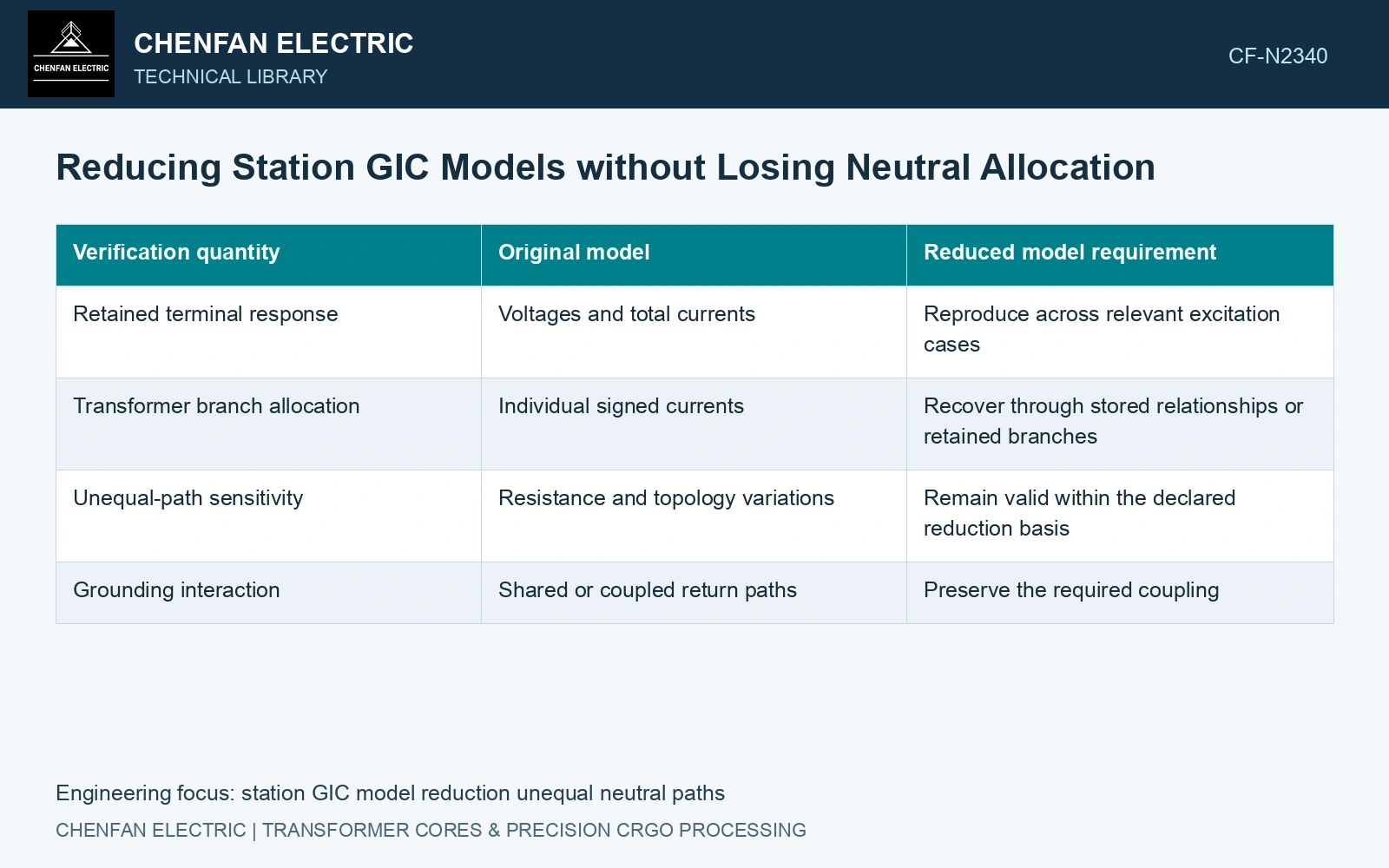
| Verification quantity | Original model | Reduced model requirement |
|---|---|---|
| Retained terminal response | Voltages and total currents | Reproduce across relevant excitation cases |
| Transformer branch allocation | Individual signed currents | Recover through stored relationships or retained branches |
| Unequal-path sensitivity | Resistance and topology variations | Remain valid within the declared reduction basis |
| Grounding interaction | Shared or coupled return paths | Preserve the required coupling |
Verify the reduction where it will be used
A multi-terminal resistive reduction can preserve a boundary relationship while eliminating internal nodes. Store the reconstruction needed to recover internal potentials and currents. If the reduced element is only a scalar total-current equivalent, it may be insufficient when several retained terminals experience different driving voltages.
Compare the full and reduced models for relevant field orientations, grounding states and equipment availability. An exact reduction for one fixed topology does not remain exact after an eliminated branch changes without updating its representation.
Report absolute errors as well as relative errors; percentage error becomes unstable near a zero-current crossing. Identify the worst equipment-current discrepancy, not only the station-total discrepancy.
Verify winding-current recovery for the required operating cases. Keep the full local station detail wherever the reduced model loses the allocation needed to assess individual transformer exposure.
References
- R. L. Bailey and coauthors, Modelling geomagnetically induced currents in midlatitude Central Europe using a thin-sheet approach, Annales Geophysicae 35, 2017. DOI: 10.5194/angeo-35-751-2017.
- NERC, Transformer Thermal Impact Assessment White Paper, Project 2013-03 Geomagnetic Disturbance Mitigation, October 2017.