

Thermal storage creates a physical delay between GIC and transformer temperature. Clock offsets, filtering and sensor response add measurement delays. Separate those effects before comparing the onset, evolution and cooling in the two records. [1]
The NERC framework retains current duration and initial thermal state. Bailey’s measurement discussion includes filtering. Together they show why event interpretation needs the complete time and processing basis of each channel.
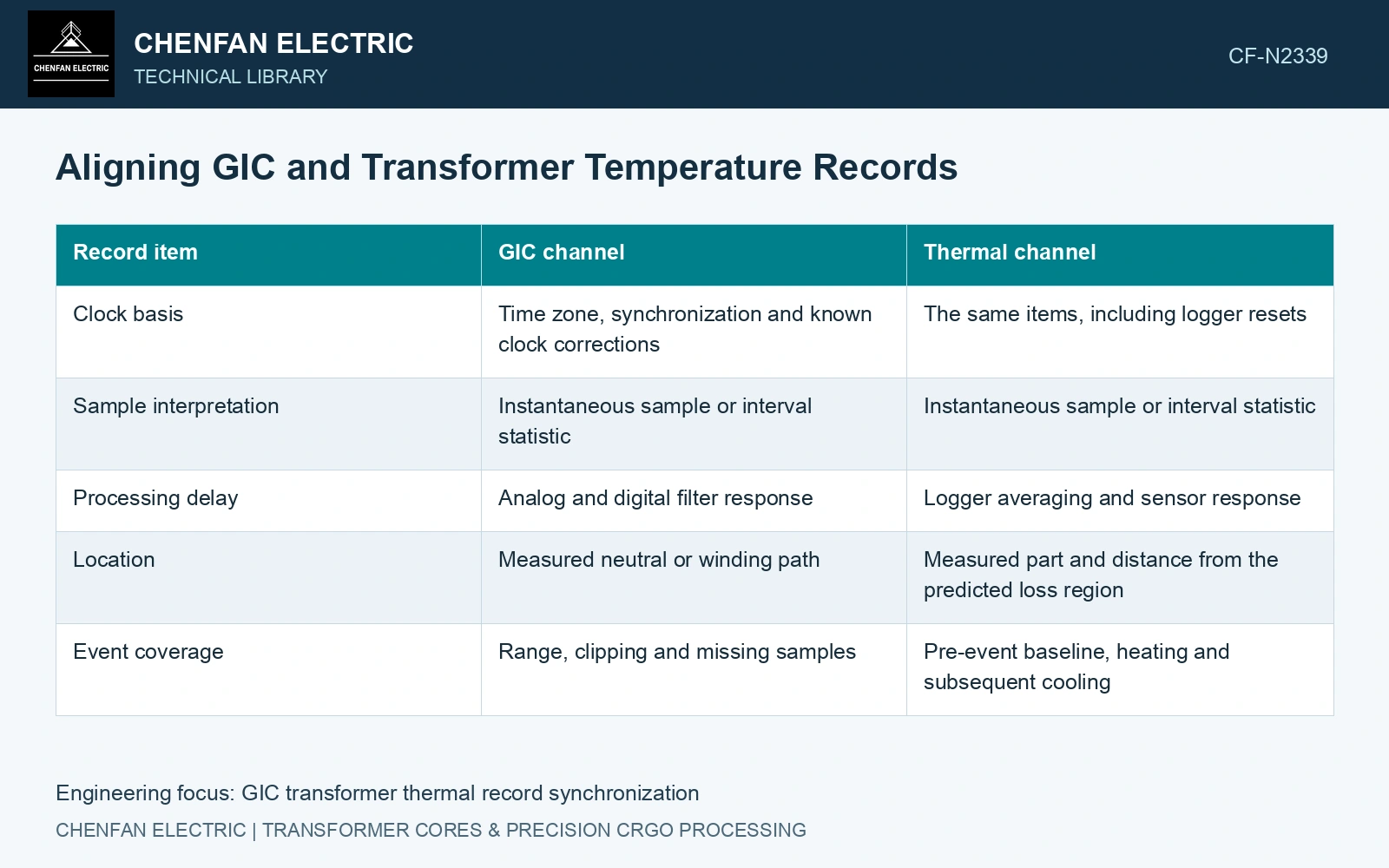
Create a time-alignment record
| Record item | GIC channel | Thermal channel |
|---|---|---|
| Clock basis | Time zone, synchronization and known clock corrections | The same items, including logger resets |
| Sample interpretation | Instantaneous sample or interval statistic | Instantaneous sample or interval statistic |
| Processing delay | Analog and digital filter response | Logger averaging and sensor response |
| Location | Measured neutral or winding path | Measured part and distance from the predicted loss region |
| Event coverage | Range, clipping and missing samples | Pre-event baseline, heating and subsequent cooling |
Identify whether a timestamp denotes the start, center or end of an averaging interval. Two channels with correct clocks can still be misaligned if their interval conventions differ. Retain clock uncertainty rather than shifting one trace until it looks visually convincing.
Resample without creating information
Place the records on a common comparison grid appropriate to their actual resolution. Interpolating a slowly sampled temperature channel does not supply missing fast thermal observations. Downsampling current should preserve the event features relevant to the intended calculation.
If raw current is clipped, an interpolated peak cannot recover the original amplitude. Flag the interval and propagate that limitation into any magnetic or loss estimate.
Compare the input history with a thermal hypothesis
Record initial load, oil temperature, cooling changes and ambient conditions alongside the event. A rising temperature during GIC may also reflect a load increase. These inputs should remain in the model or the competing explanations.
Peak current, duration and an integral of absolute current can describe an event. They are not automatically thermal energy. A validated or otherwise justified relationship between winding DC input and local additional loss is required before integrating the resulting power as heat.
Use that loss history to drive the relevant thermal response and compare the predicted temperature at the sensor location. A remote sensor may warm later than the hottest structural part. Do not force its trace to represent the unmeasured hot spot by adding an arbitrary time shift.
Quantify a timestamp convention before fitting thermal lag
Assume a temperature logger forms a 60 s average and stamps its end, while current samples are instantaneous. The value stamped 12:01:00 covers 12:00:00–12:01:00 and has a 12:00:30 interval centre. Its time centroid is 30 s earlier than the stamp, but a nonlinear temperature average need not equal the instantaneous centre value. Apply the same averaging operator to the predicted temperature before comparison [2]; do not replace physical thermal history [1] with an arbitrary 30 s shift.
Account for known instrument delays and compare the full onset, evolution and cooling history. Investigate discrepancies through clock conventions, competing thermal inputs and the local-loss model, with the remaining timing uncertainty recorded.
References
- NERC, Transformer Thermal Impact Assessment White Paper, Project 2013-03 Geomagnetic Disturbance Mitigation, October 2017.
- R. L. Bailey and coauthors, Modelling geomagnetically induced currents in midlatitude Central Europe using a thin-sheet approach, Annales Geophysicae 35, 2017. DOI: 10.5194/angeo-35-751-2017.