

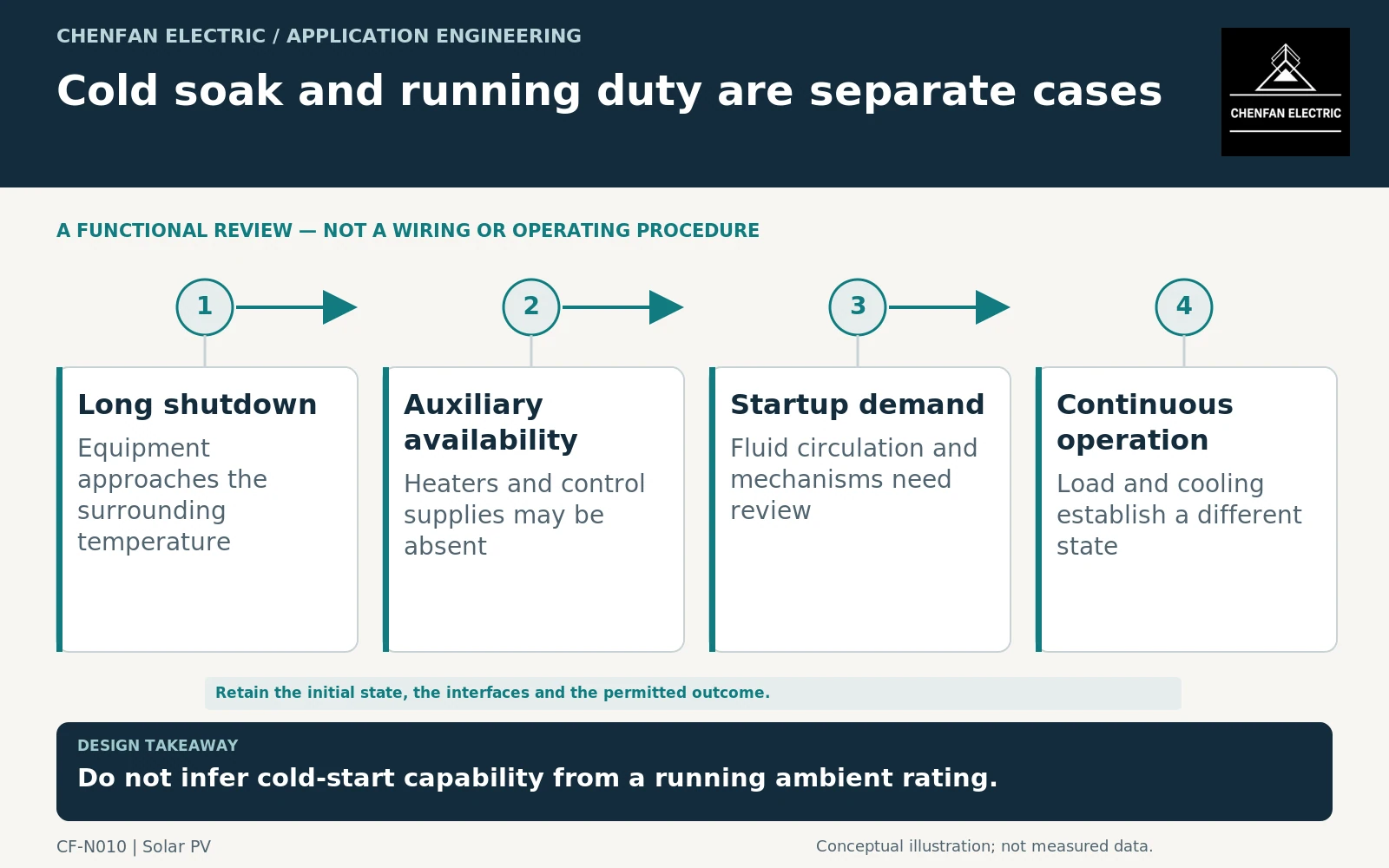
A low ambient-temperature entry is not a complete cold-climate photovoltaic (PV) transformer specification. The enquiry must distinguish continuous operation from startup after a prolonged cold soak. Insulating liquid, cooling equipment, tap-changing mechanisms, control devices and seals may have different limits. A transformer that operates acceptably once warm is not automatically suitable for every cold-start sequence.
Define the condition before energization
State the minimum site temperature, expected shutdown duration and whether auxiliary power remains available while the main transformer is disconnected. Identify whether heaters are supplied from an independent source or depend on equipment that has not yet started.
A cold-soaked assembly may begin with its liquid, metalwork and control compartments near the surrounding temperature. The operating case should therefore include the initial state, not only the forecast air temperature after sunrise. Avoid assuming that solar generation will immediately provide the auxiliary supply needed to prepare the equipment for operation.
General transformer requirements and application guidance provide a framework for agreeing service conditions. Unusual site conditions need to be identified in the enquiry rather than silently included in a standard ambient assumption. [1] [2]
Separate insulation behavior from accessory operation
The main insulation system and each accessory require their own suitability review. For a liquid-immersed unit, fluid properties influence circulation and mechanical behavior, but an acceptable liquid datasheet does not qualify the complete transformer or its cooling circuit.
The cited cooling-pump and fan standards concern defined accessories of liquid-immersed power transformers and reactors, not every cooling arrangement. Their existence reinforces the need to specify accessory duties, rather than treating the main transformer rating as evidence for every attached component. [3] [4]
| Item | Information to confirm |
|---|---|
| Insulating liquid | Applicable temperature-dependent properties and agreed use |
| Pumps and fans | Starting and running limits in the installed arrangement |
| Tap-changing equipment | Permitted operation at the specified temperature |
| Controls and heaters | Supply availability, temperature limits and alarm behavior |
| Seals and connections | Compatibility with the stated environmental cycle |
Do not turn this list into a universal warm-up instruction. Any startup restrictions or preparation sequence must come from the equipment supplier and the approved site operating procedure.
Examine the first production period
PV output can change rapidly as light becomes available, while equipment temperatures respond on different timescales. Provide the expected startup loading sequence and any plant-control restriction that limits initial current. Identify whether nighttime reactive-power operation changes the starting thermal condition.
A loading assessment should use the appropriate transformer type and the actual initial conditions. Mineral-oil loading guidance addresses thermal effects of loading and ambient conditions, but it does not replace the manufacturer’s low-temperature limits for mechanisms or auxiliaries. [5]
Also review loss of auxiliary power during a cold spell. A design depending on continuous cabinet heating should disclose that dependency and the required response to an interruption. An alarm is useful only when the operator knows which operating capability has become uncertain.
Write acceptance evidence that matches the claim
Ask the supplier to provide a component temperature-limit schedule, the assumptions for cold-soak starting, and the permitted operating envelope after startup. Any claimed low-temperature test should identify the tested configuration, temperature, duration and functions demonstrated. A catalogue statement for one component is not a complete assembly test.
Keep transport and storage conditions separate from energized service. Packaging protection, condensation control during installation and initial commissioning may create additional requirements, but they should not be confused with the continuous electrical rating.
The final specification should answer a practical question: after the defined winter shutdown, which functions are available, which conditions must be confirmed, and what operating limits remain? That is a usable cold-climate requirement; a solitary negative temperature is not.
Core procurement checkpoint: Specify cold-weather handling as well as electrical duty
For a core-only order, translate the cold-site conditions into agreed storage, preservation and assembly instructions rather than assuming the steel designation covers the entire installation. Confirm who controls condensation during unpacking and transfer into the winding assembly area. Any clamps, insulation pieces or other supplied components need their own agreed specification; low ambient temperature is not a complete core acceptance criterion.
For the core enquiry: Storage and assembly conditions; supplied component list; packing and preservation requirements; approved drawing and inspection plan.