

A useful photovoltaic (PV) transformer enquiry needs more than an inverter’s total harmonic distortion figure. It needs current spectra, operating conditions and a clear measurement boundary. Harmonic heating depends on the current components imposed on the transformer, while network distortion also depends on impedance and the interaction of equipment. A brochure compliance statement cannot resolve both questions on its own.
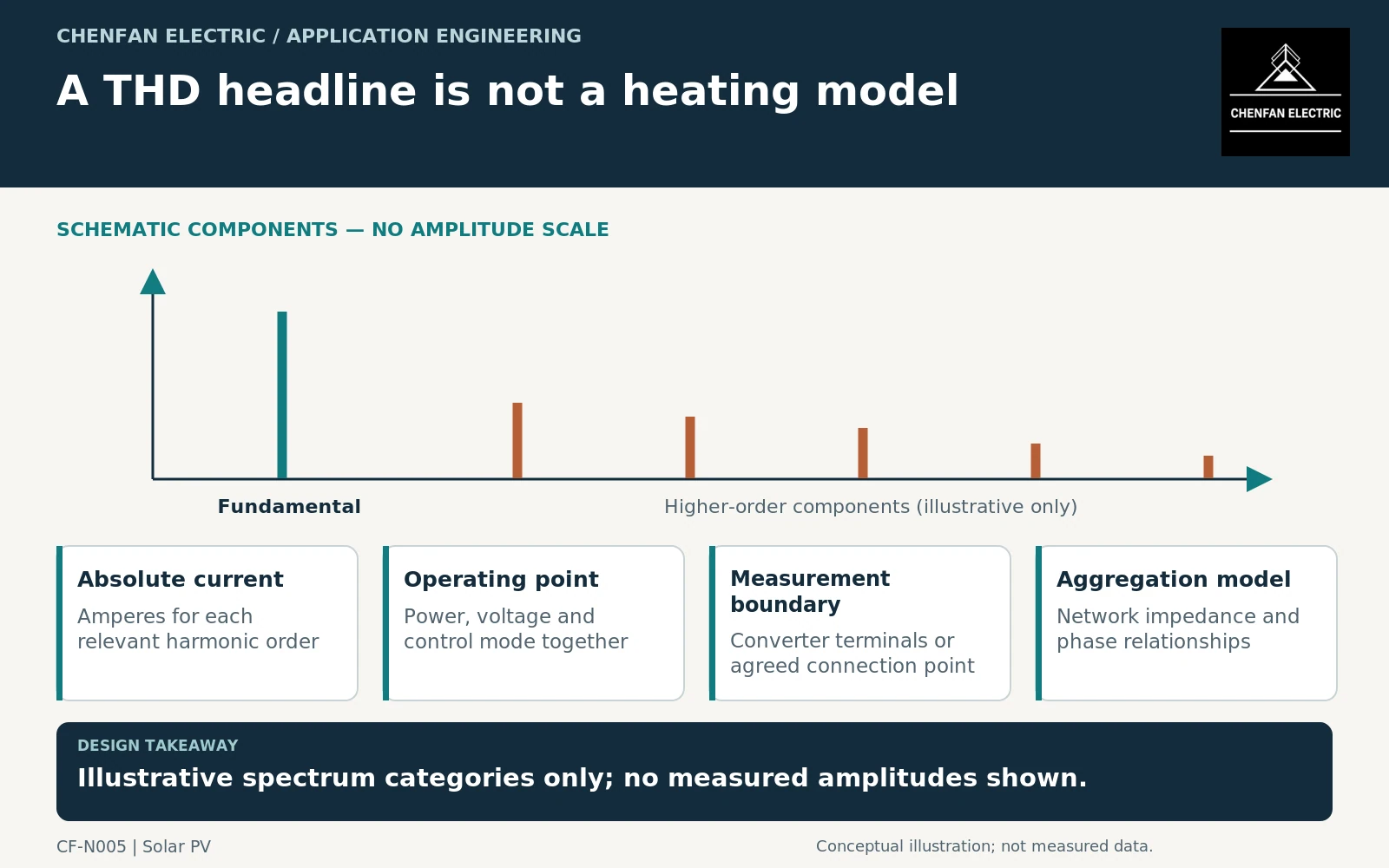
Ask what the reported percentage represents
Total harmonic distortion of current normally compares the harmonic root-sum-square current with the fundamental current. The same percentage can therefore represent very different absolute harmonic amperes at different load levels. A high percentage during light load is not automatically the greatest heating condition, and a low percentage at full output is not a complete duty description.
Obtain the manufacturer’s definition, frequency range, instrument or calculation method and operating conditions. Distinguish current distortion from voltage distortion. A limit assessed at the plant connection point is not necessarily a guaranteed waveform at every inverter terminal.
ABB’s technical material treats harmonics as a consequence of nonlinear loads and emphasizes their system effects. For transformer loading under nonsinusoidal current, IEEE C57.110 provides a relevant framework within its defined transformer scope; it is not a universal substitute for converter-transformer specifications. [1] [2]
Specify the operating points that the plant will use
Request representative spectra at high and partial active power, relevant reactive-power conditions and any nighttime operating mode. Include the alternating current (AC) voltage, switching or control configuration and filter arrangement associated with each dataset. A spectrum measured with one optional filter does not automatically apply to an unfiltered alternative.
| Data item | Why the transformer team needs it |
|---|---|
| Harmonic current by order, in amperes | Establishes the actual imposed current components |
| Fundamental current and terminal voltage | Defines the operating point and denominator |
| Duration or operating share | Separates sustained duty from brief events |
| Filter and converter configuration | Preserves the validity of the supplied evidence |
Ask the converter supplier to identify whether data are measured, simulated or guaranteed. Do not relabel a representative simulation as a factory test, and do not attach a guarantee to a spectrum that the manufacturer only describes as typical.
Keep transformer heating and plant compliance separate
For a common transformer serving several inverters, the study must address aggregation. Harmonic currents have phase relationships, and the network can modify their distribution. Multiplying one inverter’s harmonic amplitudes by the inverter count is an assumption, not an automatically correct result. Assuming perfect cancellation is equally unjustified.
The transformer designer needs an agreed current duty at each winding. The power-quality study needs suitable network impedances, background distortion and operating scenarios. These are related deliverables, but one cannot be inferred solely from the other.
Where a transformer is part of a specialized semiconductor-converter arrangement, IEC 61378 application guidance may be relevant. IEEE C57.110’s stated exclusions, including rectifier transformers, must be respected rather than citing it indiscriminately. [3] [2]
Make missing information visible before quotation
Use a harmonics data sheet with fields for source document, revision, converter operating point, measurement boundary, frequency coverage and evidence status. Mark unsupported operating modes explicitly. The transformer offer should state which spectrum was used and whether subsequent converter changes require review.
If detailed spectra are not yet available, request a conditional assessment rather than inventing a universal derating percentage. Identify what can be priced now and what remains dependent on the final converter data.
The enquiry is technically useful when the converter supplier, network analyst and transformer designer can trace the same current evidence through their respective assessments. A solitary total harmonic distortion (THD) percentage, without that chain of context, is insufficient.
Core procurement checkpoint: Separate current harmonics from core excitation conditions
The harmonic-current spectrum supports the complete transformer’s loss and heating assessment, but it should not be substituted for the voltage waveform used in the magnetic design. For a core enquiry, identify the designer’s excitation conditions and any agreed non-sinusoidal assessment separately. A steel grade designation or a single current-THD figure cannot by itself guarantee the converter transformer’s harmonic performance.
For the core enquiry: Voltage waveform assumptions; specified frequency and flux density; steel grade and thickness; defined core-test method and exclusions.