

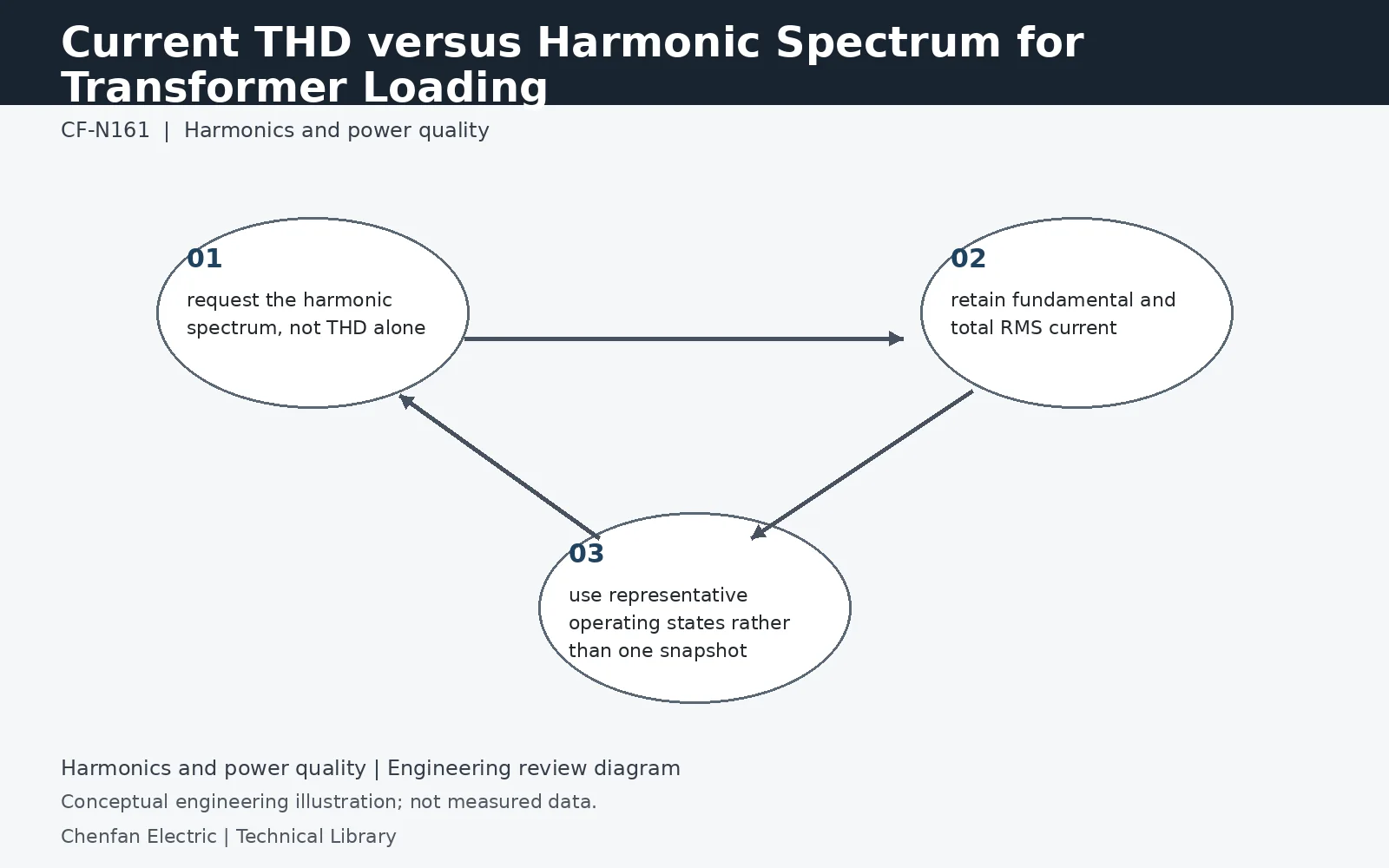
Current THD compresses a harmonic spectrum into one ratio and therefore cannot replace the individual harmonic components needed for transformer heating calculations. Two loads can have the same THD but very different high-order content, eddy-current loss and neutral impact. Request fundamental current, RMS current and the magnitude/phase or at least magnitude of relevant harmonic orders over representative operating states.
THD needs its denominator and absolute current
Current THD is commonly expressed as √(Σ Ih²)/I1, where I1 is fundamental current and the sum includes the specified harmonic orders above the fundamental. A 30% THD at 100 A fundamental represents 30 A of combined harmonic RMS current; at 10 A fundamental it represents only 3 A. The percentage is identical, but the transformer heating exposure is not. Record the upper harmonic order and distinguish THD from indices that use a fixed demand-current denominator.
Identical THD can conceal a different loss weighting
Consider two illustrative spectra with I1 = 100 A and one 30 A harmonic: the fifth in one case and the eleventh in the other. Both have 30% THD and total RMS current of approximately 104.4 A. In an idealized h²-weighted winding-eddy-loss comparison, the harmonic terms are proportional to 25 × 30² and 121 × 30². That does not make total transformer loss 4.84 times larger, but it demonstrates why the frequency distribution matters beyond RMS current.
Request spectra at the operating states that set the rating
Retain per-phase fundamental current, each relevant harmonic magnitude and the associated load state. Harmonic phase angles become important when combining multiple sources or predicting cancellation; magnitudes alone cannot establish the net current at a common bus. Include light-load, maximum-load and converter-mode changes where relevant. The transformer manufacturer then has a defined electrical duty to evaluate, rather than a THD claim measured at one favorable operating point.
Technical reference framework
[1] IEEE C57.110-2018 — Transformer capability with nonsinusoidal load currents.
[2] IEC 60076-1:2011 — Power transformers, General.