

A transformer serving floating solar does not necessarily sit on a floating platform. Its actual installation location determines the mechanical, environmental and maintenance requirements. A shore-side transformer may face flooding and humid air without continuous platform motion; a floating installation adds structural movement and changing connection geometry. Neither case should be specified simply as “marine grade” without a defined exposure and duty.
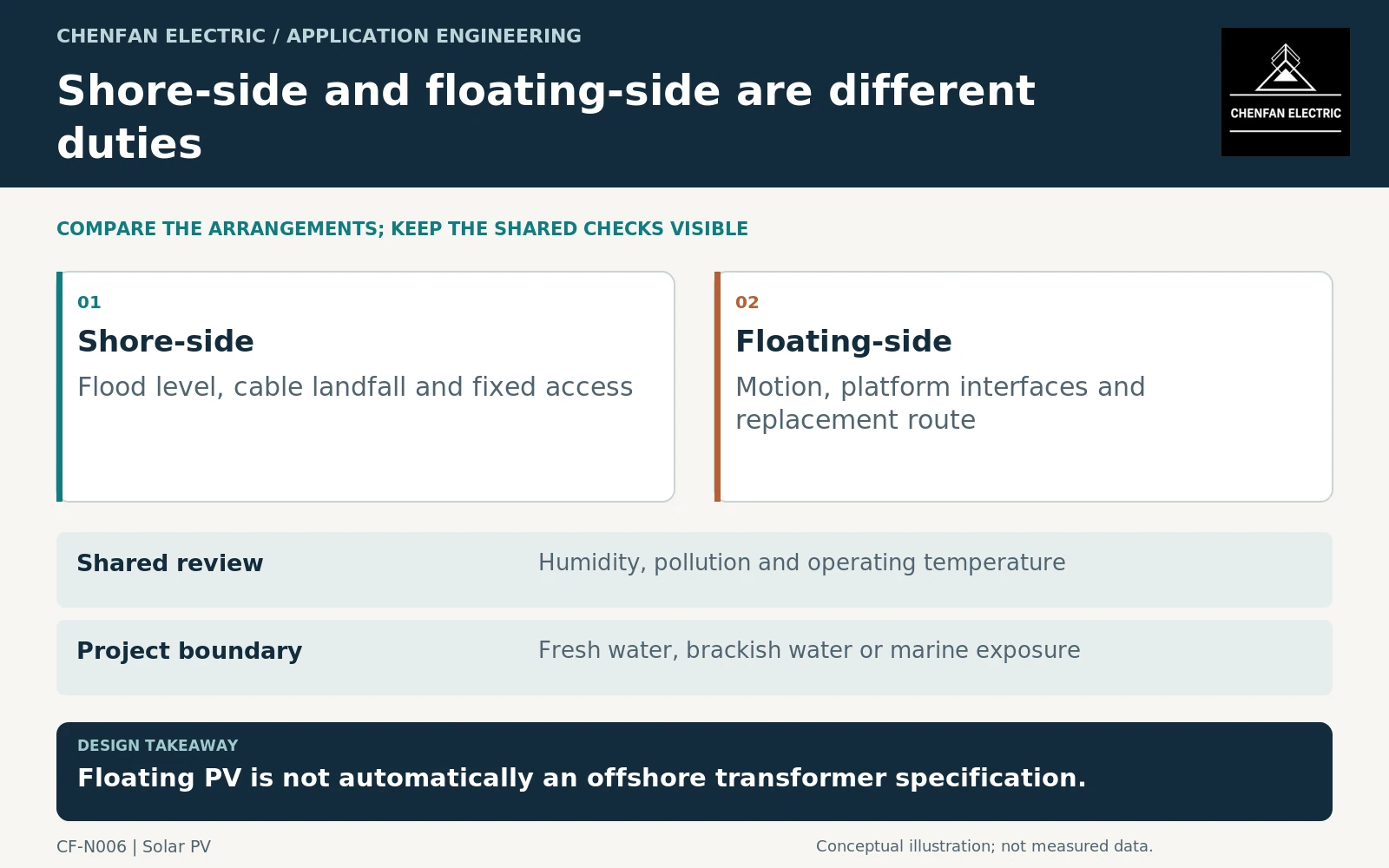
Locate the equipment before selecting environmental labels
Mark the inverter, transformer, switchgear, cable landfall and maintenance access on the project arrangement. State whether the transformer is fixed on land, on a pile-supported structure or on a moving platform. Include the water body’s characteristics and the expected operating water levels.
Freshwater reservoirs, brackish sites and exposed marine locations are not interchangeable environments. Salt deposition, wetting, waves, wind and access conditions differ. The site description should give usable design inputs instead of relying on the country’s climate label.
DNV’s floating-photovoltaic (PV) recommended practice addresses the broader floating installation, with a focus on sheltered inland waters and defined nearshore conditions. Offshore or harsher environments are outside its prescriptive scope. It is a useful system-level reference, not proof that an individual transformer, enclosure or platform has been qualified for this project. [1]
Treat floating-side motion as an interface problem
For equipment on a moving structure, obtain the platform designer’s operating and exceptional motion conditions, support reactions and connection-displacement envelope. Identify whether cables, cooling services or monitoring connections cross between structures that can move differently.
These inputs support equipment and structural assessment; they are not a reason to copy a generic transport-vibration test into the operating specification. Transit shocks and repeated in-service motion can impose different loads and require different evidence.
The equipment layout should also show where inspection and replacement occur. A transformer that fits the platform during initial assembly may not be removable after surrounding equipment is installed. Define removal masses and access envelopes without prescribing an unverified lifting procedure.
Separate water exposure from ingress and corrosion
An enclosure ingress classification does not establish resistance to every flooding event, salt atmosphere or condensation cycle. IEC 60529 addresses enclosure protection classifications; its designation must not be treated as a complete environmental qualification. [2]
Likewise, a coating description alone does not resolve external insulation pollution, cable-gland suitability or internal moisture management. Corrosivity classification can help define exposure for protective paint systems, but the full assembly includes materials and interfaces outside that coating scope. [3]
| Interface | Shore-side question | Floating-side addition |
|---|---|---|
| Water exposure | What levels and drainage conditions apply? | What spray and platform wetting occur? |
| Supports | What foundation conditions apply? | What movement and cyclic loads apply? |
| Connections | Where is the cable landfall? | What relative movement must be accommodated? |
| Maintenance | Is road access retained? | How is safe service access maintained? |
Assign ownership of the combined design
Create an interface register linking the transformer supplier, platform designer, electrical designer and operator. Each interface needs a responsible party, an input document and an acceptance deliverable. “By others” is not sufficient when both sides assume the other party has checked cable movement or cooling availability.
Keep claims proportionate to evidence. A standard terrestrial transformer adapted with a different coating has not thereby become a proven floating installation. Conversely, a shore-side unit should not inherit every offshore requirement when the exposure assessment does not justify it.
The completed specification should explain where the transformer operates, what the surrounding structure and environment impose, and how it will be accessed throughout service. That location-specific record is more useful than a broad floating-solar product label.
Core procurement checkpoint: Define what travels with the floating installation
A drawing-based core order should state whether clamps, supports and preservation measures are included or supplied by the transformer manufacturer. Motion, corrosion and platform qualification belong to the relevant assembly and installation, not to the electrical-steel grade alone. Keep the core’s handling configuration and packing requirements distinct from any claim that the finished floating transformer has been qualified offshore.
For the core enquiry: Core and clamp interface drawing; shipping assembly state; lifting responsibility; storage duration and agreed preservation requirements.