

Witness coupons for a new pressboard route should reproduce the finished set’s cutting mechanisms. Include holes, ligaments and formed corners to expose qualification gaps before the process enters production. [1]
Calculation basis. Project-specific values and gates in the illustrative screens below are assumptions; cited catalogue values retain their source test conditions.
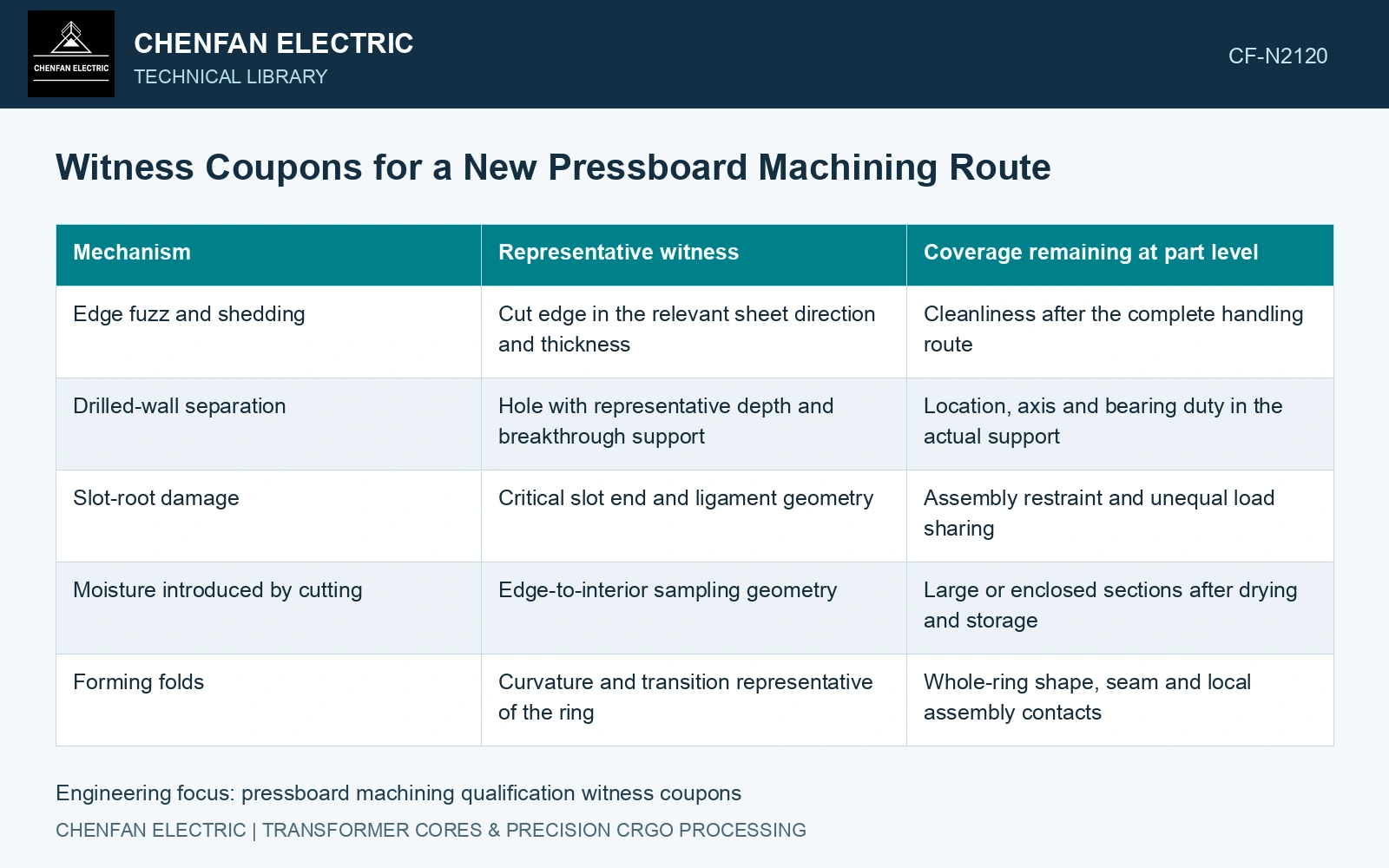
List the features that the changed route can affect. Connect each one to a representative witness and to the finished-part check that the witness cannot replace.
| Mechanism | Representative witness | Coverage remaining at part level |
|---|---|---|
| Edge fuzz and shedding | Cut edge in the relevant sheet direction and thickness | Cleanliness after the complete handling route |
| Drilled-wall separation | Hole with representative depth and breakthrough support | Location, axis and bearing duty in the actual support |
| Slot-root damage | Critical slot end and ligament geometry | Assembly restraint and unequal load sharing |
| Moisture introduced by machining | Edge-to-interior sampling geometry | Large or enclosed sections after drying and storage |
| Forming folds | Curvature and transition representative of the ring | Whole-ring shape, seam and local assembly contacts |
Match the route as well as the shape
Use the same identified material batch where practical, with recorded sheet direction and initial condition. The coupon should pass through the operations that matter to the result: cutting, cleanup, forming where applicable, drying, impregnation and handling.
A witness kept dry beside a machine does not represent a production part sent through a water-exposing operation. Likewise, a coupon removed before final cleanup cannot describe the delivered residue state. Mark the point in the route at which each witness is taken.
Place qualification observations across the proposed operating range. Include relevant tool condition and geometry severity rather than choosing only the easiest feature cut with a fresh tool. Set the sample plan from expected variation and the consequences of missing a defect.
Choose an observation that reaches the mechanism
External dimensions may be adequate for one comparison while another needs a section, a shedding witness or a mechanical test. A photograph of a hole mouth does not reveal its internal wall. A moisture average can conceal a wet edge. A load test without its failure location can conceal the wrong stress path.
Include a qualified reference route and preparation controls. Sectioning, storage and the inspection method can introduce changes of their own. Preserve the distinction between a route defect and an examination artifact.
Pressboard experiments illustrate why material state and loading history must accompany witness results. They also demonstrate the limits of transfer: a specific stacked compression test is not automatically evidence for a shaped support or a bonded block.
At the end of qualification, state the material, feature and route combinations actually covered. Retain finished-part checks for scale, restrained geometry, long ducts and the final mating interfaces. The purpose of the coupon matrix is to expose those coverage gaps early, so the new route enters production with representative evidence for each affected feature.
Make the witness matrix cover the process range
Pressboard compression evidence retains its material, conditioning and loading boundary [2]; the witness matrix below is a proposed process-coverage model.
Assume qualification needs two sheet directions, three tool-wear states and two critical feature geometries. The full combination matrix has 2 × 3 × 2 = 12 cells. Six tested cells cover only 50% by cell count, with no inference about the untested combinations. Add the missing severe cases and retain finished-part checks for scale and restraint.
References
- IEC, IEC 60641-2:2004, Pressboard and presspaper for electrical purposes — Part 2: Methods of tests.
- C. Oria, I. Carrascal, D. Ferreño, C. Méndez and A. Ortiz, Experimental dataset on the compressive mechanical properties of high-density pressboard used in power transformers spacers, Data in Brief 50, 109471, 2023. DOI: 10.1016/j.dib.2023.109471.