

A multi-element NGR measures below its expected resistance. A shorted element section is one explanation, but not the only one. Temperature, a different selected tap, a measurement path or contamination can change the reading. Investigation should preserve these alternatives until the circuit evidence separates them. [1]
Begin with the expected value at its reference temperature and terminal boundary. The original factory number may describe the complete assembly or a particular element bank. Compare like quantities before locating a defect.
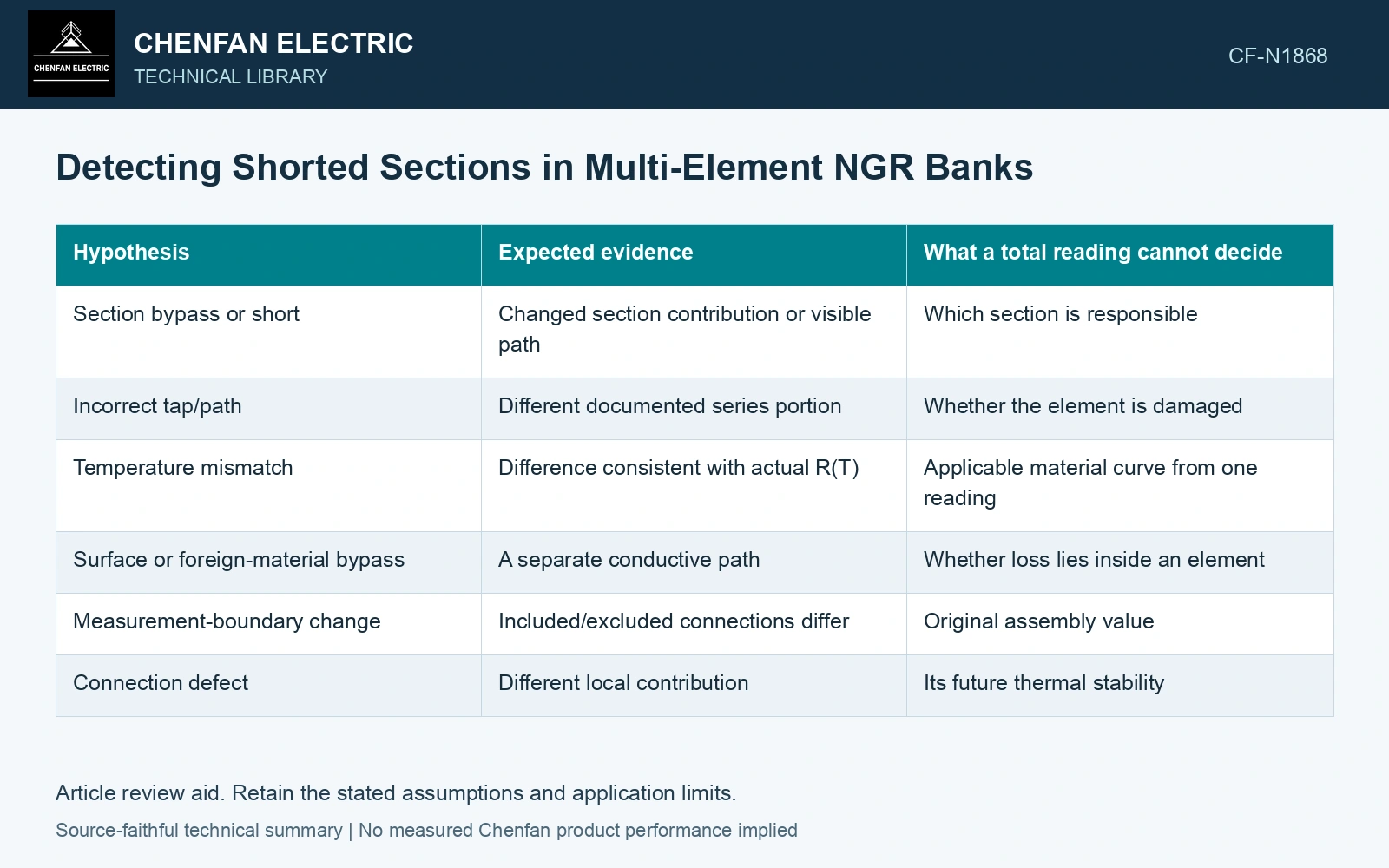
Build the resistance budget
For a purely series bank, total resistance is the sum of identified section resistances and relevant connection contributions. A bypassed section reduces that total according to the actual bypass path. If another branch lies in parallel with the bank, the simple series sum no longer describes the measured network.
| Hypothesis | Expected evidence | What a total reading cannot decide |
|---|---|---|
| Section bypass or short | Changed section contribution or visible path | Which section is responsible |
| Incorrect tap/path | Different documented series portion | Whether the element is damaged |
| Temperature mismatch | Difference consistent with actual R(T) | Applicable material curve from one reading |
| Surface or foreign-material bypass | A separate conductive path | Whether loss lies inside an element |
| Measurement-boundary change | Included/excluded connections differ | Original assembly value |
| Connection defect | Different local contribution | Its future thermal stability |
Use proportions carefully
In an illustrative bank of four equal series sections, fully bypassing one section removes one quarter of the element resistance. This assumes equal sections, negligible connections and no other parallel path. A measured quarter reduction does not prove that event occurred; several networks can produce the same total.
Partial contact or contamination can create a nonlinear or condition-dependent path. A low-voltage DC measurement may not represent that path under power-frequency fault stress. The qualified assessment needs to identify what the measurement can establish.
Preserve section identity
Where section measurements are justified, give every section its endpoints and reference condition. Record which intentional connections remain in the measuring circuit. Without that boundary, a credible local value can be added into an incorrect total.
Distinguish series-section resistance from a parallel measuring path. For linear resistances the full-network value follows the series and parallel circuit, so compare identified isolated boundaries before inferring a damaged section. [2]
Locate a short hidden by the total
Assumptions: ten intact series sections are each 10 Ω at a uniform 20 °C. A terminal reading of 90 Ω has at least two explanations: a fully bypassed section gives 9 × 10 = 90 Ω, while an intact 100 Ω bank in parallel with 900 Ω also gives 100 × 900/(100 + 900) = 90 Ω. In an assumed qualified isolated-circuit investigation, the bank reads 100 Ω after the parallel sensing path is excluded and every identified section remains 10 Ω. That evidence points to the parallel path, not a shorted element. If the isolated bank remains 90 Ω and an identified section reads approximately zero, the section-bypass hypothesis gains support. Preserve temperature, endpoint and uncertainty evidence in both comparisons.
References
- IEEE, IEEE C57.32-2015, IEEE Standard for Requirements, Terminology, and Test Procedures for Neutral Grounding Devices (historical edition).
- U.S. Department of Energy, DOE-HDBK-1011/3-92, Electrical Science, Volume 3, June 1992.