

An NGR enclosure can keep rain away from live parts and still trap too much heat. It can also cool effectively while directing water toward an insulating surface. Environmental protection and ventilation are related design tasks, but one rating cannot prove both. [1]
The assessment needs the installed orientation, clearances, ambient conditions and fault duty. A cabinet qualified with unobstructed vents may behave differently beside a wall or behind a new screen.
Draw two paths on the enclosure
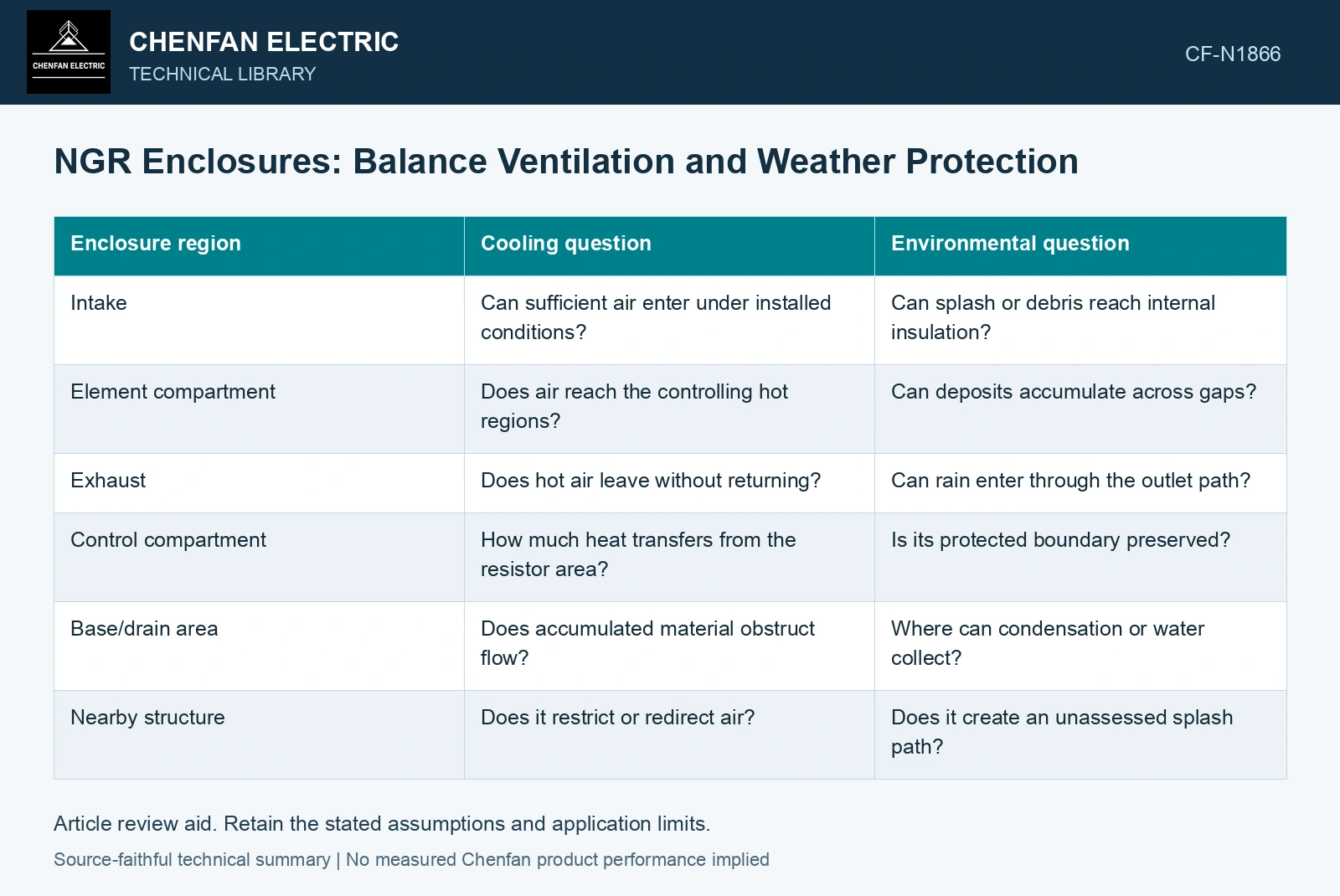
Trace the air path from intake to hot elements and exhaust. On the same drawing, trace credible rain, splash and condensation paths. Identify which baffles or barriers influence both. A detail that blocks water can add pressure loss or create a recirculating pocket.
| Enclosure region | Cooling question | Environmental question |
|---|---|---|
| Intake | Can sufficient air enter under installed conditions? | Can splash or debris reach internal insulation? |
| Element compartment | Does air reach the controlling hot regions? | Can deposits accumulate across gaps? |
| Exhaust | Does hot air leave without returning? | Can rain enter through the outlet path? |
| Control compartment | How much heat transfers from the resistor area? | Is its protected boundary preserved? |
| Base/drain area | Does accumulated material obstruct flow? | Where can condensation or water collect? |
| Nearby structure | Does it restrict or redirect air? | Does it create an unassessed splash path? |
Identify the heat balance being claimed
A continuous thermal assessment needs sustainable heat removal; a short-time assessment also needs heat-storage evidence. The enclosure’s contribution can differ between these duties. A cabinet that survives a brief event does not thereby establish continuous current capability.
For an illustrative airflow heat balance, P = ṁcpΔT. P is transferred heat in watts, ṁ is air mass flow in kilograms per second, cp is specific heat in joules per kilogram-kelvin and ΔT is the air temperature rise in kelvins. The expression does not determine natural airflow, local component temperature or losses through other paths. Those require the applicable model or test.
Check recirculation and local pockets
A warm exhaust entering the intake reduces the cooling boundary quality. Internal barriers can also leave local pockets hotter than a bulk outlet measurement suggests. Review the position of insulating supports and controls, not only the average enclosure temperature.
An enclosure IP classification addresses its stated protection boundary. It does not supply a heat-removal conductance or a permissible component temperature. Specify the installed enclosure configuration for both ingress and thermal qualification. [2]
Screen ventilation against heat input
Assumptions: continuous cabinet heat input is 2 kW, ambient air is 35 °C and the project enclosure-air acceptance gate is 100 °C. Effective heat-removal conductance is 40 W/K before a screen and 25 W/K after it. The one-node steady balance gives T = 35 °C + P/G: 85 °C before screening and 115 °C afterwards. Against the assumed air-temperature gate, the initial arrangement has 15 K margin and the screened arrangement fails by 15 K. Reject the screen pending a design that meets both the required weather protection and installed thermal duty. This air node does not establish local support or control temperatures; measure those separately. [3]
References
- IEEE, IEEE C57.32-2015, IEEE Standard for Requirements, Terminology, and Test Procedures for Neutral Grounding Devices (historical edition).
- IEC, IEC 60529:1989+AMD1:1999+AMD2:2013 CSV, Degrees of protection provided by enclosures (IP Code).
- U.S. Department of Energy, DOE-HDBK-1012/2-92, Thermodynamics, Heat Transfer, and Fluid Flow, Volume 2, 1992.