

Fleet readiness is a device-to-site match. Combine the mobile transformer’s available configuration, accessories and condition record with the station’s electrical and physical interfaces. A readiness matrix turns warehouse stock into specific deployment options. [1]
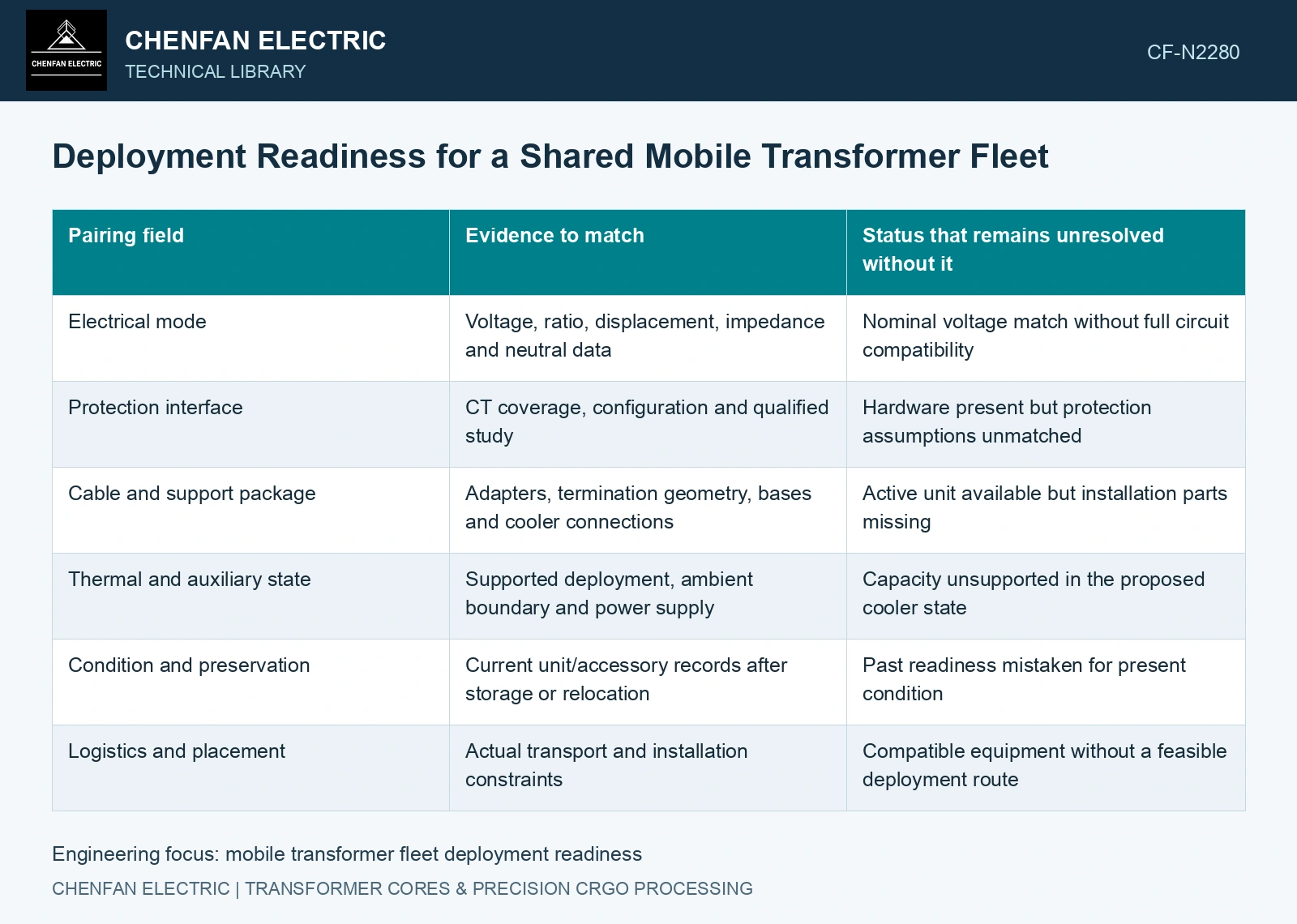
Evaluate the device-to-site pairing
For each candidate station, compare the available unit’s supported mode with the actual voltage, grounding, protection, cable, cooling, support and auxiliary requirements. Include route and placement constraints as separate logistical fields. A technically compatible unit can still lack the components or access needed to become an installation.
| Pairing field | Evidence to match | Status that remains unresolved without it |
|---|---|---|
| Electrical mode | Voltage, ratio, displacement, impedance and neutral data | Nominal voltage match without full circuit compatibility |
| Protection interface | CT coverage, configuration and qualified study | Hardware present but protection assumptions unmatched |
| Cable and support package | Adapters, termination geometry, bases and cooler connections | Active unit available but installation parts missing |
| Thermal and auxiliary state | Supported deployment, ambient boundary and power supply | Capacity unsupported in the proposed cooler state |
| Condition and preservation | Current unit/accessory records after storage or relocation | Past readiness mistaken for present condition |
| Logistics and placement | Actual transport and installation constraints | Compatible equipment without a feasible deployment route |
Separate the causes of a readiness gap
Distinguish a missing part from missing evidence and from a known incompatibility. A correct adapter that is absent requires a different resolution from an adapter whose electrical duty is unverified. A device with an incompatible neutral arrangement cannot be made ready by updating its inventory status.
Use evidence dates and configuration revisions. If a cooler bank has been transferred to another unit or a control module replaced, the previous ready status may no longer describe the candidate pairing. Status should follow the complete package, including separately stored accessories.
Make the next resolution specific
For an unresolved pairing, identify the affected field and the action that can close it: locate the matched accessory, obtain the missing mode impedance, complete the qualified protection review or verify the stored condition. Avoid a general “commissioning required” label that hides which dependency controls deployment.
Add resource competition, travel time and dispatch constraints to the verified engineering pairings when planning fleet availability.
Assign an owner and next action to every site-specific readiness gap. The fleet planner can then distinguish a spare ready for that station from one needing adapters, data or condition checks.
Test simultaneous deployments against the compatibility graph
DOE’s mobile-transformer report identifies limited fleet availability and competing deployment needs as planning constraints [1]. Assume three stations and two units: A is verified for stations 1 and 2; B only for station 2. The original graph has three verified pairings, but those cell counts do not establish emergency coverage.
| Simultaneous station requests | Feasible allocation before adaptation |
|---|---|
| 1 and 2 | A→1, B→2 |
| 1 and 3 | No unit verified for 3 |
| 2 and 3 | No unit verified for 3 |
Only one of the three two-station combinations is covered. If a qualified adapter and matched configuration make B available for station 3, all three combinations have an assignment: A→1/B→2; A→1/B→3; A→2/B→3. Two units still cannot cover all three stations simultaneously. Prioritize the station-3 interface package and state the simultaneous-demand assumption in the readiness report. Keep preservation and serial-specific condition evidence with each allocated assembly [2].
References
- U.S. Department of Energy, Benefits of Using Mobile Transformers and Mobile Substations for Rapidly Restoring Electrical Service, August 2006, sections 2.1.4 and 2.2.1–2.2.2.
- U.S. Bureau of Reclamation, FIST Volume 3-30, Transformer Maintenance, 2000.