

Marine transformer cooling should be specified by naming every medium and interface in the heat path. A dry-type transformer using an air-to-water arrangement is not the same system as a liquid-immersed transformer using an insulating-liquid-to-water exchanger. Vessel freshwater, seawater and intermediate circuits also have different boundaries. The phrase water cooled leaves these essential distinctions unresolved.
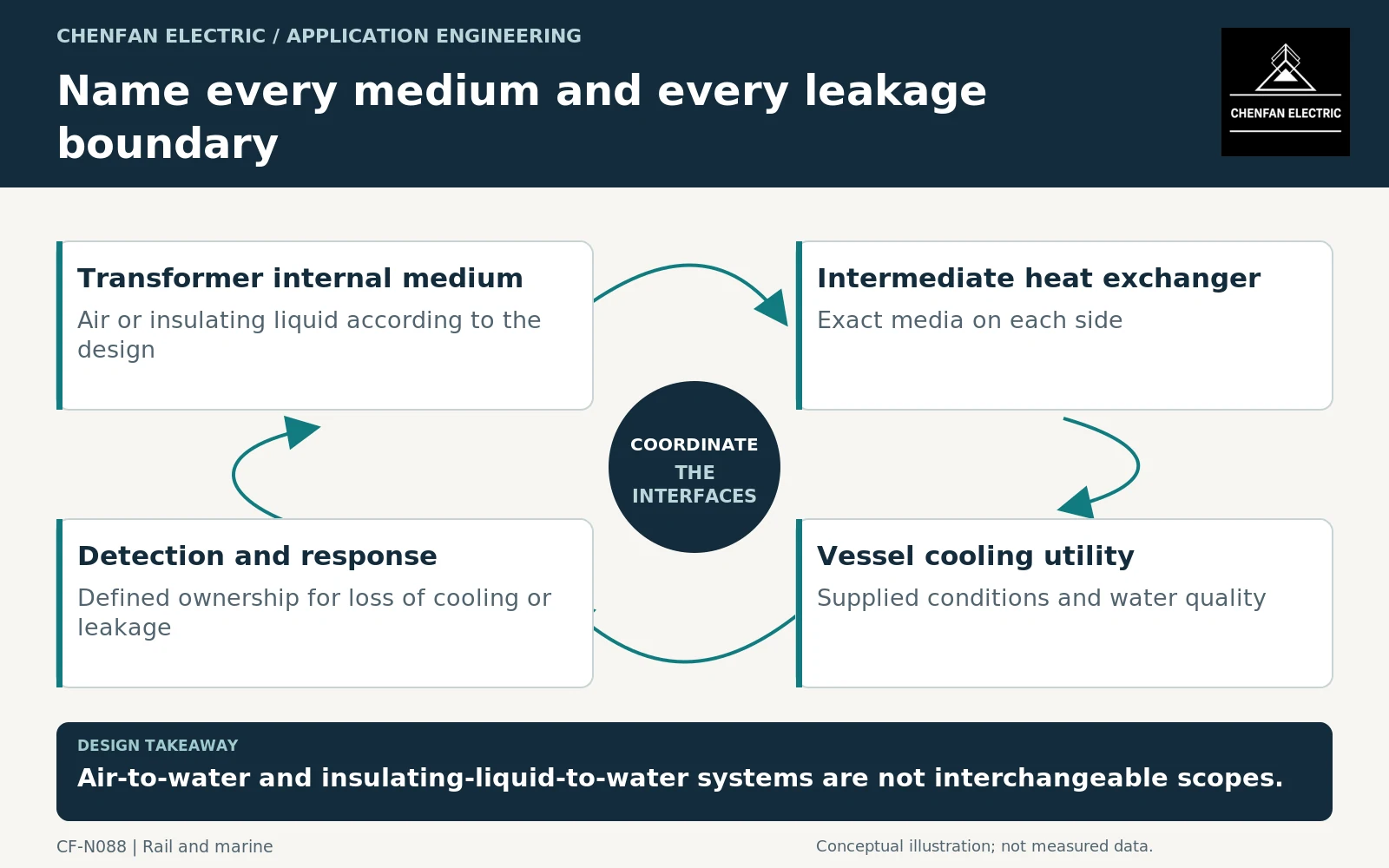
Draw the complete heat-rejection chain
Identify the medium surrounding the active transformer parts, the medium circulating through any local exchanger and the vessel utility that ultimately removes heat. State where each supplier’s scope begins and ends.
IEC 60076-22-4 addresses insulating-liquid-to-water heat exchangers within its scope. It should not be cited as though it qualifies every dry-type air cooler, seawater circuit or integrated marine cooling system. [1]
IEC 60092-303 addresses shipboard transformers, but the vessel’s cooling system still needs coordinated design and evidence. [2] The transformer supplier cannot guarantee inlet conditions that another system has not agreed to provide.
Specify conditions at named connections
Record inlet temperature, flow and pressure conditions, medium properties and the relevant operating range at the actual interface. The heat-exchanger performance should be stated for those conditions rather than as an isolated capacity number.
The vessel designer should identify normal and degraded utility states, including unavailable pumps or elevated cooling-medium temperature. The transformer assessment must use the same cases.
For circulation equipment, IEC 60076-22-5 concerns insulating-liquid pumps for liquid-immersed power transformers and reactors; it is not a generic standard for every water or dry-type cooling circuit. A qualified pump does not establish the performance or redundancy of the whole cooling loop. [3]
A useful interface sheet names the supply and return connections, measurement points, responsible party and guaranteed boundary condition. It also identifies any customer-supplied component whose performance is assumed in the transformer rating.
Treat leakage and loss of cooling as separate events
Leakage can involve different consequences depending on which media are separated by the affected boundary. Loss of flow or inadequate heat rejection is another condition, even when no leakage occurs.
| Event | Required design agreement |
|---|---|
| Reduced flow | Detection and supported operating restriction |
| High inlet temperature | Permitted duty and response boundary |
| Suspected exchanger leakage | Identification, isolation and assessment responsibility |
| Pump unavailable | Remaining cooling capability |
| Utility interruption | Coordinated transformer and vessel response |
This article does not define alarm settings, valve operations or emergency procedures. Those must follow the approved equipment and vessel design.
Do not claim that a double barrier, a sensor or a particular medium makes leakage risk zero. The relevant evidence should identify the actual construction and demonstrated function without extending it to an unlimited guarantee.
Verify the integrated arrangement
The acceptance package should reconcile transformer heat duty, exchanger performance, circulation equipment and vessel-supplied conditions. Include the installed piping or air-path arrangement at the level necessary to confirm the agreed interfaces.
Maintenance access should allow inspection and approved replacement of the cooling components. Identify whether work on a shared loop affects other equipment and whether the intended continuity claim remains valid.
The useful specification is a named-media heat path with explicit performance and failure responsibilities. That clarity prevents a technically correct component quotation from being mistaken for a complete marine cooling solution whose utility, leakage and maintenance boundaries have never been closed.
Core procurement checkpoint: Keep cooling-loop claims outside a core-only order
The core supplier should receive the geometry and supplied-component interfaces approved for the selected marine cooling arrangement. A drawing-based core order does not qualify an air path, water circuit or leak-detection system. Where liquid-immersed cooling accessories are referenced, keep their scope separate from dry-type equipment and from the full shipboard installation’s containment and redundancy assessment.
For the core enquiry: Transformer construction type; core/clamp interfaces; keep-clear zones; included components; owner of cooling-loop and leakage acceptance.