

An 18-tonne core can meet every local measurement and still reveal a geometry problem when its support changes.
That is why copying a smaller-core handling method is not a scale-up plan.
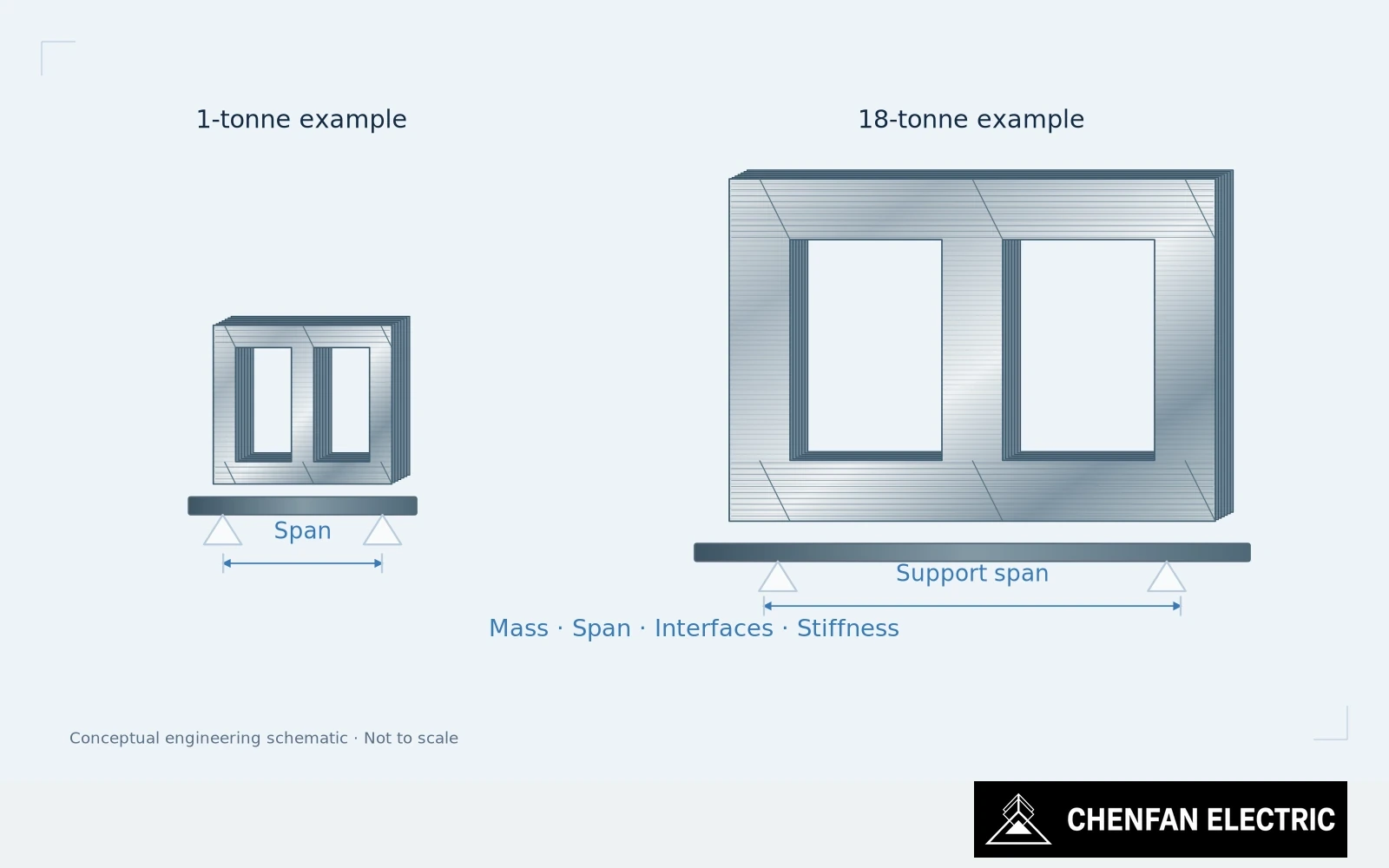
Review the actual load paths and support spans
Mass, span, support spacing and stiffness do not grow in the same way. Even for geometrically similar solid structures, weight scales with volume while load-bearing areas scale differently. A laminated core is more complicated: its mechanical response also depends on packet interfaces, clamping and the surrounding support structure.
The steel mass alone therefore cannot specify the lifting or turning arrangement.
Consider the yoke during a change of orientation. The load path that kept sheets aligned on a horizontal assembly bed may no longer exist when the core is upright. A restraint that prevents gross movement may still allow local relative movement at a packet boundary.
Measure geometry through changes of state
The large-core review needs to identify these transitions explicitly. Which component carries the load at each stage? Which dimensions are measured in the supported state, and which must remain acceptable after release? Which restraints are temporary, and when are they removed?
Long dimensions also change the significance of small angular errors. A local alignment check near a joint cannot establish the location of the far end of a long limb. Global datums, diagonals and interface positions must be checked in a defined mechanical state.
Magnetic verification should be connected to that state. If an agreed handling operation or reclamping step occurs after the release test, preserve enough before-and-after evidence to investigate a change. Do not assume that a loss difference proves mechanical damage without first reproducing the electrical test conditions.
Qualify the handling route, not only lifting capacity
The practical procurement consequence is not that a heavy core is inherently less reliable. It is that evidence from small cores does not qualify every large-core operation. Ask for an engineering review of the proposed geometry, support and handling route, rather than a capacity statement based only on crane tonnage.
The same applies to repeat orders: a familiar weight with a different aspect ratio may be a new mechanical problem.
For an 18-tonne assembly, a convincing capability demonstration is a controlled transition from stacking bed to released, transported geometry. A photograph of the finished core establishes only that it stood still long enough to be photographed.
Practical takeaway
A support transition can expose a large-core geometry problem that local inspections miss.
Chenfan Electric manufactures custom transformer cores according to customer drawings. Where applicable to the specified material and core design, agreed process controls include burr height below 0.02 mm and stacking factor above 97%. Measurement methods and acceptance conditions are defined for each order.