

Suppose the lowest-loss GOES is approved.
What is the designer allowed to change next?
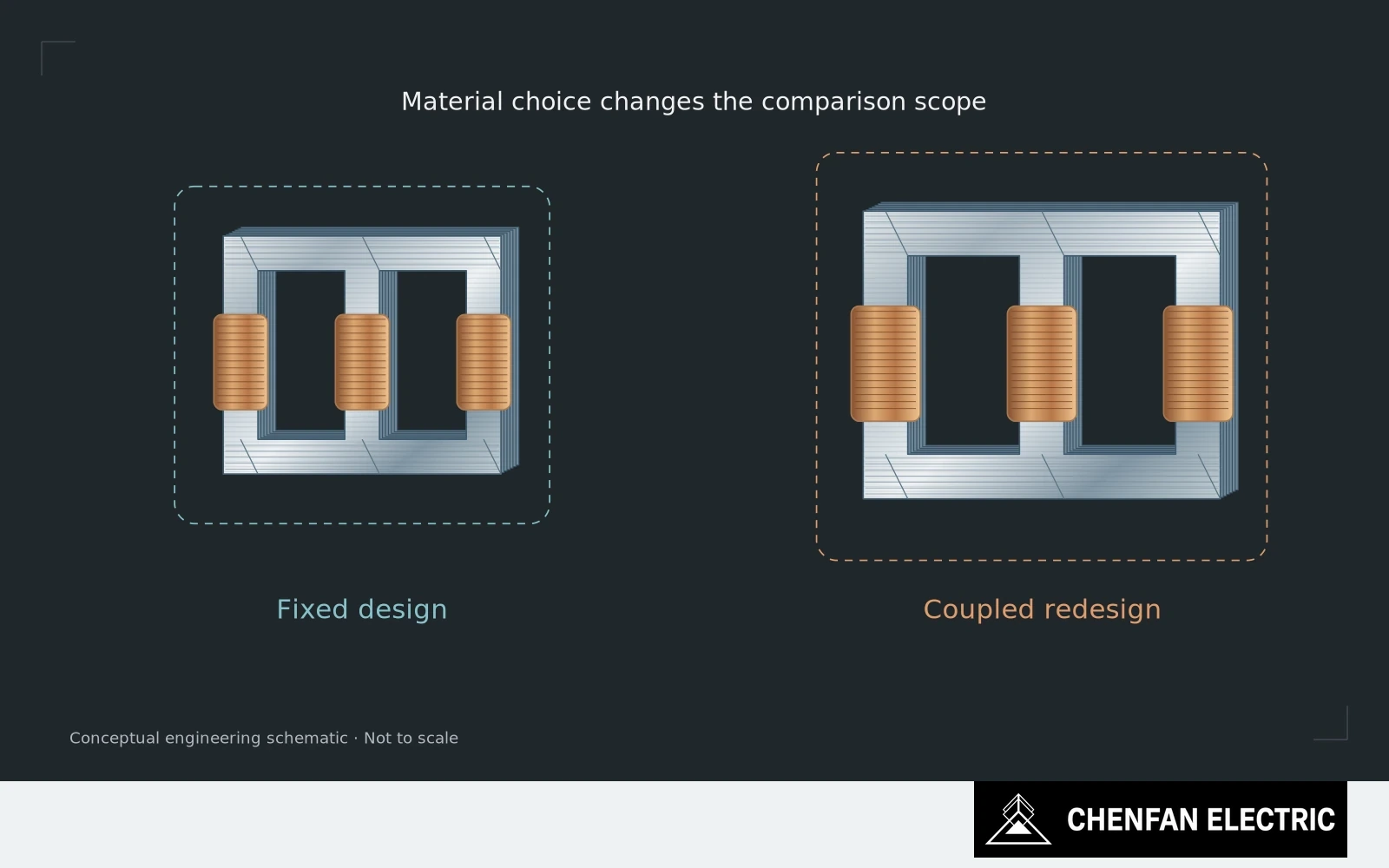
Separate material substitution from redesign
That question can alter the economic result more than the material ranking itself.
If geometry, turns and operating flux density are frozen, the comparison is relatively narrow: purchase premium against the verified change in finished-core performance. Even here, use the relevant frequency and induction rather than whichever catalogue point makes the improvement look largest.
If the transformer may be redesigned, the decision is different. A better material characteristic might support a different core section or operating point. That can alter iron mass, winding dimensions, conductor length, insulation clearances and cooling arrangements.
Set the complete design objective
Those changes are coupled. Reducing core size is not a free saving if the revised operating point consumes the magnetic margin the upgrade was intended to create. Enlarging the core to reduce induction is not automatically economical if the surrounding winding and enclosure become more expensive.
The objective should therefore be stated before the optimization starts. Lowest purchase cost subject to guaranteed losses is one objective. Lowest evaluated ownership cost under a specified duty is another. Lowest no-load loss regardless of size is a third, and it can produce a very different design.
For ownership evaluation, use the customer’s actual loss-capitalization method or stated operating assumptions. No-load energy follows energized time and voltage conditions; load-related energy requires the load profile. An invented electricity price or utilization factor can make almost any premium look attractive.
A productive design review compares feasible alternatives rather than grades in isolation. For each candidate, keep the complete transformer cost, guaranteed loss allocation, critical dimensions and manufacturing route visible. Identify whether an apparent gain comes from the steel or from another design change.
Compare feasible alternatives and their sensitivities
Sensitivity matters too. A candidate that wins only at one optimistic material price or one assumed duty is not the same decision as one that remains acceptable across the credible range.
The highest grade belongs in the comparison. It does not deserve an automatic award.
The selected design should have an explainable reason for its material choice, including what further improvement would cost and which constraint would become active next. That is a stronger engineering answer than specifying the most prestigious line in a catalogue.
Practical takeaway
The freedom to redesign can matter more than the ranking of material grades.
Chenfan Electric manufactures custom transformer cores according to customer drawings. Where applicable to the specified material and core design, agreed process controls include burr height below 0.02 mm and stacking factor above 97%. Measurement methods and acceptance conditions are defined for each order.