

Where is the large core being held straight?
In the steel assembly, or in the fixture around it?
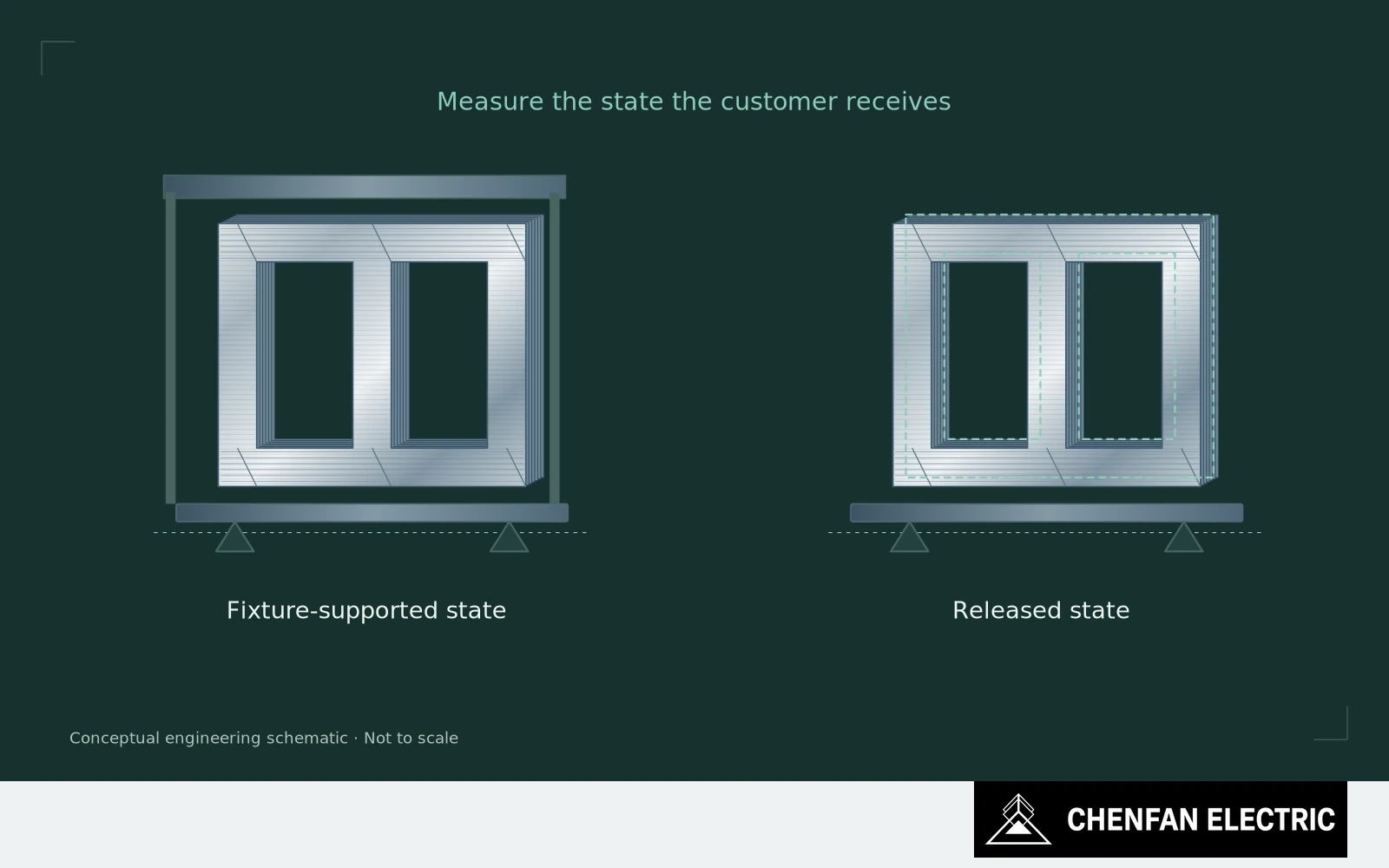
Separate constrained geometry from delivered geometry
A measurement taken before the fixture is released cannot answer that question by itself.
Large assembled cores contain several interacting geometries: the lamination packets, the completed limbs and yokes, the clamping structure, and the interfaces that must accept the windings. Good local sheet accuracy does not guarantee that these geometries settle into the intended relationship.
A fixture can temporarily conceal an assembly conflict. Releasing it may allow movement; tightening the final clamp may introduce a different restraint. Neither event automatically means that a defect exists, but both can change the state that a dimensional record describes.
Define the reference state of each interface
This creates a manufacturing issue that is easy to miss in a supplier visit. The relevant achievement is not merely building to a coordinate. It is reaching an acceptable released geometry without using uncontrolled force to reconcile incompatible parts.
Establish the reference state for each critical measurement. For example, the approved drawing or inspection plan should make clear whether an interface is checked on the assembly bed, upright, or under the specified final clamping condition. The chosen states depend on the design; there is no universal sequence that fits every core.
Then distinguish temporary tooling from permanent structure. A spacer used to establish a window cannot quietly become a corrective device for the completed assembly. A final clamp should not be expected to straighten a geometry error that was never evaluated.
The magnetic issue is equally specific. Changing restraint can alter local stress and joint seating. That gives a reason to control the mechanical state of a core test, not permission to attribute every variation in watts to fixture release.
Verify what changes when temporary tooling is removed
For larger cores, inspection records should show both the global geometry and the relevant local interfaces. A single overall height is weak evidence when the assembly problem is a twisted plane or a displaced winding interface.
The most revealing production question is often about a transition: what is rechecked when this fixture is removed?
A supplier that has defined that answer is controlling the assembly. A supplier that has only measured it while constrained has documented a condition that the customer may never receive.
Practical takeaway
A fixture can conceal the difference between constrained geometry and delivered geometry.
Chenfan Electric manufactures custom transformer cores according to customer drawings. Where applicable to the specified material and core design, agreed process controls include burr height below 0.02 mm and stacking factor above 97%. Measurement methods and acceptance conditions are defined for each order.