

The cheapest route can require the one handling operation the core was never qualified to survive.
That makes route selection an engineering review before it becomes a freight comparison.
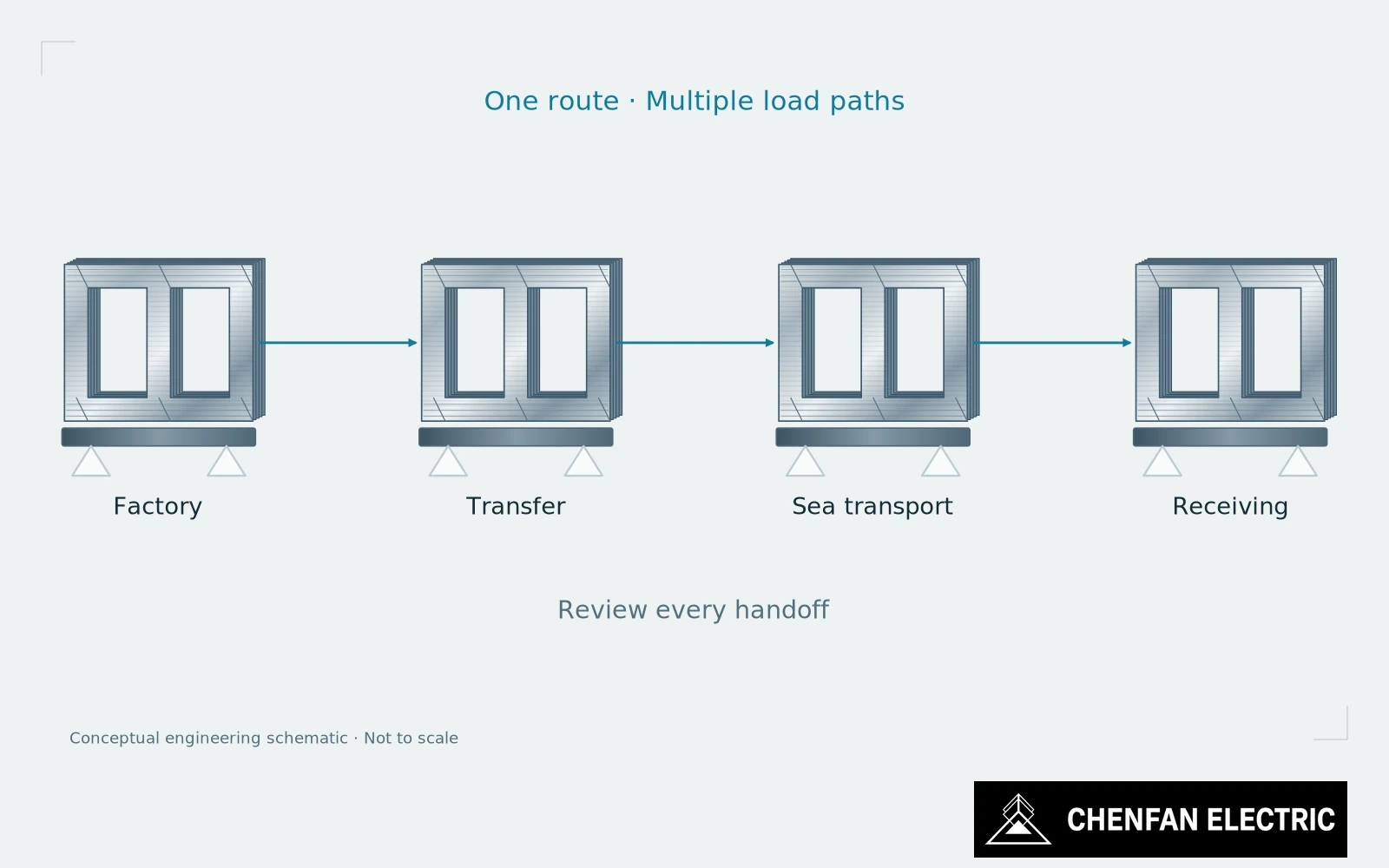
Define permitted support and handling conditions
For a complete assembled core, the shipment is a sequence of mechanical states: factory lifting, vehicle support, terminal transfer, sea or road restraint, unloading and movement into the receiving bay. A satisfactory condition at one stage does not define the next.
The engineering input should identify permitted orientations, approved lifting and support interfaces, the transport envelope and any operations that require reinspection. These are design-specific limits. A generic cargo-handling label cannot replace them.
The logistics input should identify what will actually happen: transfer points, equipment constraints, storage exposure and the unloading arrangement available at destination. It is not enough to book a vehicle that accepts the nominal weight and dimensions.
Resolve the intermodal and receiving interfaces
A particularly important mismatch is support location. A cargo restraint may secure the external frame while transmitting load through an unintended point in the core assembly. Conversely, a core-friendly support arrangement may still be inadequate for the transport acceleration cases. Both requirements must be checked together by the responsible engineers.
The IMO/ILO/UNECE CTU Code treats packing and securing across the intermodal chain, including receiving and unpacking. It is a useful framework for the transport plan, not a transformer-specific certificate of magnetic performance.
Before approving the route, resolve the difficult handoff. Can the receiving facility unload and move the delivered configuration without dismantling a part that was intended to remain assembled? Are temporary restraints accessible in the planned order? Is there a protected place to inspect the unit before packaging is discarded?
Compare routes through the final controlled handover
Shock records and photographs can support later investigation, but they do not create acceptance limits. An indicator event needs interpretation against the agreed handling design and the as-received condition.
Procurement can then compare complete alternatives: route, engineered support, packing, handling operations and receiving work. A freight quotation that leaves those interfaces undefined is not yet comparable with one that includes them.
Approve the route only after the last planned lift has an owner. The shipment does not end when the vessel arrives; it ends when the core reaches a controlled receiving state.
Practical takeaway
An apparently economical route can introduce an unqualified handling operation.
Chenfan Electric manufactures custom transformer cores according to customer drawings. Where applicable to the specified material and core design, agreed process controls include burr height below 0.02 mm and stacking factor above 97%. Measurement methods and acceptance conditions are defined for each order.