

Shipping the core intact preserves an assembly.
Removing a yoke transfers part of that assembly task to the receiving factory.
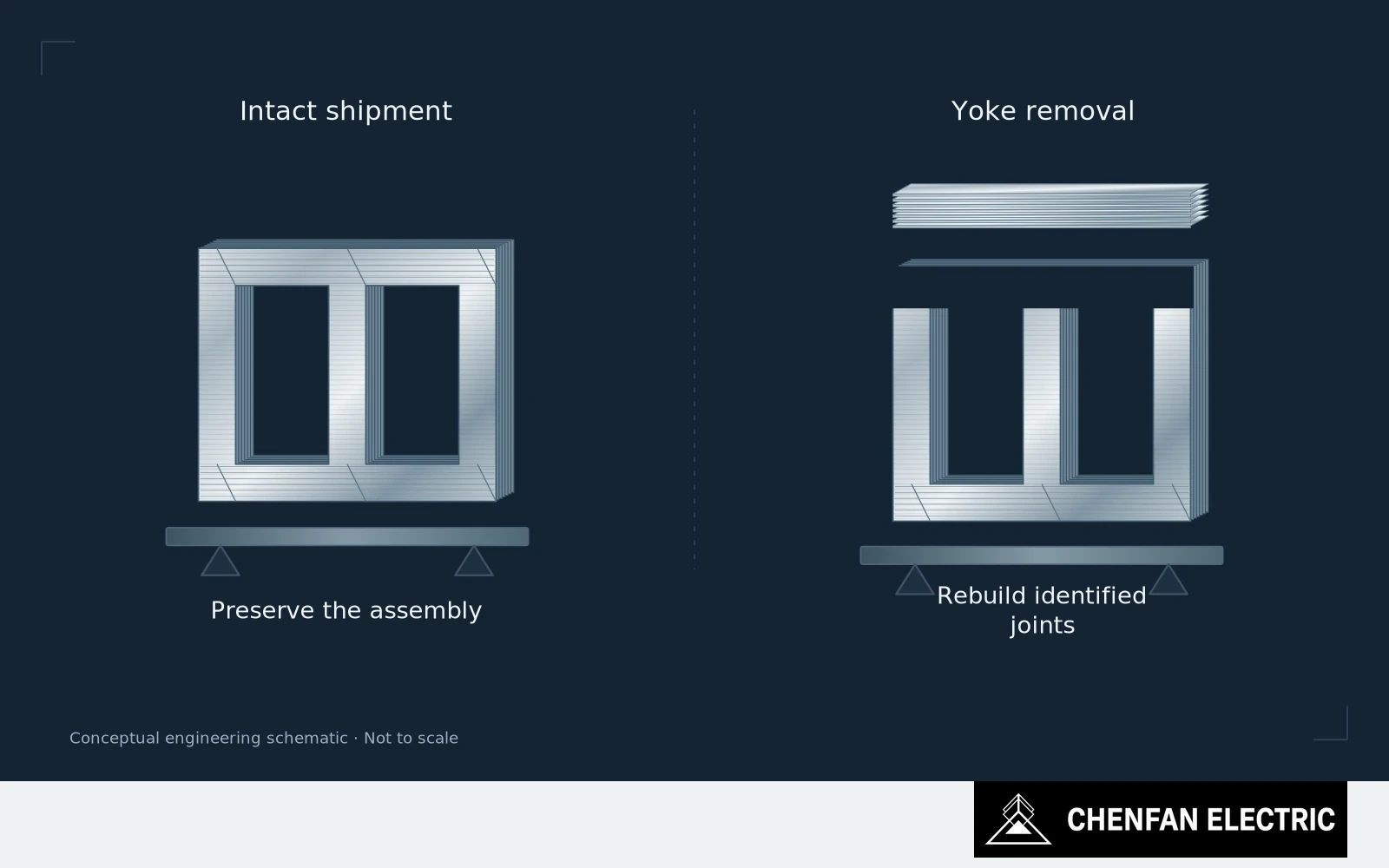
Compare the two control plans
Neither choice is automatically safer. They put the control burden in different places.
An intact core may avoid rebuilding the removed joint region, but it can require a larger transport envelope, different support arrangements and more demanding handling. Preserving the magnetic circuit on paper has little value if the actual route cannot support the delivered structure correctly.
Yoke removal can make a shipment physically manageable. It also creates a controlled disassembly and reassembly problem: sheet identification, packet order, step sequence, protection of contact surfaces and restoration of the intended geometry.
Match delivery form to winding installation
The distinction is not simply “assembled” versus “unassembled.” What matters is which operations remain at destination and whether the receiving team has a defined, qualified method for them.
Review the winding installation sequence first. If the receiving transformer process already requires opening that yoke, shipping intact may not eliminate the operation. If the process can use the delivered configuration without reopening it, unnecessary disassembly adds work that otherwise would not exist.
Then examine the evidence needed at the handoff. A pre-disassembly magnetic test describes the assembled condition before shipment. It cannot directly certify a later reassembled condition without an agreed relationship between those states.
For a removed-yoke option, agree how components are identified and preserved, what geometry is checked after rebuilding, and what electrical verification is appropriate. For an intact option, agree support, restraint, permitted orientation changes and checks after transport. These are alternative control plans, not competing slogans.
Define where the joint will be rebuilt and verified
Do not assume reassembly must worsen performance. A controlled rebuild can restore the intended condition. Equally, using the same laminations does not guarantee identical seating, alignment or mechanical stress.
The commercial comparison should include receiving labor, tooling, inspection access and scheduling. A lower shipping cost may be entirely justified where the buyer already has the required capability. It may be misleading where that capability would have to be improvised.
Choose the shipment configuration around the actual transformer assembly process and route. The critical question is where precision will be recreated, by whom, and against which acceptance record.
Practical takeaway
The choice transfers responsibility for restoring geometry rather than simply changing shipping size.
Chenfan Electric manufactures custom transformer cores according to customer drawings. Where applicable to the specified material and core design, agreed process controls include burr height below 0.02 mm and stacking factor above 97%. Measurement methods and acceptance conditions are defined for each order.