

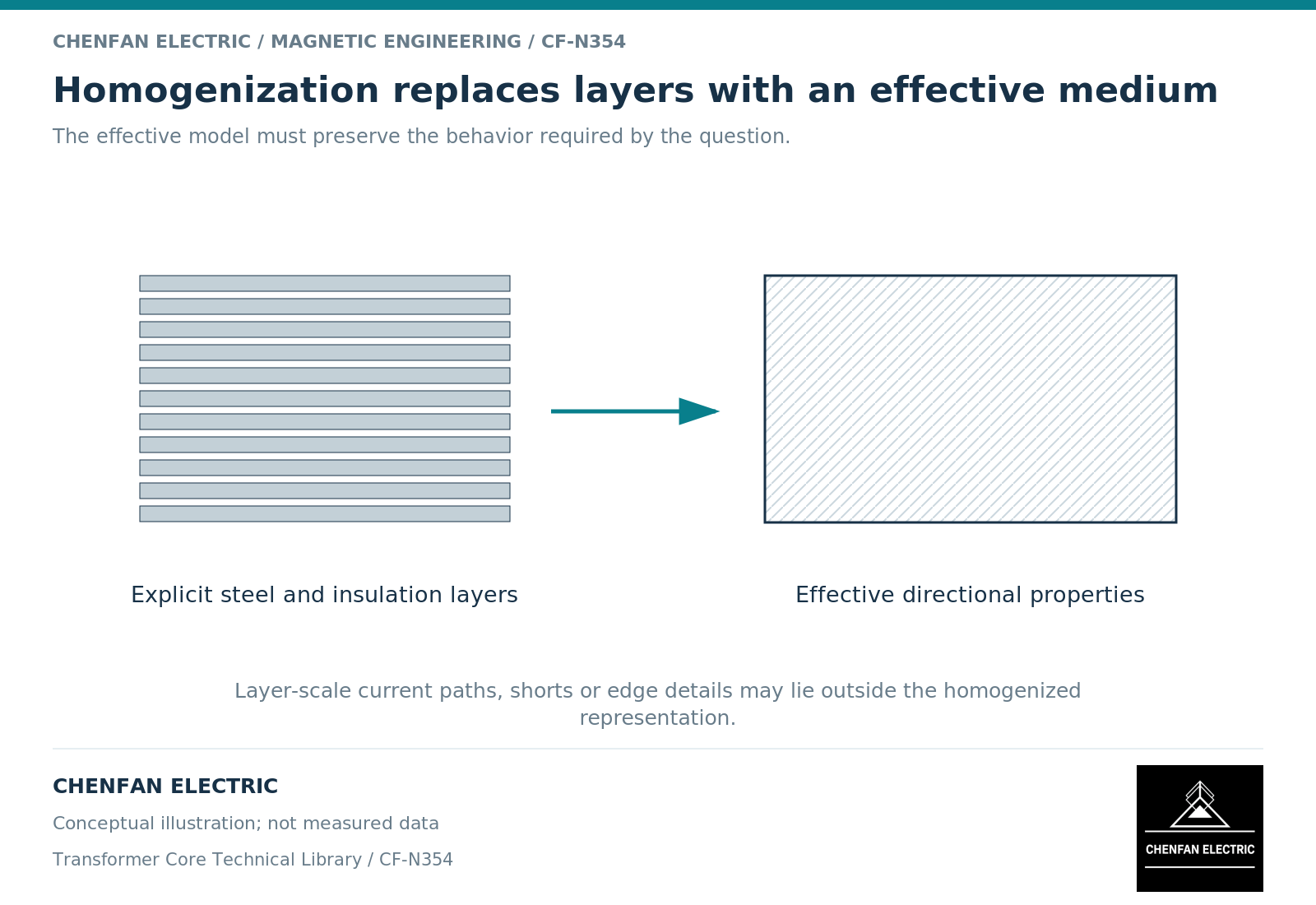
Lamination homogenization replaces many thin steel and insulation layers with an effective bulk region. It can make an assembly-scale field model practical, but it does not preserve every local interlaminar path, joint detail or insulation defect. Use it for the spatial scale and mechanisms it is designed to represent.
Identify what is being averaged
An effective model may use steel fraction, sheet thickness, stacking direction and constitutive properties to represent a laminated region. The resulting bulk response can differ along and across the layers.
The finite-element manual describes a bulk lamination approach that avoids explicitly meshing every sheet. [1] The benefit is computational efficiency, not a claim that the individual layers have ceased to matter physically.
State whether the effective region includes only the lamination stack or also absorbs gaps, joints and other features. Combining all of those into one fill factor can conceal distinct mechanisms and make later interpretation ambiguous.
Preserve the distinction between averaging and defects
A homogenized region normally represents an intended material arrangement. A local interlaminar short is a specific conducting connection that can create a different current path. Reducing a bulk insulation parameter does not necessarily reproduce the geometry of that defect.
Likewise, a step-lap joint or an opening may redirect flux over a scale that the bulk model smooths away. If the decision concerns local field concentration or loss at that feature, a resolved submodel or a separately validated effective treatment may be needed.
The correct question is not whether homogenization is “accurate” in general. It is whether the averaging removes information needed by the chosen observable.
Check the relevant length and time scales
The layer spacing should be small relative to the field variation being represented by the bulk region. Frequency-dependent penetration and local conducting paths can create additional constraints on the approximation.
A model that is adequate for an average limb flux at one excitation may not be adequate for high-frequency local loss or a fault loop across a few sheets. Material-model choice also matters: a single-valued effective relation is different from a history-dependent or vector response. [2]
Use a representative resolved comparison when the approximation is critical. Compare integrated flux, loss or another decision-driving quantity rather than only whether the contour images look similar.
Handover the averaging assumptions
| Effective input | Interpretation to preserve |
|---|---|
| Steel fraction | Volume or section basis used by the formulation |
| Sheet thickness | Steel thickness versus total layer pitch |
| Stacking direction | Local orientation in the assembly |
| Constitutive relation | Linear, nonlinear, hysteretic or frequency dependent |
| Omitted detail | Joints, local shorts, edge regions or individual sheets |
Do not apply the stacking allowance twice: once by reducing geometric area and again through a bulk material definition that already accounts for it. The geometry and material conventions must be consistent.
Also check integrated quantities. A loss density defined per steel volume and one defined per bulk laminated volume require different mass or volume multiplication. A unit-consistent result can still be wrong if those reference volumes are mixed.
The final model note should explain the scale at which the effective region is valid and identify outputs it does not support. That allows a core supplier’s actual lamination schedule to be translated into a model without pretending that the bulk representation resolves every manufacturing feature or insulation path.
References
[1] David Meeker. Finite Element Method Magnetics User Manual.
[2] Cesare Tozzo / COMSOL. Modeling Ferromagnetic Materials in COMSOL Multiphysics.