

A finite-element hot spot is not trustworthy until its sensitivity to mesh refinement and geometric idealization has been examined. A small solver residual only shows that the discretized equations were solved to the selected tolerance. It does not show that the mesh resolves the physical quantity of interest.
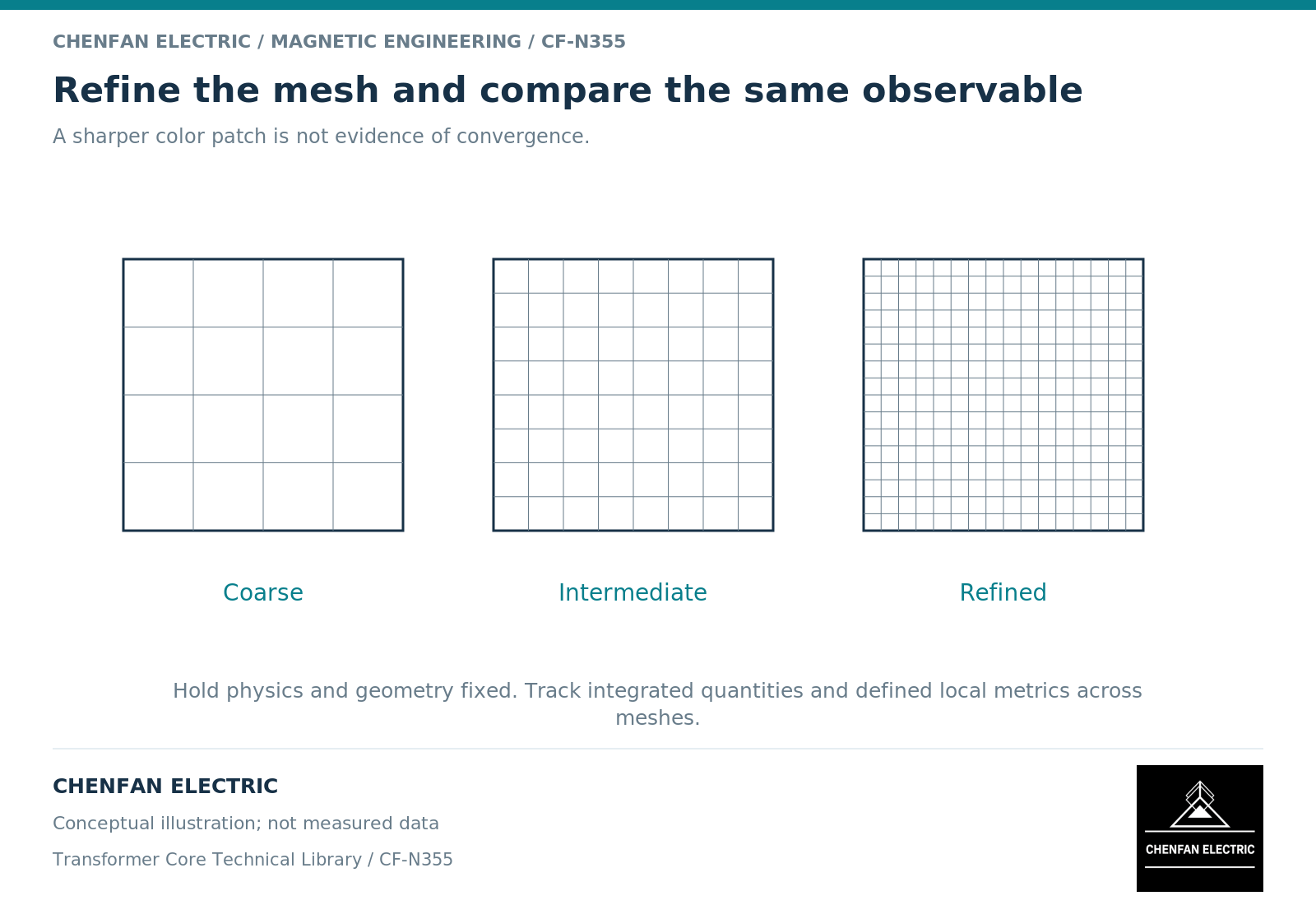
Choose a convergence quantity before refining
Track the result that drives the decision: local flux density over a defined region, integrated loss, force, inductance or temperature. Different quantities can converge at different rates.
Field derivatives and force-related quantities can be more sensitive to discretization than a global flux integral. Finite-element guidance discusses the need for mesh refinement when evaluating such derived outputs. [1]
A report that states only the number of elements is therefore incomplete. Element count does not reveal their distribution, order or adequacy near the controlling feature.
Refine where the physics varies
Openings, narrow gaps, material interfaces and conducting regions with strong field penetration gradients may need local attention. Uniformly increasing every element can be expensive while leaving a badly represented corner or thin feature unresolved.
Keep geometry, excitation and material data fixed during a mesh study. Otherwise a change in the result cannot be attributed to discretization alone. Record each mesh configuration and the same output definition for every run.
An illustrative convergence table might show a region-averaged result approaching a stable value as refinement proceeds. Such a table must contain actual solver results when used as evidence. An invented sequence can explain the method but must be labeled conceptual and cannot qualify a design.
Distinguish a physical maximum from a singularity
An ideal sharp corner can produce a maximum that continues to rise with refinement. The physical component may have a finite radius, while the mathematical model has none. More elements do not resolve that mismatch.
Use the actual radius or a justified geometric representation. Also report a region-averaged or integrated quantity when it is more physically meaningful than a point value. The averaging region must be defined before comparing designs.
Constitutive data can introduce another apparent instability. Unsupported high-field extrapolation or a poorly interpolated curve may change local behavior as the mesh resolves stronger fields. Material-model guidance should therefore be reviewed alongside numerical convergence. [2]
Separate mesh, domain and time-step checks
| Check | What changes | What remains fixed |
|---|---|---|
| Mesh refinement | Spatial discretization | Geometry, materials and excitation |
| Domain sensitivity | External boundary extent or treatment | Physical assembly |
| Time-step sensitivity | Temporal resolution | Event and constitutive model |
| Nonlinear tolerance | Iterative solution criterion | Discretized problem definition |
Passing one row does not imply that the others are adequate. A fine mesh inside an artificially small external domain can converge to the wrong boundary-value problem.
The handover should show the trend in the controlling quantity, the selected mesh and the remaining numerical uncertainty. Retain the location of the reported maximum and a consistent visualization scale across candidates.
The conclusion should be that the chosen result is sufficiently insensitive to further justified refinement for the decision being made. Avoid declaring a design validated merely because the mesh is dense or the contour is smooth. Numerical convergence is one part of verification; physical validation still requires independent evidence.
References
[1] David Meeker. Finite Element Method Magnetics User Manual.
[2] Cesare Tozzo / COMSOL. Modeling Ferromagnetic Materials in COMSOL Multiphysics.