

“DOE compliant steel” is not a complete procurement requirement.
DOE efficiency requirements apply to the covered transformer, not to a GOES grade in isolation.
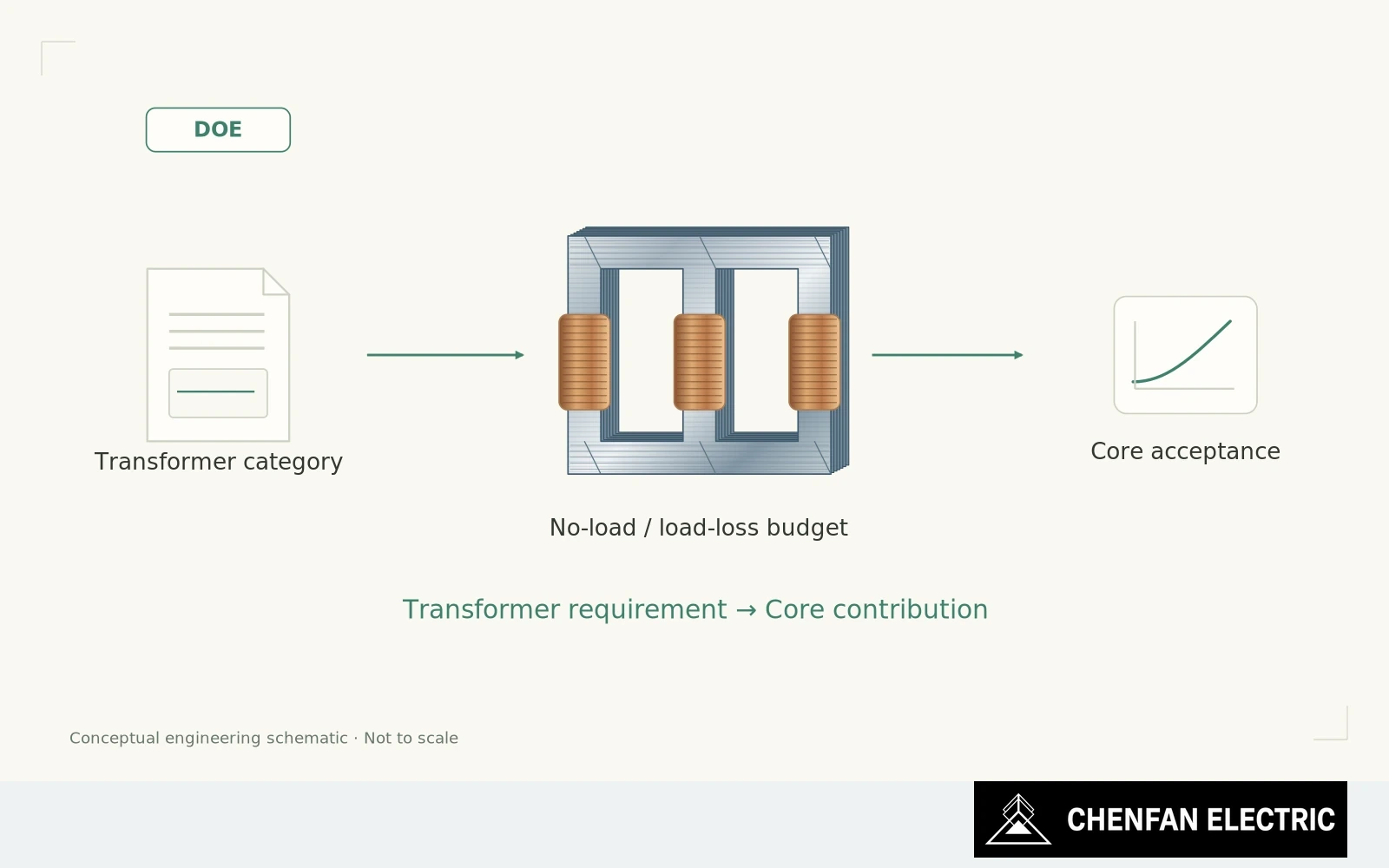
Confirm the rule, product class and test basis
As checked on 4 October 2026, DOE lists its April 2024 amended distribution-transformer standards, effective 8 July 2024, with compliance required for the applicable covered transformers manufactured on or after 23 April 2029. The relevant existing requirements apply before that compliance date. DOE’s 15 June 2026 request for information is not itself an amended final standard.
Start by confirming that the actual transformer is within the regulatory definition and identifying the applicable product class. Do not transfer a requirement between liquid-immersed, low-voltage dry-type and medium-voltage dry-type products simply because their kVA ratings match.
The next task belongs to the transformer designer: convert the applicable efficiency requirement and test basis into an allowable combination of no-load and load losses. The DOE test procedure measures these separately and evaluates efficiency under the prescribed conditions.
Allocate the core contribution to final efficiency
Only then can a useful core procurement target be allocated.
That target must account for the difference between a supplier’s core test and the final transformer measurement. Temporary excitation arrangements, the completed assembly state and measurement uncertainty need defined treatment. Calling a core “DOE ready” does not establish that relationship.
Material selection is one lever. Core section, turns, operating induction and manufacturing control are others. A rule expressed through transformer efficiency does not, by itself, prescribe one universal GOES thickness or require every design to use the same core technology.
For a production program, qualify the proposed material and manufacturing route against the design allocation. Preserve first-pass results and investigate variation within comparable designs. A development core that meets the internal target once is not yet evidence that the production population will do so consistently.
Qualify production against the design allocation
The purchasing schedule also needs the correct date logic. A regulatory compliance date is not automatically the customer’s delivery deadline or the date on which material must be ordered. Program qualification and release milestones need their own explicit dates.
Keep regulatory status and engineering allocation in separate controlled records, and review both when the rule or design changes.
The useful purchase requirement is a defined core performance contribution to a compliant transformer, with a test basis and a qualified production route. A material label cannot carry that responsibility alone.
Practical takeaway
A transformer-level efficiency rule cannot be reduced to a compliant-steel label.
Chenfan Electric manufactures custom transformer cores according to customer drawings. Where applicable to the specified material and core design, agreed process controls include burr height below 0.02 mm and stacking factor above 97%. Measurement methods and acceptance conditions are defined for each order.