

B800 is a point on a characteristic.
It is not a recommended transformer flux density.
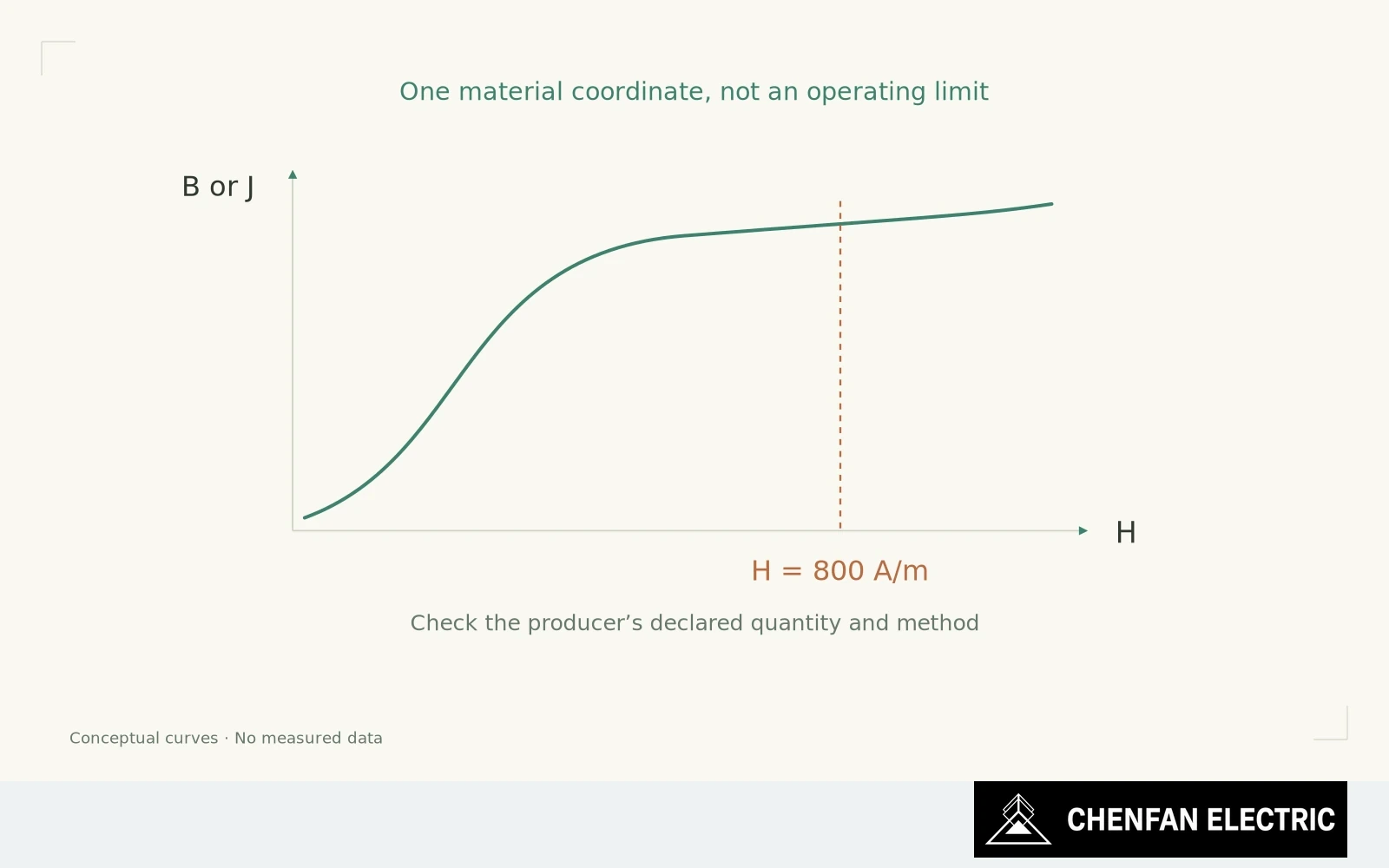
Read the stated B or J convention
Confusing those two meanings can turn a useful GOES specification into a poor design shortcut.
The subscript refers to a magnetic field strength of 800 A/m. Check the producer’s convention carefully: specifications may state magnetic induction B or magnetic polarization J at that field. They are related quantities, but their names and declared test methods should not be silently exchanged.
A high value indicates favorable magnetization behavior under the stated measurement conditions. It does not independently describe the loss curve, magnetostriction curve or current demanded by a completed core at its intended operating point.
The missing information becomes obvious when a designer asks a different question: what happens when voltage increases or frequency falls?
Use curves around the real operating point
One high-field data point cannot establish the shape of the magnetization curve around that operating range. Nor can it show how a particular joint redistributes flux or where local regions approach saturation before the nominal limb average suggests a problem.
Similarly, two materials with attractive B800 values need not have identical specific loss at the same frequency and induction. Domain refinement, thickness and other material characteristics affect the loss comparison. A purchasing rank based only on B800 would discard relevant information before engineering had used it.
For a material shortlist, request the declared loss points and magnetization information that bracket the proposed operating condition. Where acoustic performance is critical, obtain relevant magnetostriction information rather than treating high induction as a noise guarantee.
Then examine the assembled design. Turns, effective iron area, joint arrangement and test connection determine what the material is being asked to do. An attractive material indicator cannot compensate for an incorrectly calculated net section.
Connect material selection to the assembled design
This is not an argument against specifying B800. It is an argument for assigning it a precise role: a material-selection indicator with a stated method, rather than a substitute for the full magnetic design.
During a design review, the decisive follow-up to “this grade has better B800” is simple: better at which operating condition, and which other characteristic are we holding constant?
Without that answer, the comparison has not yet reached the transformer.
Practical takeaway
B800 is often promoted from a measured material characteristic into an unsupported design conclusion.
Chenfan Electric manufactures custom transformer cores according to customer drawings. Where applicable to the specified material and core design, agreed process controls include burr height below 0.02 mm and stacking factor above 97%. Measurement methods and acceptance conditions are defined for each order.