

In a forced-gas design, an internal blower outage changes winding circulation even if external cooler fans remain active. Wu et al. model a particular naturally cooled gas transformer [1]; its results cannot supply this forced-flow outage rating.
The assessment must distinguish equipment roles and preserve the thermal state at failure. A previously hot winding begins the degraded condition with less margin than a cool one. [2]
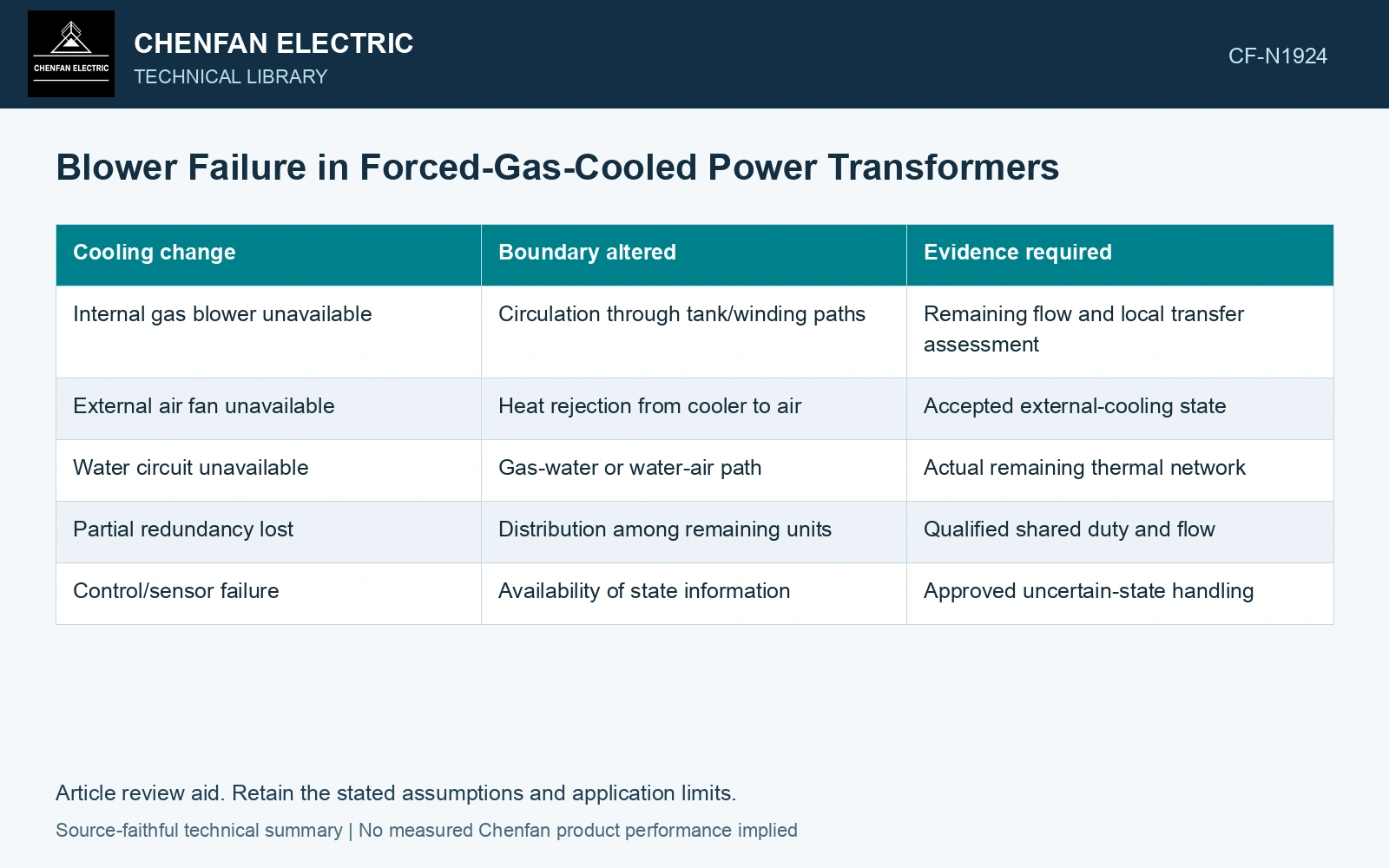
Map the failed boundary
| Cooling change | Boundary altered | Evidence required |
|---|---|---|
| Internal gas blower unavailable | Circulation through tank/winding paths | Remaining flow and local transfer assessment |
| External air fan unavailable | Heat rejection from cooler to air | Accepted external-cooling state |
| Water circuit unavailable | Gas-water or water-air path | Actual remaining thermal network |
| Partial redundancy lost | Distribution among remaining units | Qualified shared duty and flow |
| Control/sensor failure | Availability of state information | Approved uncertain-state handling |
Identify whether a standby unit actually restores the same path. Similar motor power does not establish equal blower performance in the installed network.
Do not assign natural circulation by assumption
A transformer designed for forced gas flow may have some residual natural movement. Its magnitude and local distribution depend on geometry and gas state. A stated natural-cooling rating, if available, needs its own qualification conditions.
Carry the temperature through the event
Record pre-failure loading, gas/cooling state and relevant temperature evidence. Then follow heat generation and reduced removal until the approved response or restoration occurs. Bulk gas temperature and local winding temperature can respond differently.
A simple thermal model can illustrate this memory, but the real assessment needs gas-specific flow and the relevant winding heat path. A cool external outlet after circulation loss may be poor evidence of internal conditions rather than reassurance.
Verify detection and recovery
The monitoring system should establish actual blower or flow availability within its stated coverage. A run command or motor indication alone may not prove gas circulation. Preserve what the signal observes and the verified response to disagreement.
When circulation returns, the thermal state does not instantly reset. Include the recovery interval and any credible repeated failure.
For a fictional lumped initial screen [2], assume capacitance 2 MJ/K, lost removal 20 kW and unchanged generation: dT/dt = 0.010 K/s = 0.60 K/min. An assumed 10 K available margin lasts 16.67 min if that deficit remains constant. This is an initial energy estimate, not a validated failure-rating curve. Use the actual local thermal/flow model and detection/protection sequence; remote average temperature and continued external fan operation cannot establish winding margin.
The engineering record should identify the degraded cooling configuration and the duty covered from its initial state. It supports a qualified operational limit or response. It cannot be replaced by the claim that other cooling equipment was still running, because those devices may act on the wrong side of the missing heat-transfer path.
References
- Y. Wu et al., Research on Heat Dissipation Performance of Eco-friendly Gas insulated Transformer with i-C4F7N/CO2 as the Insulation Medium, Journal of Physics: Conference Series 2527, 012011, 2023. DOI: 10.1088/1742-6596/2527/1/012011.
- U.S. Department of Energy, DOE-HDBK-1012/2-92, Thermodynamics, Heat Transfer, and Fluid Flow, Volume 2, 1992.