

A dew/frost-point result must retain gas identity and measurement pressure. NIST’s compressed-gas work shows the relation to water mole fraction and pressure also depends on a gas-specific enhancement factor [1]. A room-condition sample does not directly establish the pressurized transformer’s cold-surface margin.
The controlling surface can occur during shutdown or seasonal cooling, not necessarily during rated load. A warm operating gas measurement cannot establish the cold-state margin by itself.
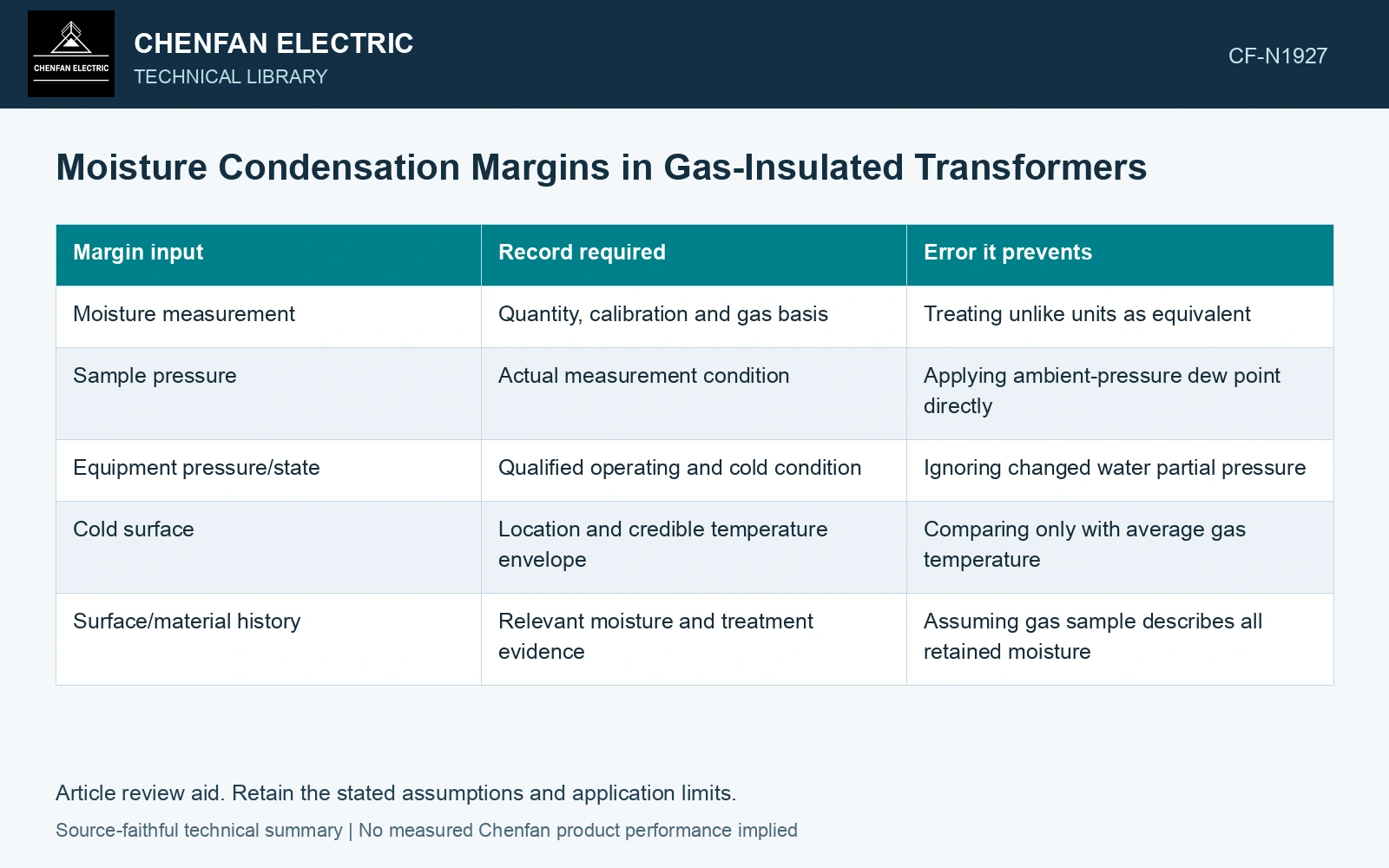
Define the water-state basis
For an ideal-mixture teaching screen, pw = ywPabs. With assumed water mole fraction 50 ppm, partial pressure is 5 Pa at 100 kPa absolute but 15 Pa at 300 kPa absolute. The author’s ideal calculation keeps concentration fixed while the saturation comparison changes. Condensation/frost assessment needs the matching phase-equilibrium property [2], and a real mixture needs its validated conversion.
This illustration assumes a known mixture and equilibrium basis. Dew and frost interpretations use different phase conditions, and the actual measurement/conversion method needs qualification. No permissible moisture value is supplied here.
| Margin input | Record required | Error it prevents |
|---|---|---|
| Moisture measurement | Quantity, calibration and gas basis | Treating unlike units as equivalent |
| Sample pressure | Actual measurement condition | Applying ambient-pressure dew point directly |
| Equipment pressure/state | Qualified operating and cold condition | Ignoring changed water partial pressure |
| Cold surface | Location and credible temperature envelope | Comparing only with average gas temperature |
| Surface/material history | Relevant moisture and treatment evidence | Assuming gas sample describes all retained moisture |
Compare states consistently
If gas is expanded for sampling, its pressure changes. A dew-point result needs conversion on a justified concentration/state basis before it represents the pressurized compartment. Use the method’s verified gas and pressure model, not a casual temperature adjustment.
The tank, conductors and supports can cool at different rates. A local surface may be colder than the bulk gas during a transition. The margin assessment should identify that location and timing.
Keep a margin range
Measurement uncertainty, temperature-model uncertainty and water exchange with materials can influence the result. Preserve a credible range instead of reporting one decimal-place temperature separation as certainty.
Where the margin depends on an inaccessible cold region, identify the evidence or conservative bound used. A convenient external sensor cannot automatically represent it.
Assess the final gas/material combination
Assume a gas-specific validated conversion at equipment pressure 300 kPa absolute gives a water frost point −20 °C, and the coldest internal surface reaches −25 °C. The frost-margin screen is −5 K, so the proposed cold state does not pass an assumed nonnegative-margin criterion. Hold for approved moisture/material-state revision. The frost point is a separate assumption, not derived from the earlier 50 ppm illustration. Retain uncertainty, ice/water basis and solid-insulation moisture exchange; no universal gas-moisture limit is assigned here.
The result should state the pressure-correct water basis and the controlling surface envelope. It gives a qualified reviewer a specific condensation question to resolve. A dew-point reading detached from its measurement pressure can look reassuring while answering the wrong equipment condition.
References
- NIST, Dew-point measurements for water in compressed gases, updated August 2025.
- U.S. Department of Energy, DOE-HDBK-1012/1-92, Thermodynamics, Heat Transfer, and Fluid Flow, Volume 1, 1992, Compression Processes.