

Split FRA data by physical transformer before training or scoring a diagnostic model. Keep repeated sweeps, reconnects, phases, taps and augmented descendants in the same partition so the test evaluates the intended population of unseen units.
Calculation basis. Unless a value is explicitly attributed to a cited source, numerical inputs in the demonstrations are assumptions for the stated model. Normalized variables are dimensionless. The examples define their own geometry, excitation and measurement boundary.
The first acceptance question is what the test set is independent of: the trace, the physical transformer, the design family or the operating site. State that level with the score.
Group the data by physical origin
Assign each record a stable transformer identifier. Link repeated measurements, preprocessed versions and augmented descendants to the same parent. A simulated trace should retain its model and geometry lineage rather than acquire a new identity because its noise realization changed.
Dependent traces from one physical transformer share unit information. For an unseen-transformer validation question, exclude every record from the paired test unit when training the fold.
A healthy and a modified record from the same unit should remain in the same outer partition even if their class labels differ. Otherwise the classifier can exploit shared geometry or measurement characteristics that will not be available for a new unit.
Quantify why a trace split is weak
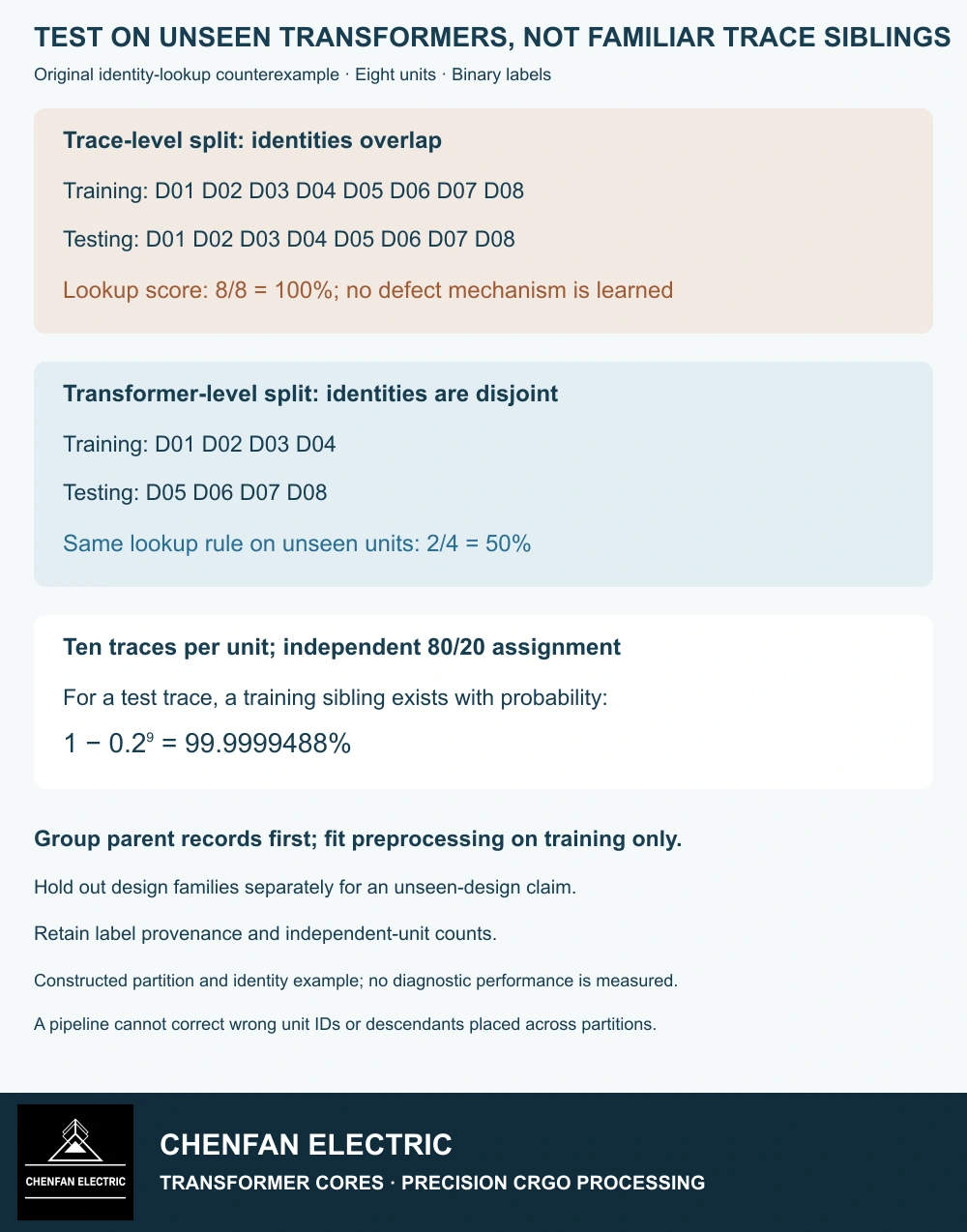
Consider a constructed dataset with ten traces per transformer. Assign each trace independently to training with probability 0.8 and testing with probability 0.2.
Conditional on one trace being in the test set, the probability that at least one of the other nine traces from the same transformer is in training is:
1 − 0.2⁹ = 99.9999488%.
The probability that a transformer contributes traces to both sets is:
1 − 0.8¹⁰ − 0.2¹⁰ = 89.2625715%.
These are partition probabilities under the stated independent assignment rule. They do not predict a classifier’s accuracy, but they show that a trace-level split overwhelmingly exposes familiar units to the model.
Adding more repeated traces from the same units increases the record count without creating the same number of independent validation units. Report both counts.
A classifier can succeed by recognizing identity
Use an original eight-unit illustration with binary labels D01–D08 = [0, 1, 0, 1, 1, 0, 1, 0]. Let a deliberately trivial classifier store the label associated with each known unit identity and predict class 0 for an unseen identity.
With training and test traces from all eight units, the identity lookup scores 8/8 = 100%. It contains no defect mechanism at all.
With D01–D04 in training and D05–D08 held out, the same rule predicts class 0 for each unseen unit and scores 2/4 = 50%. The difference comes entirely from the partition. These constructed results demonstrate a leakage mechanism, not a field-diagnostic performance benchmark.
Keep preprocessing inside the training partition
Fit scaling, imputation, dimensionality reduction, feature selection and learned normalization within each training fold. Apply the fitted transformation to validation records without refitting.
Keep augmentation within the training partition after grouping. Do not create augmented copies first and distribute siblings across folds. Select hyperparameters and decision thresholds using inner training/validation splits; reserve the outer held-out units for the final evaluation of that selection process.
A pipeline helps control fitted preprocessing, but it does not repair incorrect group identifiers or leaked parent records. Audit the identities and descendants explicitly.
Define the defect truth separately from the curve
Record the origin of each label: controlled physical modification, inspection, dismantling, independent test evidence or an expert interpretation of the same curve. These sources support different claims.
A label assigned solely from the FRA curve cannot independently validate that the classifier detects a physical defect. Synthetic parameter changes test recognition within the declared simulation model; they do not by themselves establish diagnosis on factory or field measurements.
Keep ambiguous cases and the labeling protocol visible. A useful dataset distinguishes confirmed states from uncertain interpretations rather than forcing every unusual trace into a definite defect class.
Test the generalization claim you intend to make
A unit-grouped split tests unseen units within its represented population. To claim transfer to unseen winding designs or ratings, hold out the relevant design families as well. A site or instrument change may require an additional outer evaluation against that change.
Check the number of independent units per class, class imbalance and missing combinations of design and defect. Group separation can reveal that a class is represented by only one unit; that is a limitation of the evidence set to fix, not a reason to split the unit’s traces across folds.
Report class-level errors, the independent-unit counts and the prediction aggregation rule. If several traces produce one transformer decision, score that decision as well as the trace outputs. Preserve the held-out predictions and partition manifest so another engineer can reproduce the result.
Release a score with its evidence boundary
The handover should identify the grouping level, lineage checks, training-only transformations, label provenance and exact held-out population. State whether the score concerns synthetic cases, unseen physical units or unseen design families.
Use the isolated test to report performance on the units and conditions expected in service. Keep independent-unit counts, class errors and the partition manifest with that result so a deployment decision follows the population actually evaluated.
Kapoor and Narayanan identify data leakage as a cause of inflated machine-learning performance. Separate dependent unit records and fit data-dependent preprocessing within the training partition. [1]
IEC 60076-18 addresses frequency-response measurements and measurement equipment for transformers in factory and site conditions. Record the actual test connections and instrument conditions with each curve. [2]
References
[1] S. Kapoor and A. Narayanan, Leakage and the Reproducibility Crisis in Machine-Learning-Based Science, 2023, DOI:10.1016/j.patter.2023.100804.
[2] IEC, IEC 60076-18:2012, Power transformers — Part 18: Measurement of frequency response.