

Direct-current bias and transient asymmetry are not the same condition. A persistent or slowly varying current component can displace the magnetic operating region, while an energization transient can create an offset flux trajectory without a continuing external direct-current source. Identify the mechanism and duration before assigning a core capability requirement.
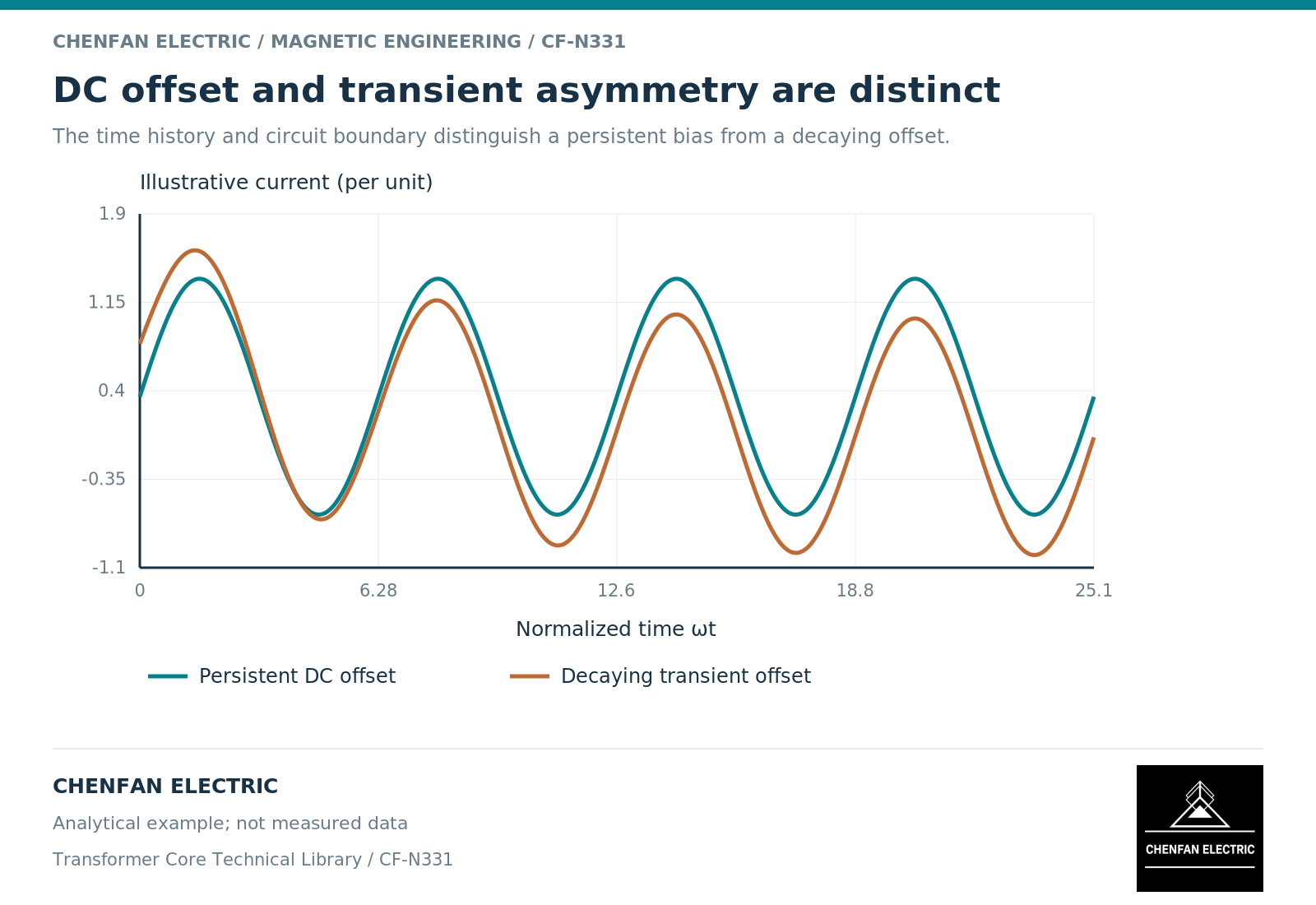
Separate the source from the observed waveform
An asymmetric magnetizing-current trace is an observation. It does not, on its own, identify the cause. Residual flux, closing angle, a low-frequency current path, unequal circuit conditions or measurement offset can require different explanations.
Geomagnetically induced currents provide one example of a quasi-direct-current mechanism through connected transformer windings. Research on system modeling links that mechanism to half-cycle saturation and associated system effects. [1] A converter-related injection is another possible project-specific mechanism, but its actual circuit path must be established rather than inferred from the presence of a converter.
The first useful question is therefore whether the driving condition persists after the initial transient has decayed. The second is which winding and return circuit carry the relevant current.
Describe bias through ampere-turns and topology
A winding current produces magnetomotive force in proportion to its turns, with sign determined by polarity. Multiple winding contributions must be combined consistently. A neutral current is not automatically the per-phase effective bias in every transformer connection.
The core then distributes the resulting excitation through its magnetic paths. Shared limbs, outer return limbs and external regions can respond differently. A single material B-H curve cannot establish the complete transformer response without that geometry and circuit boundary.
History-dependent constitutive models also distinguish an operating state from a fixed material property. [2] This matters when a slowly changing bias moves the alternating cycle across different parts of the characteristic.
Use duration to separate electromagnetic and thermal claims
An electromagnetic model may show waveform distortion or a large current peak over a short interval. A thermal claim requires the resulting losses and their duration, repetition and cooling conditions.
Do not compare a brief energization event with sustained bias solely through the largest current value. The loss distribution and cumulative heating can be different. Likewise, a modest average current can coexist with a strongly distorted waveform that requires harmonic and local-loss assessment.
| Condition | Defining evidence |
|---|---|
| Switching asymmetry | Initial state, closing event and decay record |
| Sustained direct-current bias | Current path, magnitude, polarity and duration |
| Quasi-direct-current variation | Time history and system connection |
| Measurement artifact | Channel baseline, bandwidth and independent checks |
The table helps classify a case without prescribing a protection setting or allowable bias current.
Write a mechanism-specific qualification request
Specify the affected winding, the current definition, the alternating excitation, loading and duty duration. Include the core topology and the required outputs: reactive demand, harmonic current, local loss or temperature.
Ask the original equipment manufacturer to distinguish measured evidence, validated calculation and extrapolation. A magnetization curve supports part of the model, not an unrestricted statement that the complete transformer is “DC tolerant.”
For a core supplier, the appropriate interface is the branch-flux and material-data requirement derived from that assessment. The supplier should not be asked to guarantee a system phenomenon from a current value whose circuit meaning has not been defined. Clear classification at the start prevents both unnecessary redesign and unsupported capability claims.
References
[1] Jessica Wert and coauthors. The Effects of Correctly Modeling Generator Step-Up Transformer Status in Geomagnetic Disturbance Studies (2022).
[2] Cesare Tozzo / COMSOL. Modeling Ferromagnetic Materials in COMSOL Multiphysics.