

Treat a resin-filler revision as a change to both casting production and finished-winding behavior. Filler distribution and loading affect flow, cure and thermal response, so qualify the formulation with the process that produces the winding.
Compare the uncured system first
Identify the complete formulation revision, including filler type, particle distribution, surface treatment and loading basis. Equal mass fraction does not establish equal volume fraction when densities differ. A resin/hardener comparison without the actual filler package is therefore incomplete.
Compare viscosity as a function of the relevant temperature, time and shear condition, not only one initial reading. Settling and redistribution can change the material encountered at different points in a production run. Keep these observations attached to the actual mixing and delivery configuration represented by the trial.
Verify cure and thermal mismatch separately
For an illustrative free-expansion comparison, assume resin and conductor linear expansion coefficients of 45 and 17 × 10⁻⁶ K⁻¹ over a chosen 80 K interval. Their free strain difference is (45−17) × 10⁻⁶ × 80 = 0.00224, or 0.224%. These assumed values are not the specified product properties. They do not calculate interface stress, which also depends on restraint, geometry, modulus, temperature dependence and processing history.
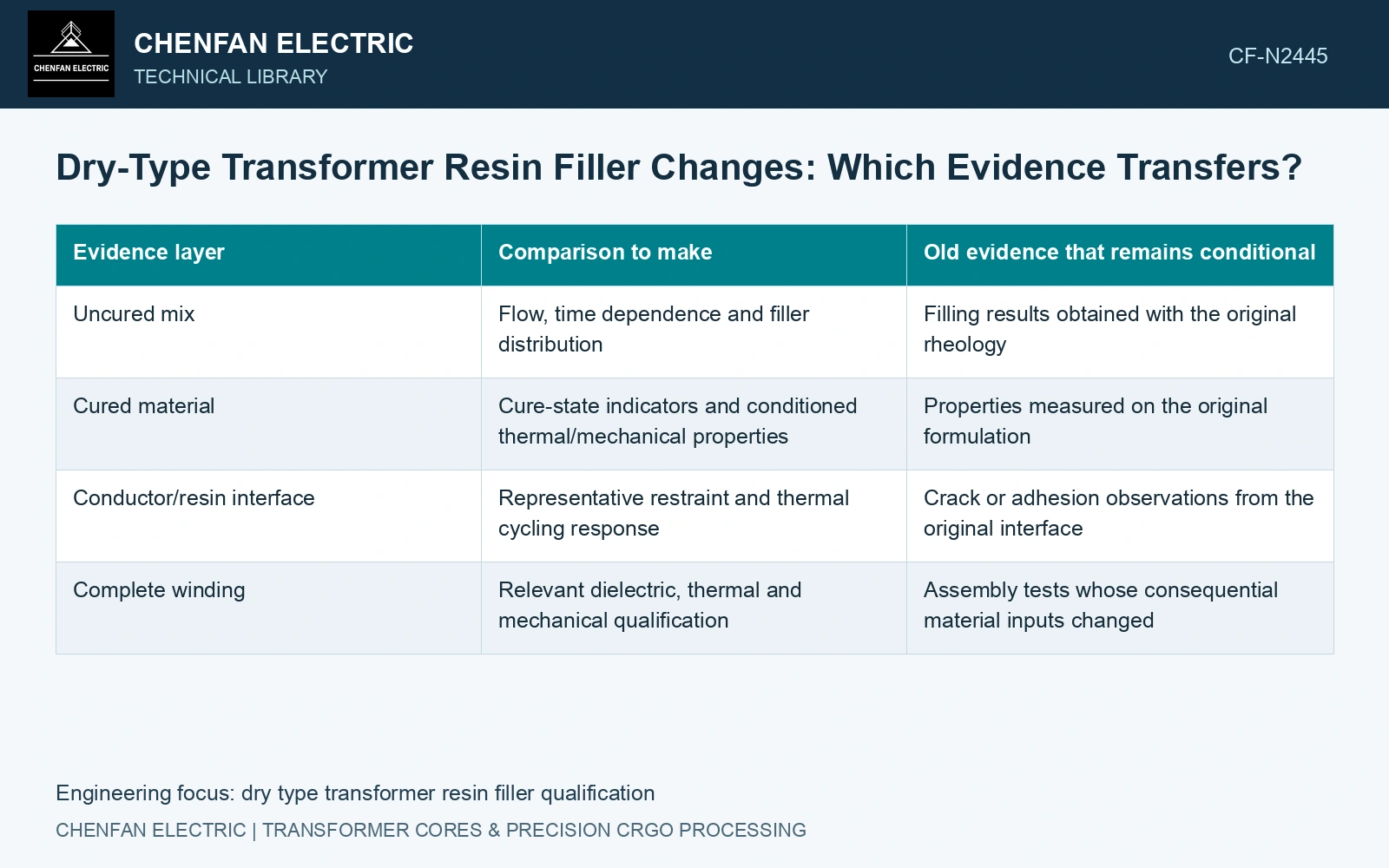
| Evidence layer | Comparison to make | Old evidence that remains conditional |
|---|---|---|
| Uncured mix | Flow, time dependence and filler distribution | Filling results obtained with the original rheology |
| Cured material | Cure-state indicators and conditioned thermal/mechanical properties | Properties measured on the original formulation |
| Conductor/resin interface | Representative restraint and thermal cycling response | Crack or adhesion observations from the original interface |
| Complete winding | Relevant dielectric, thermal and mechanical qualification | Assembly tests whose consequential material inputs changed |
Use specimens that expose the transfer gap
A small cured coupon can compare material properties, but may not reproduce the fill path, thermal history or restraint in the winding. Retain both coupon evidence and a representative assembly route, explaining what each covers. Inspect consequential interfaces and locations where the process is least well represented by a convenient specimen.
Document any compensating process changes as part of the same configuration. If a new filler is accepted only after changing mixing or cure controls, the release applies to that combined revision. It cannot be extended to the old process simply because the initial trial used the same mould.
Make the filler volume fraction explicit
Assumptions: 1.0 kg each of filler and resin, with densities 2.65 and 1.20 kg/L. Their volumes are 0.377 and 0.833 L, giving 31.17% filler by combined volume despite 50% by mass. A filler of assumed density 3.90 kg/L lowers that volume fraction to 23.53% at the same masses. This geometric comparison does not predict flow or bonding. IEC 60505 concerns insulation-system evaluation [1]; establish the formulation/process evidence separately and freeze that combined revision [2].
Release the combined formulation and process revision with evidence for casting quality, cure state and the consequential winding interfaces. Record which earlier tests retain their governing conditions and identify the new evidence for each changed condition.
References
- IEC, IEC 60505:2011, Evaluation and qualification of electrical insulation systems.
- NASA, NASA Systems Engineering Handbook, section 6.5, Configuration Management, official online text.