

A tariff gives many devices the same economic signal. If they all wait for the lower-price boundary, their demand can become more correlated. A schedule that is inexpensive for each household may produce a new peak at the local transformer. Moving demand in time is not sufficient evidence of local peak reduction. [1]
Compare joint start times, not only daily energy
Preserve arrival times, energy requests and device power limits in the comparison. Then record the start-time distribution under the proposed tariff. A model that assumes independent random starts after optimizing every device to the same price boundary contains conflicting assumptions.
Use transformer-level and phase-level load traces to evaluate the resulting coincidence. The local feeder may differ from the portfolio used to design the tariff. Report participation, overrides and nonflexible demand; registered devices do not all respond identically, and ordinary household use remains part of the peak.
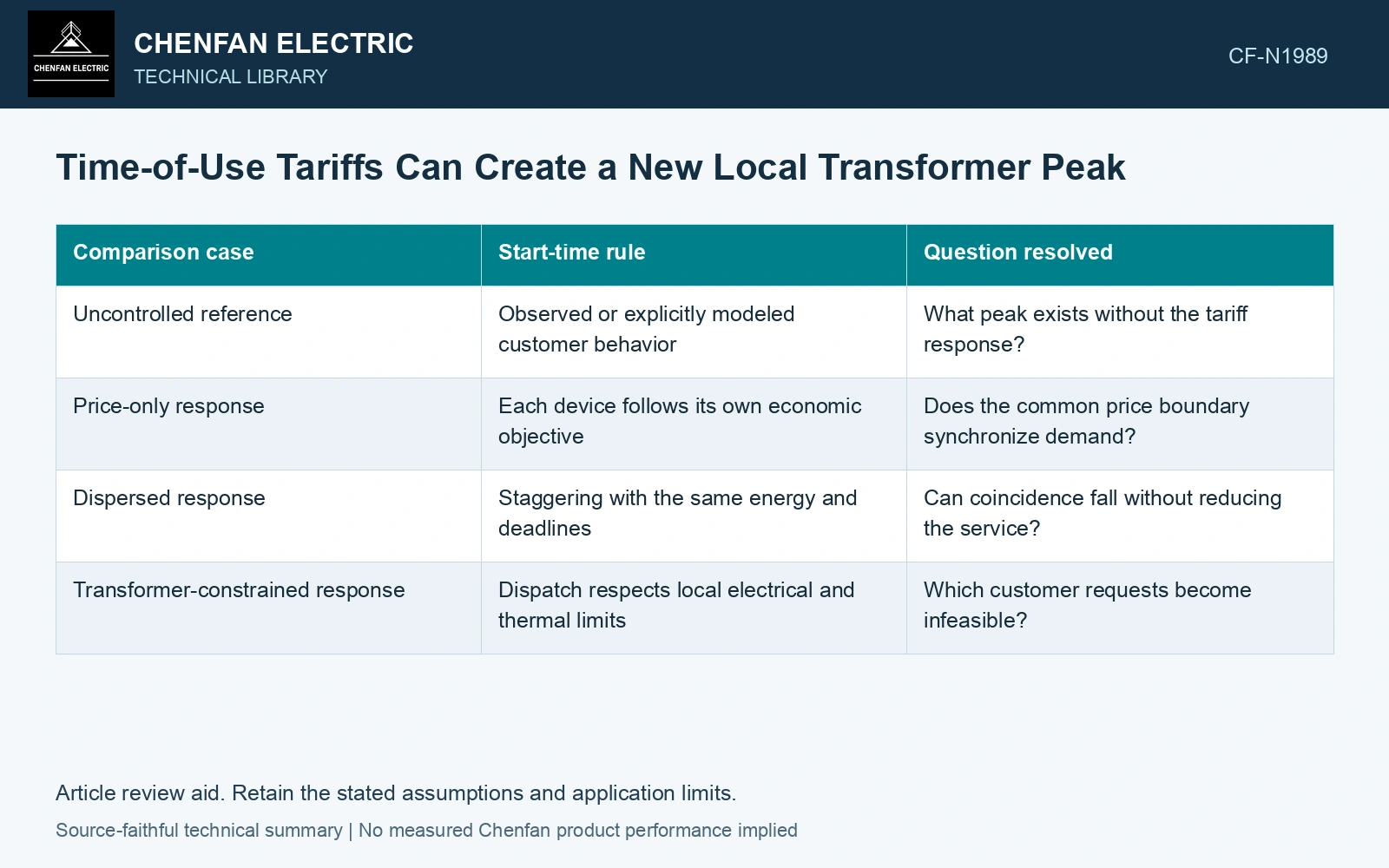
| Comparison case | Start-time rule | Question resolved |
|---|---|---|
| Uncontrolled reference | Observed or explicitly modeled customer behavior | What peak exists without the tariff response? |
| Price-only response | Each device follows its own economic objective | Does the common price boundary synchronize demand? |
| Dispersed response | Staggering with the same energy and deadlines | Can coincidence fall without reducing the service? |
| Transformer-constrained response | Dispatch respects local electrical and thermal limits | Which customer requests become infeasible? |
A dispersion trial must preserve the obligation
Distributing starts can make the curve look flatter by leaving some vehicles unfinished. Keep the required energy and deadline checks alongside the load comparison. Where a device has little remaining availability, the controller may have less freedom to stagger it than another device with the same energy request.
Evaluate thermal history across the original peak, the waiting interval and the tariff-driven peak. Lower earlier demand may provide some recovery, but the degree of recovery must come from the thermal assessment. It should not be assumed simply because the price changed at a later hour. [2]
Measure the peak where the claim is made
Report the transformer’s maximum current, duration near its operating envelope and any relevant voltage effect over the complete evaluation period. An upstream portfolio improvement is a different result. It can coexist with deterioration at a particular transformer if the resources are unevenly distributed.
If a tariff shift concentrates starts at the same boundary, change the local coordination rule or incentive timing and repeat the comparison. Retain requested services and participation sensitivity. A lower bill demonstrates a cost outcome; it does not establish that the transformer peak or thermal exposure fell.
References
- A. Jain and M. Karimi-Ghartemani, Mitigating Adverse Impacts of Increased Electric Vehicle Charging on Distribution Transformers, Energies 15, 9023, 2022. DOI: 10.3390/en15239023.
- IEC, IEC 60076-7:2018, Power transformers – Part 7: Loading guide for mineral-oil-immersed power transformers.