

For a star-connected three-phase load, an acceptable total can coexist with an overloaded winding. Keep the verified phase connection and voltage definition inside the current calculation. [1]
Keep a phase assignment with each controllable resource
Record the transformer, phase or phase pair, metering point and connection arrangement. Identify which assignments are verified and when. A customer identifier is not a phase identifier, and a topology or wiring change can invalidate yesterday’s map without changing the device’s software address.
Translate the proposed resource powers into the corresponding winding-current calculation. Use the actual connection and voltage definitions. A three-phase line-current formula should not be applied to a single-phase charger by inserting its power into an aggregate total. Where harmonics or unbalance matter, retain the appropriate current quantities rather than only net real power.
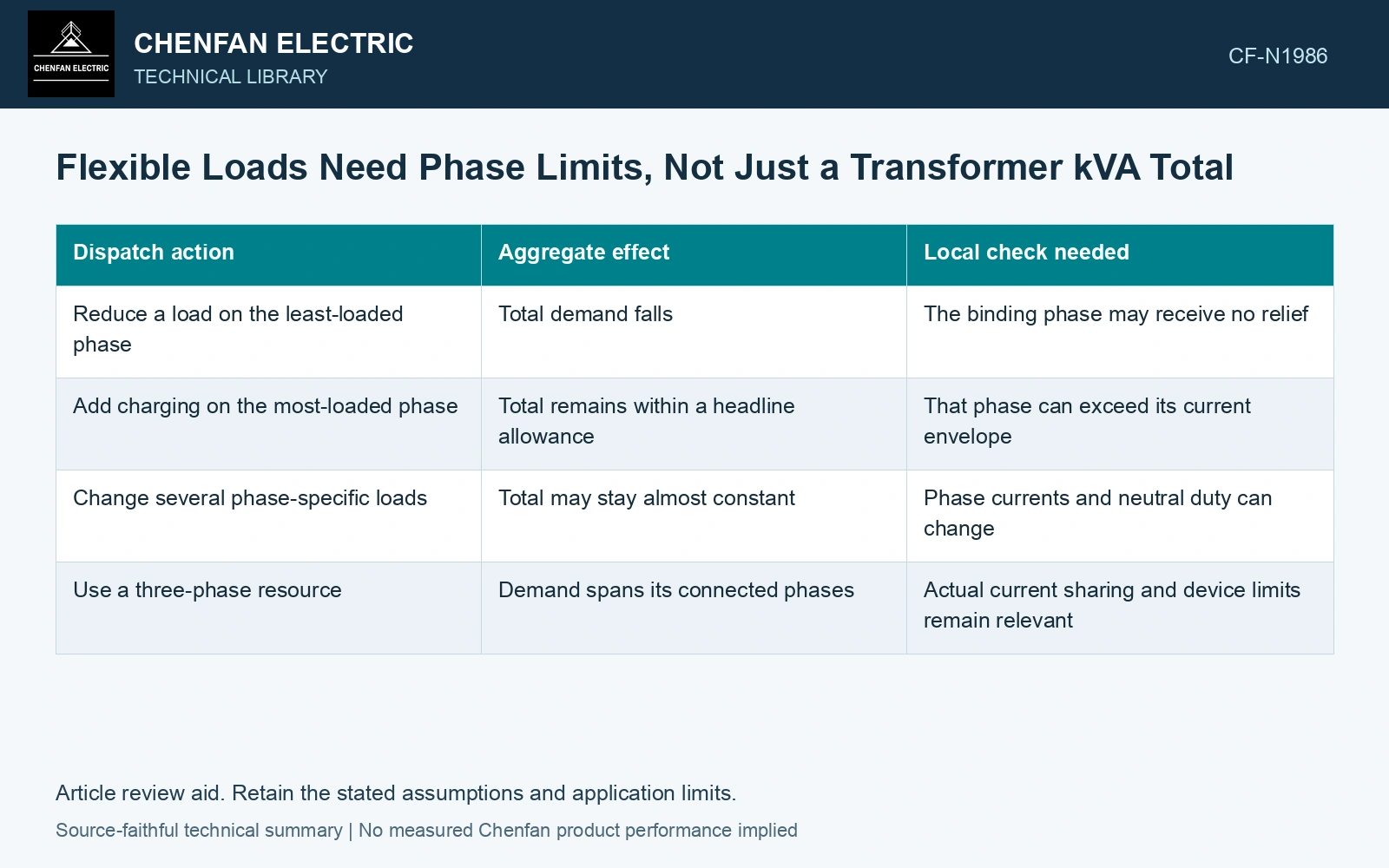
| Dispatch action | Aggregate effect | Local check needed |
|---|---|---|
| Reduce a load on the least-loaded phase | Total demand falls | The binding phase may receive no relief |
| Add charging on the most-loaded phase | Total remains within a headline allowance | That phase can exceed its current envelope |
| Change several phase-specific loads | Total may stay almost constant | Phase currents and neutral duty can change |
| Use a three-phase resource | Demand spans its connected phases | Actual current sharing and device limits remain relevant |
The neutral calculation needs the currents’ relationship
For fundamental-frequency phasors, neutral current is the vector sum of the phase currents, with sign convention defined. Adding their magnitudes is a conservative-looking operation that does not describe that relationship. Equally, a balanced fundamental model cannot establish neutral heating where harmonic currents are material.
Measure phase and neutral currents to evaluate the representation. An aggregate meter cannot establish the phase split; carry any unknown connection as an unresolved input rather than a verified allocation.
Allocate in the feasible phase region
Represent each resource as a phase-specific contribution with availability and service limits. Apply current constraints and the thermal history; the loading guide addresses temperature/ageing, not a phase-identification protocol [2]. An aggregate objective cannot replace each local constraint.
Assume a star system with 230 V phase-to-neutral (398.37 V line-to-line) and 500 A per-phase cap. Unity-power-factor phase loads 120/100/80 kW total 300 kW, below the balanced 345 kVA screen. Individual currents are 521.74/434.78/347.83 A; phase A fails by 21.74 A. Their 120° fundamental phasor sum has magnitude 150.61 A in the neutral [1]. Curtail or relocate phase-A demand; spare phase-B/C capacity does not transfer automatically. These fundamental calculations exclude triplen harmonics and do not establish neutral thermal compliance.
After dispatch, compare predicted and measured changes by phase. A correct total with the wrong phase response is evidence of a mapping, device or model problem. The controller should resolve that discrepancy before counting the same resource as reliable phase-specific flexibility in the next event.
References
- U.S. Department of Energy, DOE-HDBK-1011/3-92, Electrical Science, Volume 3, June 1992.
- IEC, IEC 60076-7:2018, Power transformers – Part 7: Loading guide for mineral-oil-immersed power transformers.